The hauntingly beautiful recitation often referred to as the “Viking prayer for the dead” has captivated audiences around the world. Uttered by brave warriors facing insurmountable odds, the rhythmic chant stirs something primal within us. It speaks of ancient lineages, unyielding bravery, and the promise of an eternal afterlife.
Interest in Old Norse death rituals and Viking culture has surged in recent years, largely driven by the explosive popularity of the Vikings TV series and numerous blockbuster films. Fans and history enthusiasts alike find themselves drawn to the raw, poetic way these ancient seafaring people approached mortality. This deep fascination often leads individuals to seek out a genuine Norse prayer for the departed to use in modern memorial services, or simply to understand the true meaning of funerals and how our ancestors processed grief.
However, the line between Hollywood screenwriting and authentic 10th-century history is frequently blurred. Did the Vikings truly stand before battle and chant to their fathers and mothers? Did they possess canonical prayer books?
In this comprehensive guide, we will explore the famous “valhalla prayer for the dead,” uncover its surprising origins, and delve into the authentic historical texts and mythologies that shaped Old Norse burial practices. We will also provide culturally accurate, respectful readings for those looking to incorporate Heathen or Asatrú traditions into a modern memorial.
The Famous “Viking Prayer for the Dead”
If you are searching for a Viking funeral prayer, chances are you are looking for one specific, highly recognizable piece of text. It is a powerful declaration of honor, family lineage, and fearlessness in the face of death.
The Full Text (“Lo, There Do I See My Father…”)
This famous recitation is most widely known for its cinematic depiction. When recited, it is traditionally spoken with a steady, unflinching cadence, embodying the stoic bravery expected of a warrior entering the afterlife.
Here is the complete English text:
“Lo, there do I see my father.
Lo, there do I see my mother, and my sisters, and my brothers.
Lo, there do I see the line of my people, back to the beginning.
Lo, they do call to me.
They bid me take my place among them, in the halls of Valhalla!
Where the brave may live forever!”
When we analyze this text, its core themes perfectly align with what modern audiences perceive as the ultimate Viking ethos. First, it emphasizes the vital importance of family lineage and ancestry. The speaker finds comfort not in a peaceful paradise, but in rejoining their bloodline.
Second, it highlights bravery and honor as the ultimate currency of the Norse world. Finally, it culminates in the glorious entrance into Valhalla, the grand hall where fallen heroes are rewarded with eternal feasting and fighting. It is an undeniably moving piece of poetry, but its origins are far more complex than a simple ancient runic translation.
The Real Origin: Hollywood vs. 10th-Century History
If you are researching the lo there do i see my father origin, the truth might surprise you. This exact poem is not an ancient Norse artifact. It is, in fact, a 20th-century literary creation penned by the acclaimed author Michael Crichton for his 1976 novel, Eaters of the Dead.
Crichton’s novel was later adapted into the cult-classic 1999 film The 13th Warrior, starring Antonio Banderas. It was the cinematic delivery of this chant by the film’s Norse warriors that cemented the prayer in the global pop culture consciousness.
However, Michael Crichton did not pull this beautiful prose entirely out of thin air. The prayer is heavily inspired by a genuine, primary historical source: the writings of Ahmad ibn Fadlan. Ibn Fadlan was an Arab diplomat and chronicler sent from Baghdad in 922 CE to visit the King of the Volga Bulgars. During his travels, he encountered a group of Norse tradesmen known as the Volga Rus.
While stationed with the Rus, Ibn Fadlan witnessed a chieftain’s funeral, which included a lavish and horrific ship burial. When exploring different funeral and burial practices around the world, Ibn Fadlan’s account remains one of the most detailed and visceral primary sources of the Viking Age.
During the chieftain’s funeral, a slave girl volunteered to be sacrificed to accompany her master into the afterlife. According to Ibn Fadlan’s travelogue, the girl was lifted over a doorframe-like structure to peer into the realm of the dead. It was she, the enslaved girl facing her imminent ritual death, who spoke the words that inspired Crichton.
According to translated historical accounts of Ibn Fadlan’s manuscript, the girl said:
- “Behold, I see my father and mother.”
- “Behold, I see all my dead kindred seated.”
- “Behold, I see my master seated in Paradise… He calls me. Let me go to him.”
Michael Crichton and the subsequent screenwriters of The 13th Warrior took the solemn, tragic final words of a sacrificed slave girl and creatively adapted them. They condensed her vision of the afterlife into a booming, masculine warrior’s chant about Valhalla. While the movie prayer is a modern work of fiction, it undeniably contains a heartbeat of genuine 10th-century history.
Authentic Old Norse Beliefs & Texts on Death
If the famous movie quote is a modern adaptation, what did actual Viking funeral prayers look like? To understand genuine Old Norse death rituals, we must look at how these ancient people recorded their beliefs and honored their dead.
Primary Sources: The Poetic Edda and Hávamál
It is crucial to understand that pre-Christian Norse society was heavily reliant on oral traditions. The Vikings did not have written canonical prayer books or rigid, dogmatic scriptures like those found in Abrahamic religions. Spiritual beliefs, mythological tales, and honorific poems were passed down verbally from generation to generation by skalds (Norse poets).
Most of what we know today about Norse mythology and funeral rites was written down centuries later by Christian scholars in Iceland, most notably Snorri Sturluson in the 13th century. The two most vital compilations of these ancient oral traditions are the Poetic Edda and the Prose Edda.
Within the Poetic Edda is the Hávamál (Sayings of the High One), a collection of proverbs and wisdom attributed to the god Odin himself. When looking for an authentic Norse perspective on mortality, Stanza 76 of the Hávamál is arguably the most famous and accurate representation of Viking philosophy:
“Cattle die, kinsmen die, thyself shall die as well;
but a noble name will never die, if good renown one gets.”
This stanza perfectly encapsulates the Norse worldview. The physical body is temporary, and death is an absolute certainty for all—even the gods. The only true immortality a person can achieve is through their reputation, their deeds, and the stories told about them after they are gone.
To ensure these stories survived, Norse skalds composed Erfikvæði, which were intricate memorial poems. These poems were typically commissioned by a deceased chieftain’s heirs and recited during the erfiöl (the inheritance ale or funeral feast). Skaldic poetry was highly structured and praised the fallen leader’s bravery, generosity in the mead hall, and success in battle, ensuring their “noble name” lived on.
Norse Afterlife Destinations
The Old Norse concept of the afterlife was far more nuanced than simply “everyone goes to Valhalla.” In fact, the destination of a soul depended entirely on how the person lived and, more importantly, how they died.
| Realm | Ruler | Who Enters | Description & Characteristics |
|---|---|---|---|
| Valhalla | Odin | Half of those slain bravely in battle | A grand hall in Asgard where heroes feast, fight, and prepare to assist Odin during Ragnarök. |
| Fólkvangr | Freyja | The other half of the battle-slain (chosen first by Freyja) | A majestic heavenly meadow (“Field of the Host”) offering peace, honor, and eternal beauty. |
| Helheim | Hel | Those who died of old age, illness, or non-combat causes | A quiet, neutral realm under the earth where ancestors continue a peaceful, everyday existence. |
Guiding these souls across the threshold were the Valkyries, the fierce and beautiful female entities who scoured the battlefields to choose the worthy dead. The transition from the world of the living (Midgard) to the realms of the gods was often symbolized by the crossing of the Bifröst, the burning rainbow bridge.
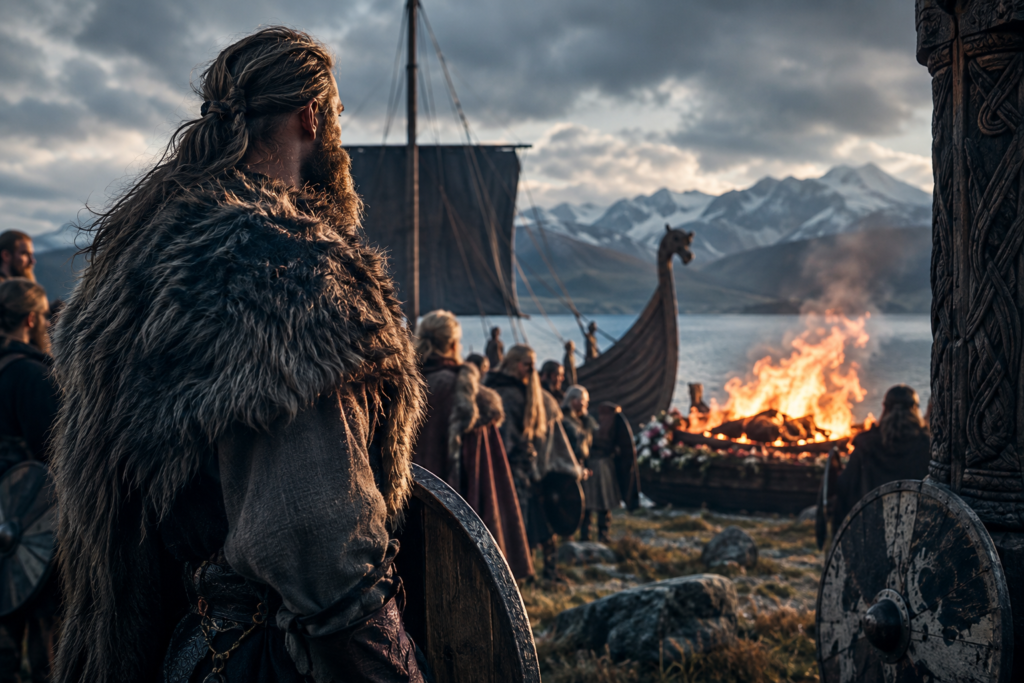
To aid the dead on this journey, the Vikings practiced elaborate Viking burials. Wealthy chieftains might receive a grand ship burial, where they were placed inside a longship alongside vast amounts of grave goods. These grave goods—including weapons, sacrificed animals, tools, and jewelry—were intended to be used by the deceased in the afterlife. Alternatively, a funeral pyre was used to cremate the body, an act believed to release the soul so it could swiftly ascend to the realm of the gods on the billowing smoke.
Modern Funeral Readings Inspired by Norse Tradition
Today, many individuals feel a deep connection to the values of strength, nature, and ancestral honor found in Old Norse culture. Whether the deceased was a practitioner of modern Heathenry/Asatrú, or simply an admirer of Viking history, finding the right words to say goodbye is paramount.
For those looking to move beyond conventional religious funeral services, crafting a modern reading inspired by Norse tradition offers a profoundly meaningful alternative.
Contemporary Heathen & Asatru Invocations
Modern practitioners of Asatrú (the modern revival of Norse paganism) often write custom invocations to honor the departed. Because there is no strict ancient dogma, these prayers can be tailored to the specific life and virtues of the deceased.
Here are two respectful, modern adaptations that can be used for non-traditional funeral or memorial services:
Invocation to the Guides (Calling upon Heimdall and the Valkyries):
“We call to Heimdall, Watcher of the Gods and Guardian of the Bifröst. We ask that the bridge shines bright for our beloved [Name]. May the Valkyries guide their steps with honor. May their journey be swift, their spirit unburdened, and their welcome grand. We do not say goodbye, but rather, until we meet again in the halls of our ancestors.”
Prayer for a Peaceful Passing (Calling upon Hel and Odin):
“All Father Odin, we offer you the memory of a life lived with courage and truth. Goddess Hel, we ask that you receive [Name] with gentle hands and a warm hearth. They have laid down their burdens in this world. May they find peace, rest, and reunion with the kin who have gone before them. Their name is spoken, their deeds are remembered, their spirit endures.”
These modern prayers draw upon authentic mythological figures while providing the comfort and closure necessary for a modern grieving audience.
Incorporating Viking Traditions into a Memorial
Beyond spoken prayers, there are several ways to respectfully incorporate Viking traditions into a modern celebration of life.
- The Sumbel (The Ritual Toast): In ancient Norse culture, the mead hall was the center of community life. During a funeral feast, a sumbel was held. This is a highly structured, ritualized series of toasts. A drinking horn (or chalice) is passed around the gathering. The first round of toasts is dedicated to the gods, the second round to the ancestors, and the third round to the specific deeds and memories of the deceased. This is a beautiful, communal way to share honorific speeches.
- Modern Grave Goods: While we no longer bury longships, placing modern, symbolic grave goods in a casket or alongside an urn is a powerful nod to Viking tradition. This could include a favored tool, a piece of handcrafted jewelry, or a written letter.
- The Emphasis on Storytelling: Remember the wisdom of the Hávamál. The best way to honor a Norse-inspired life is to ensure their “noble name” does not die. Structure the memorial around storytelling. Encourage guests to share tales of the departed’s bravery, humor, and generosity, keeping their spirit vibrantly alive in the minds of the living.
The Enduring Power of the Norse Goodbye
Whether you choose to recite the famous Hollywood adaptation of the “Viking prayer for the dead,” read a stanza from the ancient Hávamál, or draft a modern Asatrú invocation, the underlying sentiment remains the same.
The Old Norse approach to death was not one of cowering fear, but of bold acceptance. It was an acknowledgment that while our physical bodies are bound to the earth, the love of our family, the honor of our actions, and the stories we leave behind have the power to echo in the halls of eternity. By bridging the gap between pop culture fascination and rich historical reality, we can find a truly powerful way to say a final, honorable farewell.