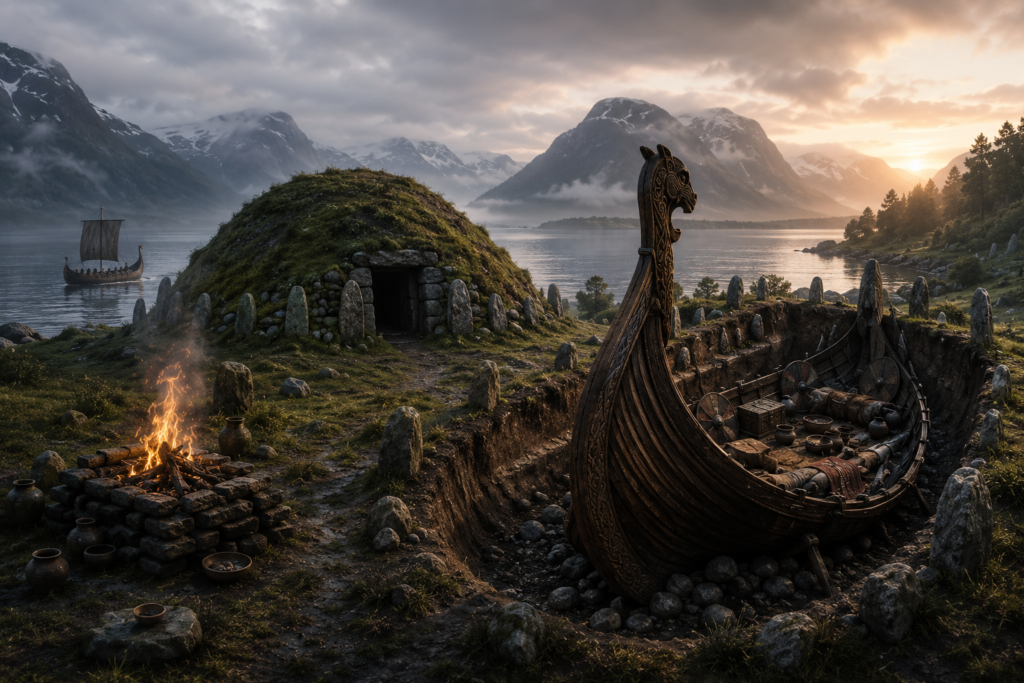
There was no single “Viking burial.” Across the Viking Age, Norse communities used different funeral customs depending on the region, time period, social status, family traditions, and religious beliefs involved.
Some people were cremated. Others were buried intact. Graves could be simple pits, chambers, burial mounds, boats, ships, or stone settings shaped like vessels.
The famous image of a warrior placed on a flaming ship and pushed out to sea is mostly a product of later literature and modern entertainment. Archaeology does show boat and ship burials, as well as land-based cremations involving vessels, but full ship burials were rare and usually connected to people of exceptional status.
“Viking funerals were not defined by one standard ritual. Burial customs varied widely across regions, communities, social groups, and generations.”
Key takeaways:
- Viking funerals varied widely, and both cremation and burial were used.
- Boats and ships appeared in some graves, but full ship burials were exceptional.
- Most knowledge comes from archaeology, supported cautiously by eyewitness accounts and later written traditions.
What Was a Viking Burial?
The term “Viking burial” broadly refers to the funeral and burial customs practiced by Norse communities during the Viking Age, commonly dated from the late eighth century to the eleventh century.
“Viking” originally described an activity associated with raiding and travel, while “Norse” is often the more accurate term for the wider Scandinavian societies of the period.
A burial did not always mean placing an intact body in the ground.
Cremated remains could be deposited in:
- A pit
- An urn
- A burial mound
- A grave containing burned objects
In other cases, the deceased may have been:
- Laid in a wooden coffin
- Wrapped in fabric
- Placed in a chamber grave
- Buried inside a boat or ship
This variety is one of the most important facts to understand. Viking-age funeral customs were not uniform.
Families interested in how burial traditions differ between societies can also explore HonorYou’s guide to different funeral and burial practices around the world.
The phrase “Viking burial” describes a broad group of practices rather than one ceremony followed by every Norse community.
There Was No Single Viking Funeral
Norse funeral practices changed across Scandinavia and the wider Viking world.
Customs in Norway, Denmark, Sweden, the British Isles, and the Rus territories could differ considerably. Practices also changed over time, especially as Christianity spread.
The major burial forms included cremation, inhumation, burial mounds, chamber graves, boat burials, ship burials, and stone ship settings.
Cremation
Cremation was common in many Viking-age communities, but it was never universal.
A body might be burned on a pyre together with:
- Personal possessions
- Food offerings
- Tools or weapons
- Animals
The remaining bone fragments and ash could then be collected and placed in an urn or grave, sometimes beneath a mound.
Fire may have held practical, symbolic, and religious meanings. Archaeologists must interpret each burial site individually, however.
Burned remains do not prove that every part of a ceremony followed the same pattern, and customs could vary even between nearby settlements.
Inhumation
Inhumation means burying the body without cremation.
Viking-age inhumation graves range from modest pits to elaborate chambers. The deceased might be placed in a wooden coffin, wrapped in textiles, or laid directly in the grave.
Archaeologists sometimes discover objects such as:
- Tools
- Jewelry
- Weapons
- Household objects
- Food containers
- Animal remains
The condition and arrangement of these objects can reveal how mourners presented the deceased and which aspects of their identity they wanted to preserve.
Burial Mounds and Chamber Graves
Some graves were covered by burial mounds, also known as tumuli.
A mound made a burial visible within the landscape and could connect the deceased to:
- Family land
- Ancestry
- Political authority
- Community identity
Not every mound contained a wealthy person, and not every high-status person received a monumental grave.
Chamber graves used wooden structures to create a room-like space around the body and grave goods. These graves could display wealth, but their meaning depended on local traditions and the people involved.
Boat and Ship Burials
Boats and ships are among the most recognizable features of Viking burial history.
In some graves, a small boat served as a container for the body. In rare elite burials, a much larger vessel was placed beneath a mound along with people, animals, and valuable objects.
A boat burial and a ship burial are not the same thing.
| Burial Type | Typical Characteristics | Possible Meaning |
|---|---|---|
| Boat burial | A smaller vessel used to contain or accompany the body | Travel, identity, occupation, status, or local custom |
| Ship burial | A large seagoing vessel placed in a grave or mound | Exceptional wealth, authority, power, or ceremonial importance |
Boats were smaller and more widely available, while complete seagoing ships represented extraordinary resources.
Their use in burial may have communicated status, travel, power, community identity, or a symbolic journey. There was probably no single meaning that applied everywhere.
Stone Ship Settings
Some burial sites used standing stones arranged in the outline of a ship.
These “stone ships” were not wooden vessels that had been burned or buried. They were monuments shaped to evoke the appearance of a ship.
Stone ship settings could contain:
- Cremated remains
- Burial deposits
- Memorial offerings
- Other ceremonial materials
Their existence shows how powerful the symbol of the ship could be even when no wooden vessel was used.
Did Vikings Really Burn Ships at Sea?
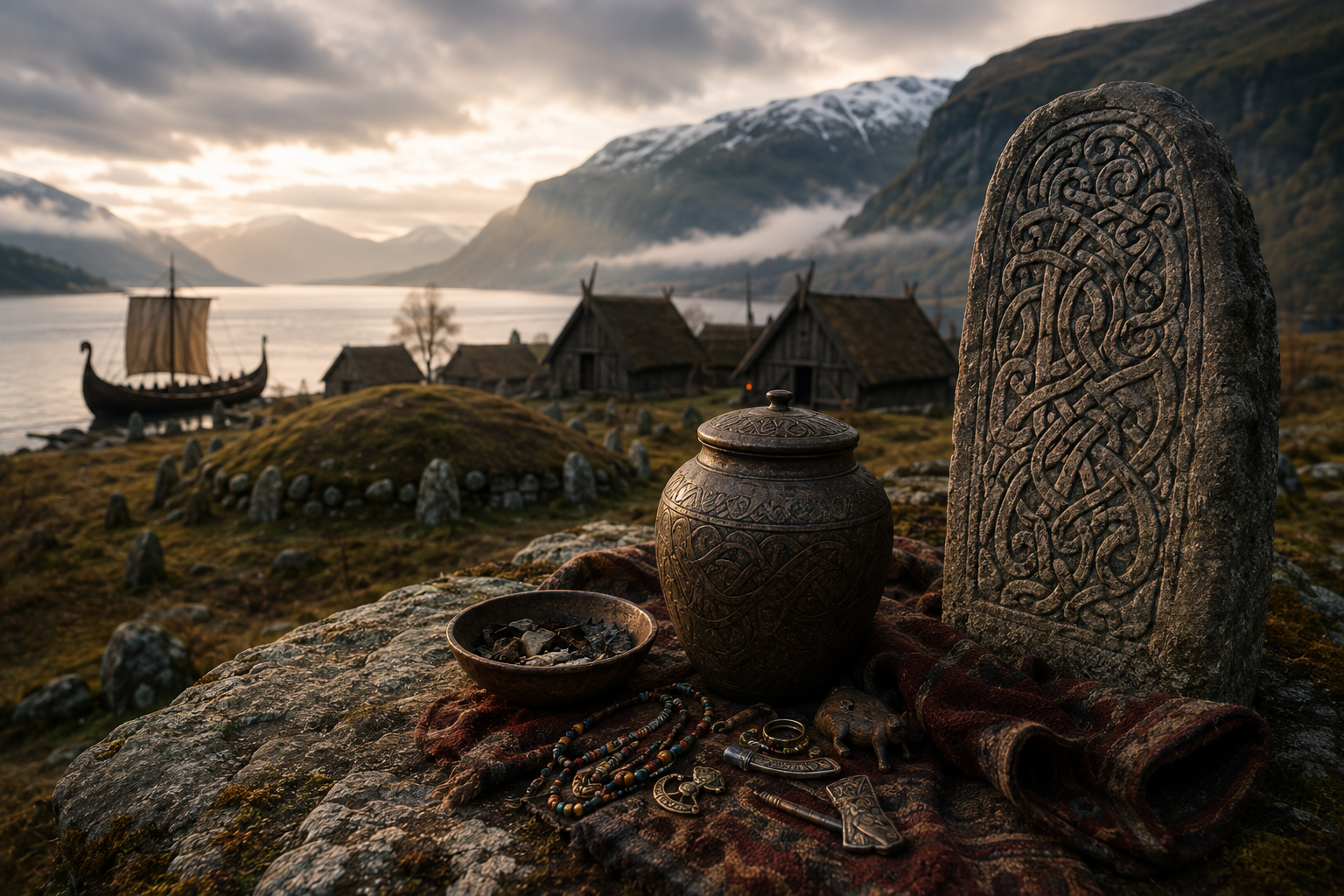
The familiar scene of a burning ship drifting across open water is not the normal Viking funeral described by archaeology.
There is evidence for:
- Ships buried beneath mounds
- Boats used as graves
- Vessels burned during land-based cremations
- Stone monuments shaped like ships
There is little support, however, for the idea that most Vikings placed the dead on ships, set them alight, and launched them into the sea.
Several literary traditions helped create the modern image.
The medieval story of the god Baldr describes a funeral involving his ship. The Old English poem Beowulf opens with a royal ship funeral, although the vessel is sent to sea with treasure rather than shown burning.
Later art, literature, television, and film combined these themes into the dramatic flaming-arrow scene audiences recognize today.
The burning ship launched into open water is one of the most persistent Viking funeral myths, but it is not supported as a common historical practice.
What Archaeology Shows
Archaeological discoveries provide the strongest evidence for understanding Viking-age funerals.
The most famous ship burials are spectacular, but their fame can create a misleading impression. These graves were exceptional rather than typical.
The Oseberg Ship Burial
The Oseberg ship burial in Norway contained the remains of two women.
The burial also included:
- A richly decorated ship
- Carved wooden objects
- Textiles
- Sledges
- Animals
- Household equipment
The Oseberg burial demonstrates that high-status ship graves were not limited to male warriors.
The Gokstad Ship Burial
The nearby Gokstad burial contained a man in a large ship with animals, smaller boats, and equipment.
Although much of the grave had been disturbed, it remains one of the clearest examples of an elite Norwegian ship burial.
The Myklebust Burial
At Myklebust in western Norway, archaeologists found evidence of a large ship used in a cremation beneath a mound.
The site provides evidence that a ship could be burned on land as part of an elite funeral.
The Ladby Ship Burial
The Ladby ship in Denmark was buried rather than burned.
The grave included animals and equipment, although human remains and many objects had been removed or disturbed in antiquity.
Archaeological context: Oseberg, Gokstad, Myklebust, and Ladby are famous because they are unusual. Most Viking-age people were buried or cremated without an entire seagoing vessel.
Ibn Fadlan and the Rus Funeral
One of the most vivid written descriptions of a Viking-age funeral comes from Ahmad ibn Fadlan.
Ibn Fadlan encountered a group commonly identified as Rus traders on the Volga during the early tenth century.
He described the funeral of a wealthy man, including:
- Several days of preparation
- Grave goods
- Animal sacrifice
- A vessel used during the ceremony
- The burning of the vessel on land
The account is important because it was written by an eyewitness.
It should not, however, be treated as a universal guide to Viking funerals. The ceremony involved a particular high-status community in a specific location.
Some details may reflect:
- Rus customs
- Local cultural influences
- Elite funeral practices
- The observer’s own perspective and interpretation
Ibn Fadlan’s account is valuable eyewitness evidence, but it describes one unusual funeral rather than a standard ritual followed throughout the Viking world.
What Happened During a Viking Funeral?
No complete ceremony can be reconstructed for every Norse community.
Archaeological and written evidence suggests that a funeral may have involved several stages.
Possible preparations included:
- Washing the body
- Dressing the deceased
- Displaying the body
- Preparing a grave, chamber, boat, or pyre
- Selecting possessions and offerings
The ceremony may then have included:
- A procession
- A communal feast
- Religious or ceremonial acts
- Animal sacrifice
- Cremation or burial
- The placement of grave goods
Funeral gatherings were also social events.
They could reinforce:
- Family relationships
- Inheritance claims
- The reputation of the deceased
- Political authority
- Claims to land
Feasting and memorial activity may have continued after the burial, especially at prominent mounds or ancestral sites.
Understanding the broader meaning of funerals helps explain why these gatherings were about more than handling the body. They also allowed communities to remember the deceased, express shared beliefs, and redefine relationships after a death.
Grave Goods and Sacrifices
Viking-age graves may contain a wide range of objects.
Examples include:
- Weapons
- Tools
- Jewelry
- Combs
- Keys
- Beads
- Textiles
- Cooking equipment
- Food
- Furniture
- Vehicles
These objects were not necessarily a complete record of everything the deceased owned.
They were selected by the living and may have represented:
- Occupation
- Social rank
- Gender roles
- Family identity
- Community status
- Beliefs about what was needed after death
Animal remains are also found in some graves, including horses, dogs, birds, and livestock.
Evidence and written accounts indicate that human sacrifice occurred in exceptional circumstances, but this subject should be discussed carefully.
It was not a standard feature of every Viking funeral, and the surviving evidence is uneven.
Viking Beliefs About the Afterlife
Valhalla is the best-known Norse afterlife destination, but it was not the only one.
Later mythological texts describe several possible destinations.
| Afterlife Destination | Association in Later Norse Sources |
|---|---|
| Valhalla | Odin receives some of those who died in battle |
| Folkvangr | The goddess Freyja receives some of the battle-dead |
| Hel | A realm associated with many who died outside battle, although descriptions vary |
Burial practices do not map neatly onto these literary destinations.
Families may have held local beliefs that were never written down. Graves also suggest an ongoing relationship between the living and the dead, with ancestors remaining connected to farms, communities, and landscapes.
Not every Norse person expected to enter Valhalla. Viking-age beliefs about death and the afterlife were more diverse than modern popular culture often suggests.
Famous Viking Burials and What They Reveal
Several major archaeological sites have shaped modern understanding of Viking-age death and burial.
| Burial Site | Location | What It Reveals |
|---|---|---|
| Oseberg | Norway | A ninth-century ship burial containing two women, art, textiles, vehicles, and household objects, showing the ceremonial importance of elite women |
| Gokstad | Norway | A large ship grave containing a man, animals, boats, and equipment, demonstrating the resources committed to a powerful individual |
| Ladby | Denmark | Denmark’s only known ship burial in which the vessel remains in its original burial place, showing elite display and later grave disturbance |
| Myklebust | Norway | A large cremation burial involving a ship beneath a mound, showing that vessels could be burned on land |
| Salme | Estonia | Two ship burials containing dozens of men, weapons, gaming pieces, and animals, offering evidence about mobility, violence, and Scandinavian activity across the Baltic |
These sites reveal the diversity of Viking-age burial customs, but they should not be treated as representative of every Norse funeral.
How Status, Gender, Age, and Region Shaped Burial
The spectacular ship graves displayed in museums represent only a small part of Viking-age death.
Most people left less elaborate archaeological traces.
Simple cremation deposits and modest inhumation graves are essential for understanding:
- Farmers
- Craftspeople
- Traders
- Children
- Other members of ordinary communities
Status
Wealth and influence could affect the size of a grave, the quantity of grave goods, and whether a boat, chamber, or mound was used.
Status was not the only factor, however. Local customs and family choices also shaped the final arrangement.
Gender
Gender cannot be identified reliably from grave goods alone.
Weapons do not automatically prove that a grave belonged to a male warrior. Jewelry or domestic equipment should not be used as a simple biological label either.
Modern analysis combines:
- Skeletal examination
- DNA analysis
- Grave objects
- The full burial context
Age
Children were also buried according to local customs, although their graves are often less visible or poorly preserved.
The treatment of children may have differed according to age, family status, region, and community beliefs.
Region
Regional differences were extremely important.
The form of a grave could reflect local identity as much as personal wealth. A custom common in one area might be rare or absent in another.
Archaeological principle: Objects should be interpreted together with human remains, grave structure, location, dating, and regional custom rather than in isolation.
How Christianity Changed Viking Burial Customs
As Christianity spread through Scandinavia during the tenth and eleventh centuries, funeral practices gradually changed.
Cremation declined, and churchyard burial became more common.
Bodies were increasingly placed in east-west graves, while grave goods often became fewer.
The transition was gradual rather than immediate.
Older and newer practices sometimes overlapped. Some graves combine traditional Norse customs with elements associated with Christianity.
The change was influenced by:
- Missionary activity
- Political authority
- Trade and contact with Christian regions
- Family choices
- Changing religious beliefs
Modern families can learn more about the role belief systems play in memorial customs through HonorYou’s overview of religious funeral services.
The conversion of Scandinavia did not replace older burial customs overnight. Christian and pre-Christian practices overlapped for generations.

What Viking Burials Tell Us About Remembrance
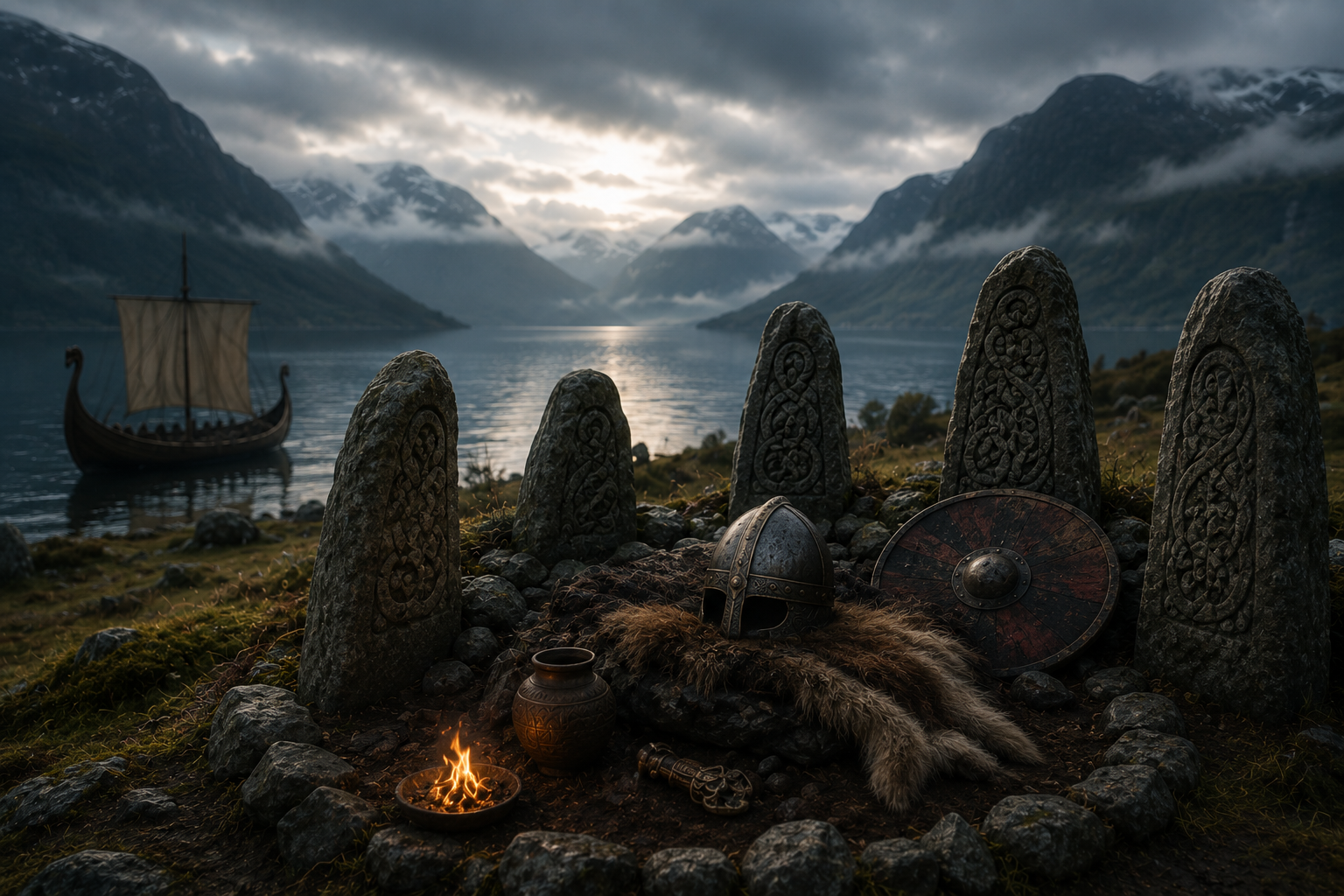
Viking burials show that remembrance was never only about disposing of a body.
Funerals communicated:
- Identity
- Family relationships
- Social status
- Religious beliefs
- Community belonging
- Connections to land and ancestry
Mounds reshaped landscapes, grave goods told stories, and gatherings helped communities define how a person would be remembered.
Modern memorials use different materials and follow different laws, but the human purpose remains familiar: preserving a life story and creating a place for memory.
Across history, societies have developed distinctive methods of remembrance. HonorYou’s guide to how different cultures honor and mourn the deceased explores several ways communities express grief and preserve memory.
Lasting idea: The materials and rituals have changed, but funerals still help communities preserve identity, share memories, and establish how a person will be remembered.
Separating Evidence From Viking Funeral Myths
Understanding Viking burials requires separating several different types of evidence.
| Evidence Type | What It Can Show | Main Limitation |
|---|---|---|
| Archaeology | Bodies, cremated remains, grave structures, objects, animals, and burial landscapes | Many ceremonial actions leave no physical trace |
| Eyewitness accounts | Detailed descriptions of particular ceremonies | Usually describe one community, event, or observer’s interpretation |
| Later literature | Stories, myths, and remembered traditions | Often written long after the Viking Age and shaped by literary goals |
| Modern entertainment | Popular visual ideas about Viking funerals | Frequently combines mythology, fiction, and historical elements for dramatic effect |
No single source can reconstruct every Viking funeral.
The strongest interpretations combine archaeological context with cautious use of written evidence.
Conclusion
The best evidence shows a world of diverse Viking burial customs rather than one standard ritual.
Cremation and inhumation existed side by side. Boats, mounds, chambers, and stone ships appeared in particular regions and communities.
Full ship burials were rare, and the burning vessel launched to sea belongs more to myth and modern storytelling than to everyday Viking-age practice.
The evidence also shows that funeral customs were shaped by:
- Region
- Time period
- Social status
- Gender and age
- Family identity
- Religious change
By separating archaeology, eyewitness testimony, later literature, and pop culture, we gain a more accurate and more human understanding of how Norse communities faced death and preserved memory.
Like the many funeral and burial practices found around the world, Viking-age customs reflected the beliefs, relationships, and values of the people who carried them out.
Frequently Asked Questions
Did Vikings burn all their dead?
No.
Both cremation and inhumation were used. The preferred practice depended on location, time period, family, social position, and community tradition.
Did Vikings send burning ships out to sea?
The cinematic burning ship at sea was not a typical archaeologically supported funeral.
Some ships were buried, and some vessels were burned during land-based cremations. There is little evidence that launching burning funeral ships into open water was a common practice.
Were Viking women buried in ships?
Yes.
The Oseberg ship burial contained two women and is one of the richest Viking-age graves ever discovered.
What did Vikings put in graves?
Grave goods could include tools, weapons, jewelry, textiles, food, furniture, vehicles, and animals.
The selection varied widely and may have reflected status, identity, occupation, family choices, and local custom.
Did all Vikings believe they would go to Valhalla?
No.
Norse traditions described several possible destinations after death. Beliefs were not uniform across the Viking world, and Valhalla was primarily associated in later sources with some of those who died in battle.
What is the difference between a Viking boat burial and a ship burial?
A boat burial used a smaller vessel, often as a container for the body.
A ship burial involved a much larger seagoing vessel and required extraordinary resources. Full ship burials were much rarer and usually associated with elite individuals.
Were Viking ship burials common?
No.
Ship burials are famous because they are spectacular and archaeologically important, but they represented only a small portion of Viking-age funerals.
Most people were cremated or buried without an entire ship.
What was placed inside a Viking ship burial?
Depending on the site, a ship burial could contain the deceased, animals, tools, weapons, furniture, textiles, food containers, smaller boats, vehicles, and ceremonial objects.
The contents varied greatly between graves.
Did Vikings sacrifice animals during funerals?
Animal remains have been found in some graves, including horses, dogs, birds, and livestock.
Animal sacrifice appears to have formed part of certain funerals, particularly some high-status burials, but it was not present in every grave.
Did human sacrifice happen at Viking funerals?
Written accounts and some archaeological interpretations indicate that human sacrifice may have occurred in exceptional circumstances.
It should not be described as a standard feature of Viking funerals because the evidence is limited and uneven.
How did Christianity change Viking burials?
As Christianity spread through Scandinavia, cremation became less common and churchyard burial increased.
Bodies were more often placed in east-west graves, and grave goods generally became fewer. The transition occurred gradually, with older and newer traditions sometimes overlapping.
Can you have a Viking-style funeral in the United States today?
Symbolic Norse-inspired elements may be possible, including readings, music, clothing, carvings, or a ship-shaped memorial display.
Rules governing open flames, waterways, cremated remains, and land use vary by federal, state, and local jurisdiction. Families should consult funeral professionals and the relevant authorities before planning any ceremony.