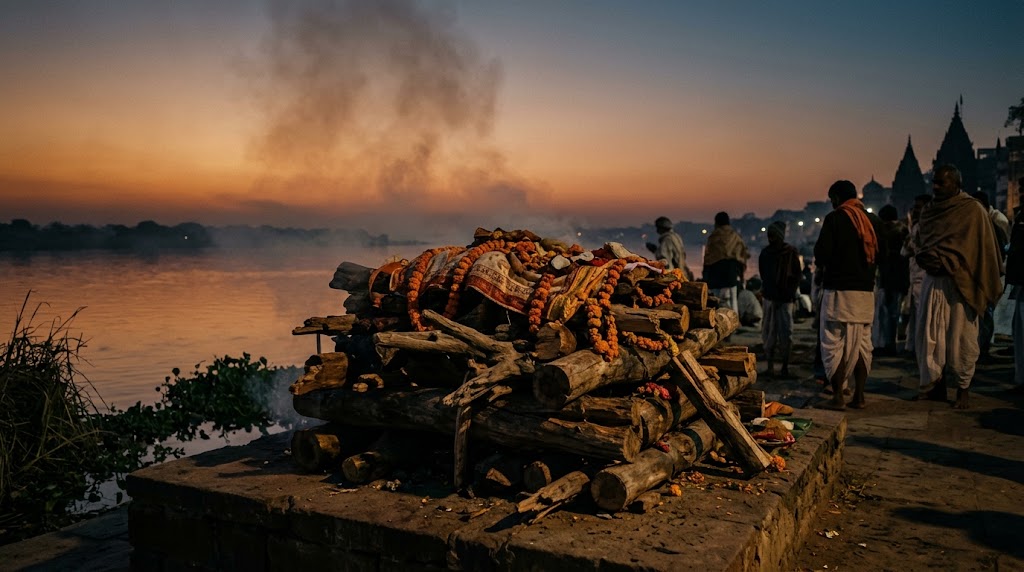
Throughout human history, cultures across the globe have developed diverse rituals to mark the end of earthly life. Among the oldest and most profound of these sacred rites is the funeral pyre. Long before the invention of modern indoor retorts and industrial equipment, ancient communities turned to open-air flame as a transformative means of returning the physical body to the elements. Today, the cremation pyre remains both an enduring cultural symbol of transcendence and an active spiritual rite practiced by millions of people worldwide.
Understanding the funeral pyre meaning requires looking beyond the physical fire to examine how different civilizations view the relationship between the body, the soul, and the natural world. While contemporary Western death care predominantly centers on in-ground burial or mechanical cremation, open-air cremation rites carry deep philosophical weight in many sacred traditions.
In this educational guide, we will explore the history of the traditional funeral pyre, examine how it is practiced across diverse religious and cultural landscapes, explain how an open-air ceremony works, and answer the most common questions regarding modern legality and practice.
Cultural Perspective: Across ancient and modern societies, fire has rarely been viewed simply as a destructive force in funerary rites. Rather, it is recognized as a sacred, purifying element that releases the spirit, dissolves earthly attachments, and facilitates the soul’s transition to the next realm.
What Is a Funeral Pyre?
A funeral pyre is a structure, traditionally constructed from stacked wood, used to cremate a deceased person in an open-air fire. Funeral pyres have been utilized across numerous historical and cultural traditions, particularly in Hindu funeral practices, where open-air cremation holds vital religious and spiritual significance.
What Is a Funeral Pyre?
At its most fundamental level, a funeral pyre definition describes an outdoor, elevated platform made of combustible materials—primarily seasoned timber—built specifically for the purpose of open-air cremation. The term “pyre” derives from the ancient Greek word pyra, meaning fire or hearth.
Unlike modern cremation, which takes place out of public view within an enclosed, fuel-powered industrial chamber, a funeral pyre cremation is an open-air, communal event. The body is placed directly upon or within the timber architecture, often accompanied by sacred herbs, clarifying oils, incense, and floral tributes.
A funeral pyre differs fundamentally from traditional earth burial:
- Transformation vs. Preservation: Earth burials and mausoleum entombments emphasize resting the body intact within the ground, whereas pyre cremation rapidly reduces the physical form to ash and bone fragments through heat and flame.
- Communal Visibility: While modern crematoriums shield the mechanical process behind steel doors, an open-air cremation invites the mourning community to bear witness to the transformation, serving as a powerful psychological marker of finality.
- Elemental Connection: Pyre rituals intentionally unite the core natural elements—earth, fire, air, and often sacred water—as an expression of cosmic renewal.
The History of Funeral Pyres
The funeral pyre history stretches back thousands of years across prehistoric, classical, and medieval societies. Archaeological excavations around the world demonstrate that ancient humans utilized fire in funerary practices as far back as the Paleolithic and Neolithic eras.
Classical Antiquity: Greece and Rome
In ancient Greece, open-air cremation on elaborate wooden pyres was the customary method of honoring fallen warriors and civic leaders. Classical literature, including Homer’s Iliad, contains vivid descriptions of heroic pyre ceremonies, such as the elaborate funeral of Patroclus. The Greeks believed that until the body was consumed by fire, the shade or soul could not cross the River Styx into the afterlife.
The Romans adopted and refined these traditions, making the pyre (or rogus) an essential component of noble funerals. Roman pyres were often multi-tiered structures adorned with draperies, sweet-scented oils, and spices to mask the smoke. At the conclusion of the burning, wine was poured over the embers to extinguish them, and the remaining bone fragments were washed, perfumed, and placed into bronze or marble urns.
Evolution and Historical Shifts
As Christianity spread throughout the Roman Empire and Europe during the fourth century CE, the use of funeral pyres declined sharply across the West. Early Christian doctrine emphasized the resurrection of the physical body, drawing theological parallels to the entombment of Jesus Christ. As a result, earth burial became the mandatory standard across Europe for more than a millennium, while open-air cremation traditions remained centered in South Asia and select indigenous cultures.
Funeral Pyres in Different Cultures and Religions
While Western societies largely abandoned the practice in the Middle Ages, funeral pyre traditions have remained central to several world religions and historical communities.
Funeral Pyres in Hindu Traditions
Within Hinduism, open-air cremation is a sacred sacrament known as Antyesti (the “final sacrifice”). In orthodox practice, fire is personified by Agni, the divine messenger who consumes the physical body and carries the purified soul toward rebirth or ultimate liberation (Moksha).
When exploring traditional Hindu funeral rites, several key aspects of the pyre ceremony stand out:
- Sacred Riverbanks: Pyres are ideally erected on dedicated burning grounds (known as ghats) along holy waterways, most famously along the banks of the River Ganges in Varanasi, India.
- Ritual Preparation: The body is ritually bathed, wrapped in simple cotton shrouds, and placed atop stacks of sacred woods like sandalwood or mango wood. Clarified butter (ghee) and camphor are applied to feed the sacred flames.
- The Lead Mourner’s Role: The eldest son or chief mourner circles the pyre counterclockwise while reciting sacred mantras before lighting the flame, signifying the fulfillment of filial duty.
- Scattering the Remains: Days after the ceremony, the collected ashes and bone fragments (asti) are gathered and cast into sacred waters to ensure spiritual peace.
Funeral Pyres in Ancient Norse & Germanic Traditions
Popular culture often portrays Viking funerals as flaming wooden ships sent drifting out to sea. While maritime ship cremation did occasionally take place for exceptionally high-status chieftains, historical Norse burial rites were far more complex.
Scholars studying authentic Viking burials note that Norse warriors were frequently cremated on land-based pyres covered in stone mounds, accompanied by grave goods, weapons, and provisions for the journey to Valhalla or Helgafjell. Accompanying recitations, such as traditional Viking prayers for the dead, sought to commend the warrior’s spirit to the gods of the northern pantheon.
Other Indigenous and Asian Traditions
Open-air pyres were historically utilized by various indigenous tribes across the Americas, ancient Australian aboriginal groups, and Buddhist monastic communities in Southeast Asia. In Tibetan Buddhist and Balinese Hindu traditions, royal and high-lama cremations still feature massive, multi-tiered funeral towers that are ritually set alight amidst community chanting and celebration.
How Does a Funeral Pyre Work?
Although the visual imagery of an open-air fire is familiar, managing a funeral pyre ceremony requires precise balance, airflow, and substantial thermal energy.
- Timber Architecture: Constructing a stable pyre requires several hundred kilograms of dry, seasoned hardwood. Heavy logs form a rectangular foundation, followed by alternating crisscrossed layers designed to facilitate steady air circulation.
- Placement and Cover: The wrapped body is respectfully placed atop the midsection of the structure. Additional layers of timber are placed over the body to maintain uniform downward heat distribution.
- Combustion Accelerants: Natural resins, dried cow dung cakes, ghee, camphor, and aromatic cedar are layered throughout the stack to ensure an even burn and suppress unpleasant odors.
- Thermal Duration: An open-air cremation typically burns for four to six hours, reaching temperatures between 600°C and 800°C (1,100°F to 1,500°F). Attendants continually tend the structure with poles to ensure safe, complete reduction.
- Post-Service Gathering: Once the fire has naturally extinguished and cooled—often the following morning—attendants or family members wash the remaining ash and collect bone relics into specialized bronze, clay, or stone urns.
What Does a Funeral Pyre Symbolise?
The enduring use of funeral pyres across centuries reflects universal themes of grief, remembrance, and metaphysical transition:
1. Dissolution and Return to the Elements
In traditions influenced by Vedic philosophy, the human physical body is composed of the five great elements: earth, water, fire, air, and ether. The funeral pyre acts as an alchemical ritual that returns each component back to the cosmos—bones and matter to earth, steam to water, warmth to fire, breath to air, and consciousness to ether.
2. Severing Earthly Attachments
Unlike a preserved tomb that can become a prolonged site of earthly attachment, a pyre provides immediate, unmistakable visual proof of physical absence. By watching the form dissolve into smoke and ash, mourners are encouraged to release their attachment to the physical shell and focus on the eternal journey of the soul.
3. Collective Mourning and Catharsis
Surrounding the flames together creates an intense communal bond. The warmth and light of the fire act as a focal point for tears, shared memories, prayers, and communal support, reminding the grieving family that they do not walk through their sorrow alone.
Are Funeral Pyres Still Used Today?
Yes, funeral pyres remain widely used today, particularly in India, Nepal, and regions with significant Hindu, Buddhist, and Jain populations. However, their use is heavily regulated by geographic, legal, and environmental constraints.
Modern Practice in South Asia
In metropolitan cities across India, the demand for timber pyres has spurred environmental debates regarding deforestation and air pollution. In response, municipal governments have introduced electric and compressed natural gas (CNG) crematoriums beside traditional burning ghats, allowing families to combine ancient Sanskrit liturgies with cleaner modern heating methods.
Legal Status in Western Countries
In the United States, Canada, the United Kingdom, and Australia, traditional open-air funeral pyres are generally prohibited by state and municipal public-health ordinances, fire codes, and strict environmental air-quality mandates.
However, notable exceptions exist:
- Crestone End of Life Project (Colorado, USA): Located in Saguache County, Colorado, this non-profit organization operates the only legal, permanent, non-denominational open-air cremation pyre facility in North America. Available primarily to local residents, it provides families of all faiths the opportunity to participate in traditional outdoor timber cremations.
- United Kingdom Precedent: Following a landmark 2010 Court of Appeal ruling (Ghai v Newcastle City Council), outdoor cremations are permitted in the UK provided they take place within a roofed, enclosed building that satisfies environmental emission regulations.
Funeral Pyre vs. Traditional Crematorium
To understand the practical distinctions between open-air funeral pyres and modern facility-based cremation, consider this side-by-side comparison:
| Feature | Traditional Funeral Pyre | Modern Crematorium |
|---|---|---|
| Ceremonial Setting | Typically outdoors on dedicated riverbanks, grounds, or open pavilions. | Indoors within a dedicated facility or mortuary chamber. |
| Operational Method | Wood-based timber |