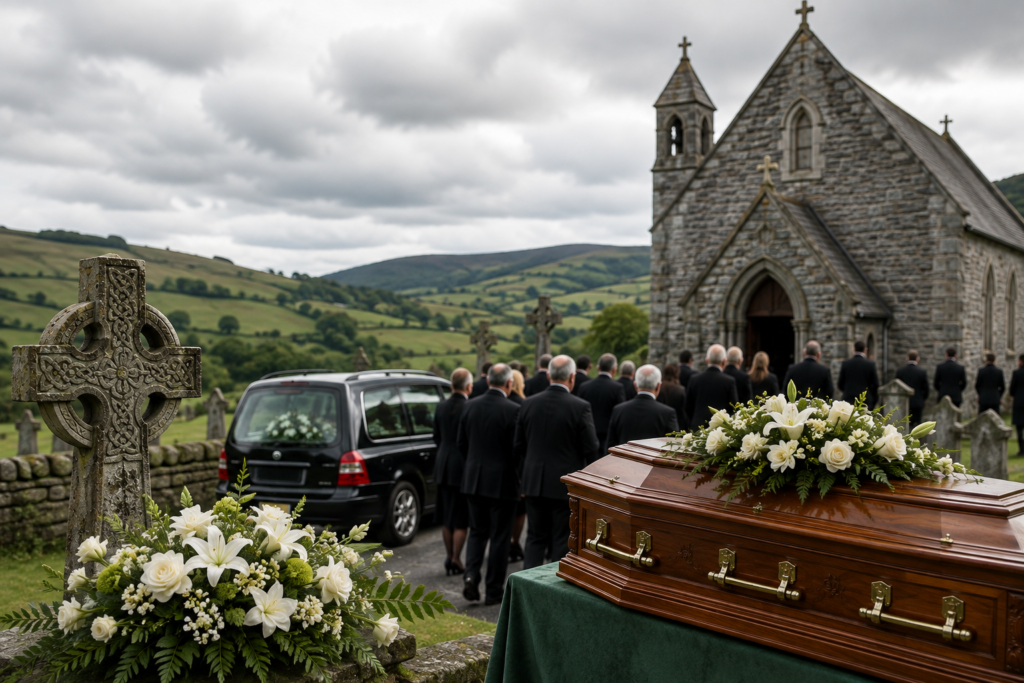
A traditional Irish funeral is often a sequence of gatherings rather than a single ceremony. It may include reposing or a wake, removal to a church or funeral venue, a religious or civil service, burial or cremation, and a meal known as the afters.
These customs create space for family, neighbors, and friends to support one another while remembering the person who died. Understanding the broader meaning of funerals can also help families recognize how these ceremonies provide opportunities for remembrance, farewell, and communal support.
There is no single format that every Irish or Irish-American family follows. Traditions vary according to region, faith, generation, and personal preference. Families may preserve older rites or adapt their values to a funeral home or contemporary memorial service.
“A traditional Irish funeral brings family, friends, and the wider community together through remembrance, hospitality, prayer, and shared support.”
What Is a Traditional Irish Funeral?
An Irish wake is one part of the broader funeral process.
The wake is the period before the formal service when people gather to view the body, offer condolences, pray, and share memories. The funeral includes the formal service and final committal, as well as the events surrounding them.
A typical sequence may include:
- Reposing or a wake at a family home or funeral home
- Removal of the coffin to a church or another funeral venue
- A Funeral Mass, religious service, civil ceremony, or family-led memorial
- A procession followed by burial or cremation
- An after-funeral gathering with food and shared remembrance
A family may shorten, combine, or omit any of these stages. The death notice, funeral announcement, or directions provided by the family should always be treated as the most reliable guide.
Important: There is no single Irish funeral format that applies to every family. Customs may differ based on faith, location, family history, and personal preference.
The Traditional Irish Funeral Timeline
Although every family makes its own arrangements, a traditional Irish funeral may follow five broad stages.
1. Reposing or the Irish Wake
“Reposing” describes the time when the deceased lies at a family home, funeral home, or another designated place before the service.
A death notice may provide specific reposing hours and identify the location. A “wake house” generally means the home where the wake is taking place.
At a home wake, visitors usually enter, greet the family, and spend a moment near the coffin. The coffin may be open, although this is never guaranteed or required.
Guests might:
- Say a quiet prayer
- Sit with the family
- Sign a condolence book
- Share a memory of the deceased
- Accept tea or simple food offered by the household
The atmosphere can hold sorrow and warmth at the same time. Tears, quiet conversation, prayer, and laughter about a familiar story can all belong in the room as people accompany the bereaved and remember the life that has ended.
If a death notice says “house private,” attend only if you are part of the immediate family or have been specifically invited.
Visitors should also give the family privacy as the time of removal approaches.
2. The Removal
The removal is the departure of the coffin from the home or funeral home, commonly for a church or another service venue.
In some Catholic funerals, the removal takes place on the evening before the Funeral Mass. Prayers may be said when the coffin is received at the church, after which mourners may offer sympathy to the family.
Removal and reception at the church are established parts of many traditional Catholic funeral services. Parish practices can differ, however, and removal is not a universal stage in every Irish funeral.
3. The Funeral Mass or Service
A Catholic Funeral Mass may include:
- Opening prayers
- Scripture readings
- Hymns
- A homily
- Communion
- Final commendation
The priest and parish can explain which readings, music, eulogies, and personal elements are permitted within the liturgy.
Irish identity does not mean that every funeral is Catholic. Families may choose from several types of religious funeral services, as well as nonreligious or family-led ceremonies that reflect the deceased’s beliefs and wishes.
Irish families may arrange:
- Catholic Funeral Masses
- Protestant funeral services
- Humanist ceremonies
- Civil funerals
- Mixed-faith gatherings
- Family-led memorial services
Some services focus on prayer and worship. Others center on music, readings, a eulogy, and stories shared by family and friends.
A clear funeral program can help guests follow the order of service. It may include the person’s photograph, obituary, readings, hymns, participants, and burial or reception details.
This can be especially useful when guests come from different faith backgrounds or are unfamiliar with the ceremony.

4. Procession, Burial, or Cremation
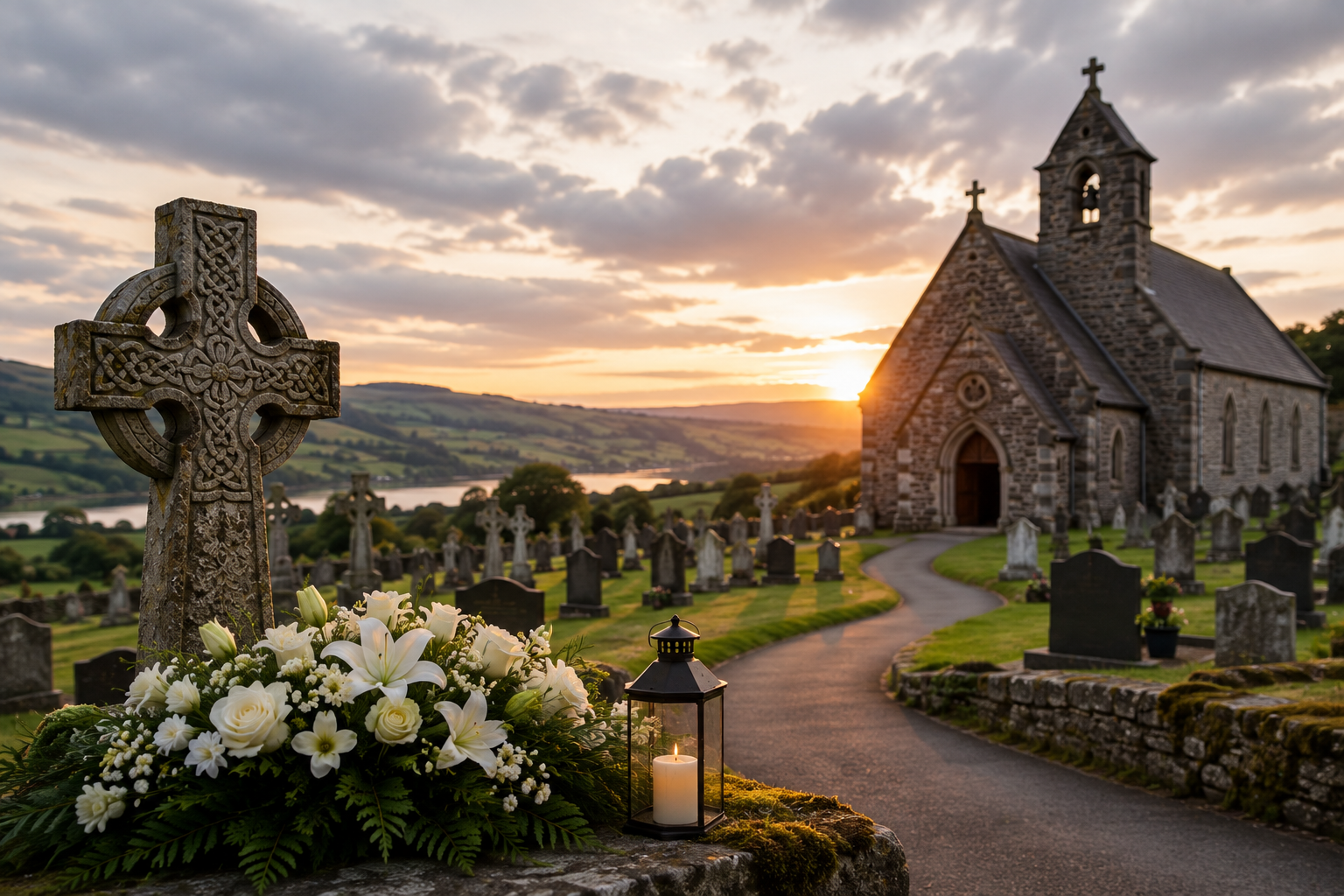
After the service, mourners may travel behind the hearse to a cemetery or crematorium.
Depending on the location and family custom, part of the procession may take place on foot.
At the place of committal, a priest, minister, celebrant, or relative may offer final prayers or words of farewell.
For burial, the coffin is committed at the grave.
For cremation, the committal may take place at the crematorium. The ashes may later be buried, scattered, or kept according to the family’s wishes and any applicable rules.
Funeral and burial customs can differ significantly between communities. Families interested in comparing Irish traditions with other practices can explore this guide to different funeral and burial practices around the world.
5. The After-Funeral Gathering
The gathering after the burial or cremation is often called the afters.
It gives mourners an opportunity to eat, rest, reconnect, and speak more informally about the person who died.
Tea, sandwiches, cakes, and shared meals have long been associated with Irish funeral hospitality.
Today, the afters might be held at:
- The family home
- A parish hall
- A hotel
- A restaurant
- Another reception venue
Alcohol is not required. Venue rules, driving arrangements, religious practice, and the family’s preferences should guide the plans.
The afters is not simply a meal. It is an opportunity for mourners to continue supporting the family and remembering the deceased in a more informal setting.
Irish Wake Traditions: Historical Customs and Modern Practice
Irish wake customs have never been identical across every county or household.
Some practices that attract attention today belong mainly to folklore, particular regions, or earlier historical periods. They should not be presented as requirements for a modern Irish funeral.
Cultures throughout the world have developed their own methods of expressing grief and preserving memory. HonorYou’s guide to ways different cultures honor and mourn the deceased provides additional examples of how communities use ceremony, storytelling, food, and remembrance to support the bereaved.
| Historical or Regional Custom | How It May Appear Today |
|---|---|
| Professional keening, or caoineadh, expressing grief through a sung lament | Personal songs, hymns, recorded music, poetry, or spoken tributes |
| All-night vigils beside the body | Scheduled reposing hours or a shorter funeral-home visitation |
| Games, tricks, and wake amusements used to keep people awake | Storytelling and gentle humor shared respectfully |
| Clay pipes, tobacco, and extensive wake provisions | Tea, sandwiches, baked goods, or a catered meal |
| Covering mirrors, stopping clocks, or leaving a window open | Observed by some families as an inherited custom, but not expected |
| A wake held in the deceased’s home | A home wake, funeral-home viewing, or private family gathering |
Prayer, Storytelling, Music, and Hospitality
The customs most readily carried forward are those that help people gather, provide comfort, and remember the deceased.
A Rosary or other prayers may be said in a Catholic home. Another family might choose:
- A blessing
- A favorite poem
- A traditional Irish song
- A period of quiet reflection
- A personal reading
Stories are equally important.
Recalling a familiar saying, an act of kindness, a family tradition, or a moment of humor gives visitors a way to speak about the person as they lived.
Food supports the gathering by offering a practical form of care to people who may have traveled or spent several hours with the family.
Core values of Irish funeral hospitality: Presence, remembrance, practical support, shared food, storytelling, and care for the bereaved.
Keening, Wake Games, and Household Symbols
Keening was once performed by women who expressed grief through a structured vocal lament.
Wake games, clay pipes, and other customs helped mourners remain beside the body throughout the night. Professional keening had largely disappeared by the early twentieth century, while many wake amusements also fell out of practice.
Household customs involving mirrors, clocks, candles, or open windows survive in family stories and regional practices.
Their meanings may be interpreted differently from one household to another.
A family may observe a custom that matters to them without suggesting that it is ancient, universal, or required.
A meaningful Irish funeral does not need to reproduce every historical custom. It should reflect the beliefs, values, and wishes of the person who died and their family.
Irish Funeral Etiquette for Guests
The family’s death notice should guide every decision about attendance, clothing, flowers, donations, and the timing of a visit.
If the notice gives public reposing hours, acquaintances may usually attend during that period.
If it says “house private,” respect the boundary.
A brief visit can be entirely appropriate when you are not close to the family. You may:
- Greet the bereaved
- Offer a simple condolence
- Spend a quiet moment near the coffin if invited
- Sign the register or condolence book
- Leave after a respectful period of time
Close relatives, friends, and neighbors may remain longer or assist with food, seating, transportation, and household tasks.
What to Wear
Choose conservative, respectful clothing unless the family requests a particular color or a less formal dress code.
Black is appropriate, but subdued navy, gray, and other dark or neutral colors are generally suitable as well.
What to Say
You do not need to deliver an elaborate speech.
Suitable condolences include:
- “I’m very sorry for your loss.”
- “You and your family are in my thoughts.”
- A short, sincere memory of the deceased
Avoid pressing the family for detailed explanations about the death.
What to Bring
Nothing is universally required as a gift.
Depending on the notice and the family’s customs, suitable gestures may include:
- A condolence card
- Food, if coordinated with the household
- Flowers, unless the family requests otherwise
- A charitable donation
- A Mass card for a Catholic family
- Practical assistance with transportation, meals, or guests
A small prayer or wake card may also be offered by the family as a remembrance. Guests should receive it as a keepsake rather than assume they are expected to bring one.
Adapting Irish Funeral Traditions in the United States
An Irish-American funeral does not need to reproduce every historical custom to remain meaningful.
Families can preserve the values beneath the tradition:
- Staying close to the bereaved
- Making room for stories
- Welcoming the wider community
- Sharing food and practical support
- Giving the deceased a thoughtful farewell
In the United States, the wake may become a scheduled funeral-home visitation.
Long-distance travel may require more advance notice, a delayed memorial, or a livestream for relatives in Ireland and elsewhere.
Funeral homes, cemeteries, churches, and reception venues may also have rules affecting:
- Viewing hours
- Open coffins
- Food and beverages
- Candles
- Music
- Funeral processions
Mixed-faith and nonreligious families can choose elements that represent the person honestly.
A blessing, contemporary reading, favorite song, family photograph, hometown reference, or immigration story can acknowledge Irish heritage without reducing the service to symbols.
A digital or printed funeral announcement can provide accurate service details to relatives across several states or countries.
It should include:
- Dates and service times
- Venue addresses
- Time zones for livestreams
- Accessibility information
- Instructions regarding flowers or donations
- Clear identification of private and public events
Memorial Details That Carry the Story Forward
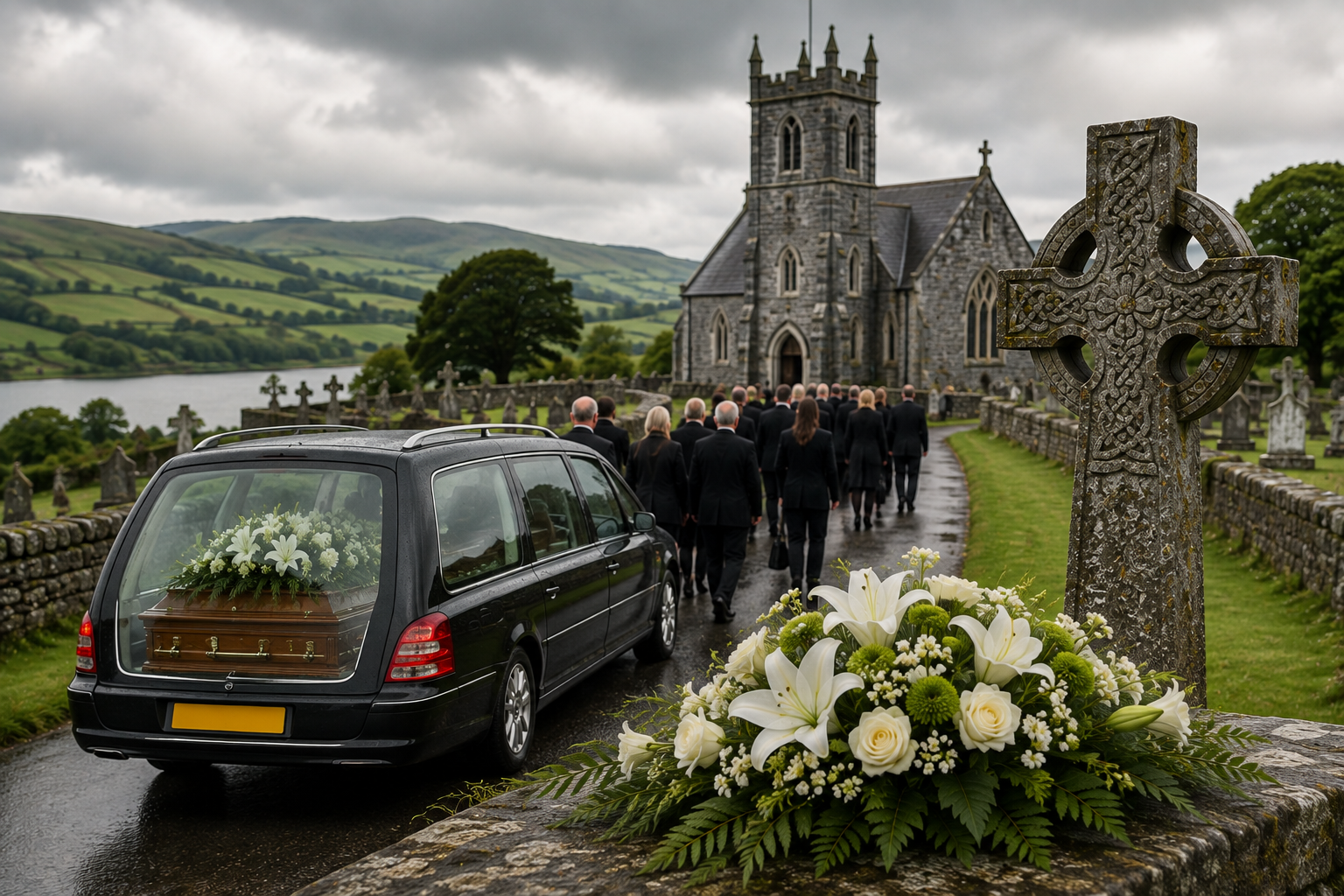
Memorial materials can preserve parts of a life that spoken remarks cannot fully capture.
A funeral program may hold the obituary and service order. A prayer card can pair a photograph with a blessing. A memorial register book can collect the names and messages of those who gathered.
Other memorial materials may include:
- Funeral programs
- Prayer cards
- Wake cards
- Memorial bookmarks
- Register books
- Photo displays
- Digital tributes
The strongest choices are personal rather than merely decorative.
Consider including:
- A line the person often used
- A photograph that reflects their personality
- A family prayer
- A meaningful Irish blessing
- A short story relatives will recognize
- A favorite song, poem, or hometown reference
The most meaningful memorial details are those that reflect the person’s actual life, beliefs, relationships, and character.
A Practical Irish Funeral Planning Checklist
- Confirm the family’s wishes, faith tradition, and cultural customs.
- Coordinate care, transportation, and timing with the funeral home.
- Decide between a home wake, funeral-home visitation, or private reposing.
- Confirm the service venue, celebrant, readings, prayers, music, and speakers.
- Choose burial or cremation arrangements and verify cemetery or venue rules.
- Prepare a death notice or announcement identifying public and private events.
- Plan hospitality for the wake and afters without overburdening the family.
- Gather photographs, an obituary, service details, and meaningful quotations.
- Order programs, cards, displays, or register books with enough time for proofreading.
- Confirm accessibility, transportation, livestreaming, and instructions for distant guests.
- Review every name, date, address, and service time before publication or printing.
Final review: Before publishing the death notice or printing memorial materials, ask at least two family members to verify all names, dates, addresses, service times, and spelling.
Final Thoughts
A traditional Irish funeral is often a sequence of gatherings that allows people to accompany the bereaved from the first hours of mourning through the final committal and the after-funeral gathering.
The process may include reposing or a wake, removal, a religious or civil service, burial or cremation, and the afters.
However, no single arrangement applies to every Irish or Irish-American family.
Some families preserve home wakes, prayers, traditional songs, processions, and shared meals. Others adapt these customs through funeral-home visitation, livestreaming, civil ceremonies, or contemporary celebrations of life.
The setting and format may change, but the central values often remain the same: presence, hospitality, remembrance, community, and care for the bereaved.
Families should choose traditions that represent the deceased honestly and respectfully rather than feeling obligated to reproduce customs that do not reflect their beliefs or circumstances.
Frequently Asked Questions
What is the difference between an Irish wake and a funeral?
The wake is the gathering or vigil held before the formal funeral service. It may include viewing the body, prayer, condolences, food, and storytelling.
The funeral refers to the broader sequence, including the formal service and burial or cremation. Modern families sometimes use the terms more loosely.
What happens at a traditional Irish funeral?
The sequence may begin with reposing or a wake, followed by removal to a church or another ceremony venue.
A Funeral Mass, religious service, civil ceremony, or family-led memorial follows. The family then proceeds to burial or cremation, and mourners often gather afterward for food and remembrance.
How long does an Irish wake last?
Historic wakes could continue through the night or over several days.
A modern wake may instead have scheduled visiting hours on one or two days. Timing depends on family wishes, travel, local custom, the funeral venue, and when burial or cremation can take place.
Check the death notice for exact hours.
What should you wear to an Irish wake?
Wear conservative, respectful clothing unless the family requests something different.
Black is appropriate, but subdued navy, gray, and other dark or neutral colors are generally suitable.
What should you bring to an Irish wake?
You do not have to bring a gift.
A condolence card, flowers, food, charitable donation, or Mass card may be appropriate. Check the death notice first and coordinate practical offerings with the family.
Are all traditional Irish funerals Catholic?
No.
Catholic rites have strongly influenced Irish funeral practices, but Irish families may be Protestant, Humanist, secular, mixed-faith, or part of another religious tradition.
The service should reflect the beliefs and wishes of the deceased and their family rather than assumptions based on Irish identity.
Can an Irish wake be held if the person is cremated?
Yes.
A family may hold a wake or viewing before cremation. They may also arrange a wake-style remembrance with an urn, photographs, or personal belongings after cremation.
The format depends on the family’s preferences, faith, timing, and the rules of the funeral home or venue.
Are Irish wakes still common today?
Irish wakes continue, but their form varies.
Some families hold a home wake, while others use a funeral home, limit attendance, or choose shorter visiting periods.
Community presence, condolences, storytelling, and remembrance can remain central even when the setting changes.
What does “house private” mean on an Irish death notice?
“House private” means that the family does not want the general public to visit the home.
Attend only if you are part of the immediate family or have received a specific invitation.
What is the removal at an Irish funeral?
The removal is the departure of the coffin from the family home or funeral home to a church or another service venue.
In some Catholic funerals, it takes place on the evening before the Funeral Mass.
What are the afters at an Irish funeral?
The afters is the gathering held after the burial or cremation.
It usually includes food, conversation, and shared remembrance. It may take place at a home, parish hall, hotel, restaurant, or another reception venue.
Is an open coffin required at an Irish wake?
No.
The coffin may be open at some wakes, but this is not guaranteed or required. The decision depends on the family’s wishes and the circumstances surrounding the death.
What should you say to the family at an Irish wake?
A simple and sincere condolence is enough.
You might say, “I’m very sorry for your loss,” offer your thoughts to the family, or briefly share a respectful memory of the deceased.