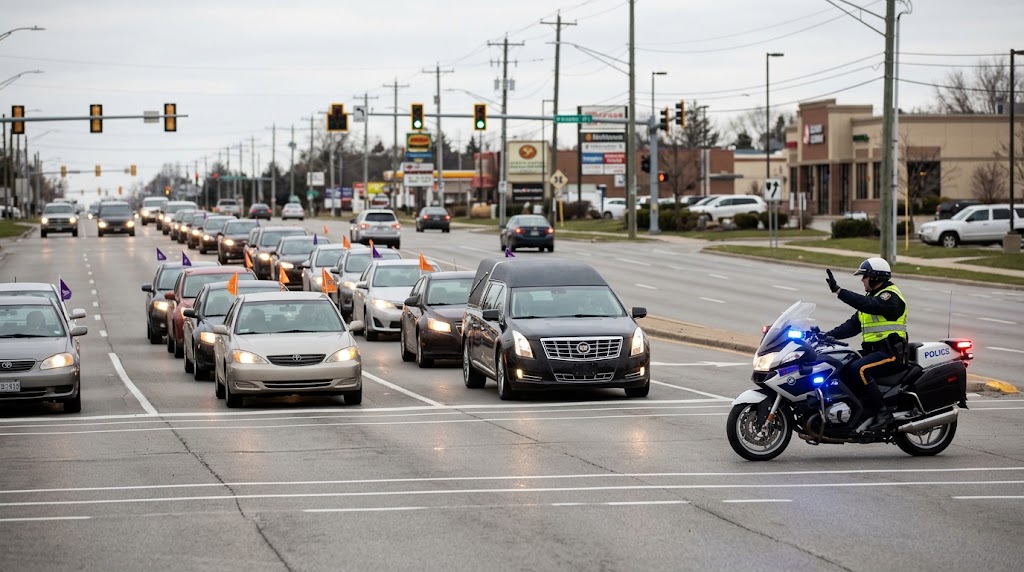
Encountering a funeral procession on the open road can instantly create uncertainty for surrounding drivers. As line after line of vehicles passes by with headlights illuminated and hazard lights flashing, motorists are often left asking: who has the right-of-way? Can a motorcycle escort legally hold up an entire intersection? What happens if cross-traffic faces a green light while a procession is moving through?
Whether you are a daily commuter trying to navigate around a procession or a grieving family member coordinating transportation for loved ones, understanding traffic laws regarding funeral escorts is critical for safety and compliance. When families gather to honor a life—whether reflecting on the tradition of wearing black at funerals meaning or preparing to deliver emotional words after learning what is a eulogy—the last thing anyone wants is traffic confusion or a motor vehicle accident on the way to the cemetery.
In this legal and safety guide, we will break down the authority held by sworn police escorts versus private motor escorts, examine state-by-state right-of-way regulations, and explain what every driver must do when encountering a funeral procession.
Legal Disclaimer: Traffic laws regarding funeral escorts and motor processions vary significantly by state, county, and municipality. The information in this article is provided for educational and informational purposes only. Drivers should consult their state’s official department of motor vehicles (DMV) or a qualified traffic attorney for specific local regulations.
Yes, sworn police escorts can legally stop traffic across all jurisdictions. Private motor escorts can also stop traffic in states that specifically license and authorize them to direct traffic; otherwise, standard traffic control signals and right-of-way rules apply.
Sworn Police Escorts vs. Private Funeral Escorts
The legal authority to stop, direct, or override normal traffic control signals depends entirely on who is leading and escorting the procession. Funeral processions typically fall under one of three categories: sworn police escorts, certified private escorts, or unescorted convoys.
1. Sworn Police Officers
When a funeral procession is escorted by active law enforcement officers—such as municipal police officers, county sheriff deputies, or state troopers riding motorcycles or driving patrol cruisers—they possess full legal authority to control traffic.
- Traffic Override Authority: Sworn officers can legally enter intersections against red lights, halt cross-traffic, and block lanes to ensure the procession remains continuous and safe.
- Emergency Equipment Use: Police escorts utilize official blue, red, or clear flashing emergency lights and sirens to clear paths through heavy urban traffic.
- Driver Compliance: All drivers on the road are legally mandated to obey explicit hand signals and traffic directions given by a uniformed law enforcement officer, regardless of what traffic signals dictate.
2. Private / Commercial Funeral Escorts
Many funeral homes hire private escort services—frequently operated by off-duty officers or retired motor officers riding specialized motorcycles equipped with amber or purple flashing lights. The legal authority of these private escorts varies widely depending on local statutes:
- Authorized States: In jurisdictions with specific escort legislation (such as Florida, Georgia, or Arizona), licensed private escort riders are legally certified as traffic flaggers. In these states, they are granted explicit permission to step into intersections, block cross-traffic, and direct cars so the procession can proceed through red lights.
- Unauthorized States: In states without private escort statutes, private motorcycle riders do not hold peace officer status. While they may ride alongside the procession to keep vehicles grouped together, they cannot legally force cross-traffic with a green light to stop or override official traffic signals.
3. Unescorted Processions
If a funeral convoy travels without an official police or certified private escort, the lead funeral car (hearse or lead limousine) must strictly obey all standard traffic lights, stop signs, and right-of-way rules. However, in many states with procession right-of-way laws, once the lead vehicle legally enters an intersection on a green light, all remaining vehicles in the marked convoy may follow through the intersection—even if the signal turns red—provided they do so safely with headlights and hazard lights illuminated.
How Traffic Laws Apply to Funeral Escorts & Processions
To help visualize how traffic authority shifts based on the escort type, the following table outlines the legal rules governing intersections and traffic flow across different escort scenarios.
| Escort / Convoy Type | Authority to Stop Traffic? | Intersection Red Light Rules | Emergency Vehicle Priority |
|---|---|---|---|
| Sworn Police Officer Escort | Full legal authority across all public roads and highways. | Can legally stop cross-traffic and lead the entire convoy through red lights. | Must yield to active emergency vehicles (sirens/lights). |
| Certified Private Escort | Permitted only in states/cities with specific licensing ordinances. | May halt traffic if state law or municipal ordinance explicitly grants flagger status. | Must yield to active emergency vehicles. |
| Unescorted Procession | No legal authority to block roads or halt cross-traffic manually. | Lead car must stop on red; once lead enters on green, continuous convoy may follow in participating states. | Must yield to active emergency vehicles. |
State-by-State Differences in Funeral Escort Laws
Because traffic safety regulations fall primarily under state jurisdiction rather than federal law, funeral escort rules vary widely across the United States. State statutes generally fall into one of three distinct categories:
1. States with Explicit Funeral Right-of-Way Laws
Many states—including Virginia, Pennsylvania, Florida, Georgia, Illinois, and North Carolina—have codified explicit statutes giving funeral processions the legal right-of-way at intersections.
- Virginia & Pennsylvania: Under state law, vehicles in a funeral procession marked with headlights and hazard lights have a general right-of-way. Other drivers must yield, and cutting through the procession is strictly illegal.
- Florida & Georgia: Florida Statute § 316.1974 grants full right-of-way to funeral processions. When the lead escort or lead vehicle legally enters an intersection, all accompanying vehicles have the right-of-way, regardless of traffic control signals.
2. States Requiring Official Police Directives
In states like California, statutory law is stricter regarding traffic signals. Under California Vehicle Code § 2817, drivers are required to obey traffic control signals unless explicitly directed otherwise by a uniformed peace officer. Private motor escorts without official peace officer status cannot lawfully halt cross-traffic against a red light. If no police escort is present, procession drivers in California must obey standard red lights and stop signs.
3. States Without Specific Funeral Statutes
A handful of states—such as Kansas, Arkansas, Vermont, Maine, and South Dakota—do not have specific statewide statutes regulating funeral processions on public roads. In these jurisdictions:
- Standard traffic laws and signal rules apply to all vehicles equally.
- Right-of-way at intersections is determined by standard traffic signals or local municipal ordinances.
- Drivers rely heavily on customary driving courtesy and safety etiquette rather than strict statutory mandates.
Rules for Other Drivers: What You Must and Must Not Do
When you encounter a funeral procession on the road, knowing how to react ensures both personal safety and respect for the grieving family. Below are the core traffic rules and etiquette expectations every driver should follow:
Do Not Cut Through the Procession
In almost every US jurisdiction, it is illegal to join, cut through, or drive between vehicles in an active funeral convoy. Vehicles carrying immediate family members, close friends, and those serving as essential support—such as family members learning what is a pallbearer to assist at the gravesite—must stay close together. Cutting into a procession separates mourning families and creates severe traffic hazards.
Yielding at Intersections
If you are approaching an intersection with a green light and observe an active, marked funeral procession moving through, you must yield the right-of-way. Wait patiently at the light or stop sign until the entire procession has safely cleared the intersection before proceeding.
Passing the Procession
Passing a funeral procession on a two-lane road is prohibited in many states if doing so interrupts or interferes with the convoy’s progress. On multi-lane highways or divided expressways, you may pass the procession in an adjacent left lane, provided you do so safely without cutting into or crowding the line of vehicles.
Should You Pull Over to the Shoulder?
Pulling over to the shoulder on two-lane rural roads is a time-honored traditional courtesy that shows respect to the deceased’s family. However, on multi-lane highways, city boulevards, or divided freeways, pulling over to the shoulder is generally not legally required unless explicitly instructed to do so by a uniformed law enforcement escort using lights or hand signals.
Liability in Funeral Procession Accidents
When a collision occurs involving a funeral procession or escort maneuver, establishing legal fault requires examining whether state right-of-way statutes were followed and whether all drivers exercised reasonable care.
Fault of the Interfering Driver
If a third-party driver fails to yield to a legally escorted procession, runs a red light into an active convoy, or cuts into the line of cars causing a rear-end collision, that driver is typically held liable for negligence. They may face traffic citations for failure to yield, as well as financial liability for vehicle damage and personal injuries.
Duty of Care for Procession Drivers
While state laws often grant funeral processions the right-of-way through red lights, drivers within the procession still owe a duty of reasonable care to others on the road. Drivers in a procession must:
- Keep illuminated headlights and active hazard flashers turned on.
- Maintain reasonable, safe speeds (typically 30–45 mph on highways).
- Exercise caution when entering intersections against a red light, ensuring cross-traffic has fully recognized the procession and stopped.
Funeral directors carefully coordinate with professional motor escort providers to minimize liability risks. Many families review escort arrangements and read verified customer reviews to ensure their procession is guided safely and respectfully from start to finish.
Frequently Asked Questions (FAQs)
Here are clear answers to common questions regarding private escorts, emergency vehicles, and identifying funeral convoys.
Can private escort riders step into the street to stop traffic?
In states that explicitly license commercial funeral escorts (such as Florida, Georgia, or Arizona), designated escort riders are legally authorized to block intersections using hand signals, whistles, or traffic flags. However, in states without commercial escort statutes, private riders do not possess peace officer authority and cannot legally step into traffic to override active traffic signals.
Do ambulances and fire trucks yield to funeral processions?
No. Emergency vehicles—such as ambulances, fire engines, and police cruisers operating with active emergency lights and sirens—always have absolute legal priority. Funeral escorts and all participating vehicles in a funeral procession must yield the right-of-way and pull over safely to allow emergency vehicles to pass immediately.
How can other drivers identify a funeral procession?
A funeral procession is identified by several clear visual markers:
- A lead escort vehicle featuring amber, purple, blue, or red flashing lights.
- A continuous line of closely spaced vehicles traveling together at a controlled speed.
- All participating vehicles driving with daytime headlights and hazard warning lights activated.
- Official funeral flags mounted on the hoods, side mirrors, or roof antennas of participating cars.