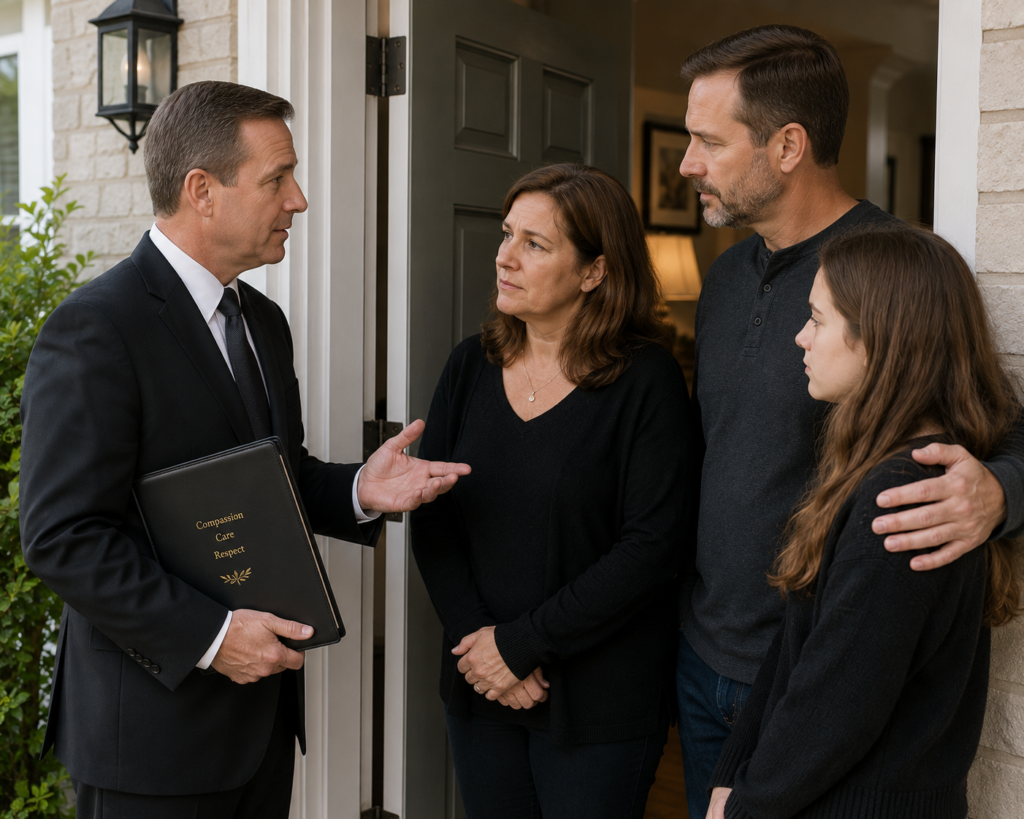
In most expected home deaths, a licensed funeral home or cremation provider collects and transports the deceased after the death has been officially confirmed. If the death is sudden, unexplained, accidental, suspicious, or unattended, emergency services and the coroner or medical examiner may need to investigate before the deceased can be released to a funeral director.
The correct first call depends on the circumstances. For an expected death involving hospice or medically supervised end-of-life care, the hospice nurse or designated healthcare provider is usually contacted first. For a sudden or unexpected death, call 911.
Local laws and procedures vary. Always follow instructions from hospice, emergency services, law enforcement, the medical examiner, or the funeral director.
Who Picks Up a Body After Someone Dies at Home?
The person or organization that removes the deceased from a private residence will depend on how the death occurred and whether an investigation is required.
The transfer may be handled by:
- A licensed funeral home
- A cremation provider
- A mortuary transport service working for a funeral home
- A coroner or medical examiner’s transport team
- A government-contracted removal service
- Emergency personnel coordinating with the appropriate authority
Police officers and paramedics may respond to the home, secure the area, and notify the proper authorities. However, they do not usually transport the deceased to a funeral home themselves.
“For an expected death, the chosen funeral home usually performs the transfer. For an unexpected death, the coroner or medical examiner may need to authorize or arrange removal first.”
Who Should You Call When Someone Dies at Home?
The correct first call depends on whether the death was expected, unexpected, or uncertain.
If the Death Was Expected
When someone is receiving hospice care or medically supervised end-of-life care:
- Call the hospice nurse or designated medical provider.
- Follow the instructions in the person’s care plan.
- Allow an authorized professional to confirm or arrange pronouncement of the death.
- Contact the selected funeral home when authorized.
- The funeral home will arrange transportation from the residence.
Families preparing for an expected death at home should keep the hospice telephone number, physician information, funeral-home contact details, and relevant documents in an accessible place.
If the Death Was Sudden or Unexpected
Call 911 when:
- The person was not receiving end-of-life care
- The cause of death is unknown
- The person died unexpectedly while apparently healthy
- The death may involve an accident or fall
- There may have been an overdose, suicide, or violence
- The deceased was found after an unknown period
- No doctor is available to certify the death
Emergency responders will assess the situation and contact law enforcement, the coroner, or the medical examiner when required.
If You Are Unsure Whether the Person Has Died
Call 911 immediately.
Do not assume death has occurred. Follow the dispatcher’s instructions and begin CPR only when instructed and when it is appropriate under the person’s care plan or advance directives.

What Happens After an Expected Hospice Death at Home?
The process after an expected hospice death is usually calmer and more predictable because the person’s medical condition and end-of-life plan are already documented.
The general process may include:
- A family member calls the hospice provider.
- A hospice nurse visits or provides instructions according to local procedure.
- The death is pronounced or verified by an authorized professional.
- Medical information is forwarded for death certification.
- The family contacts its chosen funeral home or cremation provider.
- The transfer team arrives and takes the deceased into its care.
- The funeral director begins paperwork and burial or cremation arrangements.
The family may have time to sit with the deceased, pray, contact relatives, or perform approved cultural or religious rituals before removal.
Procedures vary by state, county, hospice provider, and the availability of a physician or other authorized professional.
What Happens After an Unexpected Death at Home?
An unexpected death usually requires emergency and investigative authorities to become involved before the body can be moved.
The general sequence may be:
- Someone calls 911.
- Paramedics and possibly police arrive.
- The person and surrounding area are assessed.
- The coroner or medical examiner is notified when required.
- The deceased remains at the home until officials authorize removal.
- The body may be transported to a coroner or medical-examiner facility.
- After release, the family’s chosen funeral director collects the deceased.
Do not clean the room, move the deceased, remove medical equipment, or rearrange belongings while an investigation may be required.
After a sudden or unexplained death, the funeral home may not be allowed to collect the deceased until the coroner or medical examiner has completed the required initial review.
What Is an Unattended Death?
An unattended death generally means that no treating medical professional is available to certify an expected cause of death, or the deceased had not recently been under appropriate medical care.
The word “unattended” does not necessarily mean the person was physically alone when they died.
Examples may include:
- A person found deceased unexpectedly at home
- Someone who had not recently seen a doctor
- A death without a known terminal diagnosis
- A person found after several days
- A death with unclear circumstances
Unattended deaths are more likely to be reported to the coroner or medical examiner for review.
Does the Funeral Home Pick Up the Body?
Usually, yes. Once the death has been confirmed and the deceased has been legally released, the chosen funeral home commonly arranges transportation from the home.
The funeral home may send:
- A licensed funeral director
- A funeral-service employee
- A trained removal technician
- A contracted mortuary transport team
The deceased may be transported to the funeral home, a crematory, a refrigeration facility, or another authorized location.
HonorYou’s guide explaining what funeral homes do provides more information about transportation and care of the deceased.
Can a Cremation Provider Pick Up the Body?
Yes. A cremation provider may arrange removal directly or use a licensed transport service.
Before choosing a provider, ask:
- Who will perform the transfer?
- Where will the deceased be taken?
- Does the provider operate its own crematory?
- Is transportation included in the quoted price?
- Are mileage or after-hours charges added?
- How is the deceased identified throughout the process?
A funeral home or cremation provider can also coordinate authorizations, permits, transportation, and the return of the cremated remains.
Learn more about funeral-home cremation services and direct cremation.
When Does the Coroner or Medical Examiner Take the Body?
The coroner or medical examiner may become involved when a death is:
- Sudden
- Unexpected
- Unattended
- Accidental
- Violent
- Suspicious
- Possibly related to an overdose or poisoning
- Associated with suicide
- Connected to a workplace incident
- Without a physician able to certify the cause
The office may arrange transport to a forensic facility for an examination. After its work is complete, the deceased is released to the funeral home chosen by the family or authorized representative.
The exact jurisdiction and release procedure differ by location.
Do Police Officers Remove Dead Bodies?
Police officers may respond to an unexpected death and:
- Secure the scene
- Document the circumstances
- Contact the coroner or medical examiner
- Speak with relatives or witnesses
- Prevent the area from being disturbed
- Remain until authorized transport arrives
Police vehicles do not usually transport the deceased. The physical transfer is generally completed by a medical-examiner transport team, contracted removal service, funeral home, or mortuary transport provider.
Who Officially Pronounces the Death?
The authority to pronounce or verify death varies by state and local law.
It may involve:
- A physician
- A hospice nurse
- A registered nurse working under an approved procedure
- A paramedic
- A coroner
- A medical examiner
- Another authorized healthcare professional
Pronouncing death and certifying the cause of death are not always performed by the same person.
Pronouncing death means formally confirming that death has occurred.
Certifying the cause of death means completing the medical portion of the death certificate and identifying the cause and manner of death.
Can the Family Choose the Funeral Home?
Usually, yes. The family or legally authorized representative may generally select the funeral home, cremation provider, or other licensed provider. Reading HonorYou reviews and checking feedback from other families can offer extra confidence when choosing a compassionate partner to guide you through the process.
Possible exceptions include:
- The deceased is temporarily under medical-examiner jurisdiction.
- A prepaid funeral agreement names a provider.
- Another person has legal authority over disposition.
- Local law requires a specific release process.
- The deceased is unidentified or unclaimed.
Before signing a contract, confirm who has the legal right to authorize the funeral, cremation, or burial arrangements.
What Happens During Body Removal From a Home?
The transfer should be performed respectfully and discreetly.
The transport team will generally:
- Confirm authorization to collect the deceased.
- Verify identity.
- Speak briefly with the family.
- Prepare the deceased for safe and dignified transport.
- Use appropriate equipment to move the person.
- Transfer the deceased to the transport vehicle.
- Transport the deceased to the authorized facility.
- Document the transfer and maintain identification procedures.
The family may be asked to step into another room during part of the transfer. This can provide privacy and allow staff to work safely, particularly when stairs or narrow access points are involved.
What Equipment Is Used to Remove a Body From a Home?
Depending on the home and circumstances, staff may use:
- A transfer cot or stretcher
- A covered removal carrier
- Protective sheets or coverings
- Personal protective equipment
- Specialized equipment for stairs or difficult access
The funeral home may ask about:
- Narrow hallways
- Staircases
- Apartment access
- Elevators
- The deceased’s approximate weight
- Parking restrictions
- Pets in the home
This information helps the provider send enough staff and suitable equipment.
How Long Does It Take for a Funeral Home to Arrive?
Response time varies according to:
- Distance from the funeral home
- Time of day
- Weather and road conditions
- Staffing and call volume
- Whether pronouncement has occurred
- Whether an investigation is required
- Local transport authorization
- Access to the residence
Many funeral homes provide 24-hour transfer services, but after-hours or mileage charges may apply.
Ask the provider for an estimated arrival time rather than assuming the team will arrive within a particular period.
How Long Can a Deceased Person Remain at Home?
There is no single timeframe that applies in every situation.
The timing may depend on:
- Whether death has been officially pronounced
- Whether the coroner or medical examiner has jurisdiction
- State and local requirements
- Room temperature
- The condition of the deceased
- Religious or cultural traditions
- Whether professional home-funeral care is being used
Families should follow instructions from hospice, emergency responders, the medical examiner, or the funeral director. Do not attempt preservation or body preparation without appropriate professional guidance.
Should You Move or Clean the Body?
Do not move or clean the deceased after a sudden, unexplained, accidental, or suspicious death.
You should:
- Leave the person and surrounding area undisturbed.
- Avoid removing medical equipment.
- Do not clean the room or rearrange belongings.
- Keep children and pets away from the immediate area.
- Follow directions from 911, police, or the medical examiner.
For an expected hospice death, follow the hospice team’s instructions. Approved family, spiritual, or cultural practices may sometimes be permitted once the death has been confirmed.
Can Family Members Stay With the Deceased Before Removal?
Often, yes, particularly after an expected death.
Family members may be able to:
- Sit quietly with the person
- Pray
- Invite close relatives
- Contact clergy or a spiritual leader
- Say goodbye privately
- Participate in approved cultural or religious rituals
Access may be restricted after an unexpected or suspicious death. Follow instructions from law enforcement or the medical examiner before touching the deceased or entering the immediate area.
What Information Will the Funeral Home Need?
The funeral home may request:
- The deceased’s full legal name
- Date of birth
- Social Security number
- Home address
- Time and place of death
- Name of the professional who pronounced the death
- Physician or hospice contact details
- Next-of-kin information
- Burial or cremation preference
- Details of prepaid arrangements
- Information needed for the death certificate
HonorYou’s guide to the funeral-home death certificate process explains the information families may need to provide.
Who Completes the Death Certificate?
Several people or organizations may contribute to the death-registration process.
Generally:
- A physician, coroner, or medical examiner certifies the medical cause of death.
- The funeral director collects demographic information from the family.
- The funeral home files or helps file the record with the appropriate vital-records office.
- Certified copies are issued by the relevant government authority.
The person who pronounces the death may not be the person who completes the medical certification.
How Much Does Body Removal From a Home Cost?
The transportation charge may be:
- Included in a funeral package
- Listed as a separate transfer fee
- Subject to mileage charges
- Higher for after-hours service
- Higher when difficult access or extra staff are required
- Different when the deceased is collected from a medical-examiner facility
Ask for an itemized price list and confirm whether the quoted amount includes:
- Removal from the home
- Mileage
- Additional personnel
- After-hours service
- Transfer to a crematory
- Refrigeration or sheltering
Ask whether transportation is included before authorizing the transfer. Mileage, nighttime service, additional staff, and transfer to another facility may be billed separately.
What Happens After the Body Reaches the Funeral Home?
After arrival, the funeral home may:
- Confirm identification
- Place the deceased in secure care
- Provide refrigeration
- Prepare the deceased as authorized
- Arrange embalming if selected
- Complete paperwork
- Coordinate burial or cremation
- Schedule a viewing, funeral, or memorial
- Help order certified death certificates
- Contact cemeteries or crematories
A funeral mortician or funeral director may help the family coordinate these next steps.
How to Prepare for an Expected Death at Home
Advance preparation can reduce confusion for relatives and caregivers.
Use this checklist:
- Keep the hospice telephone number accessible.
- Choose a funeral home or cremation provider in advance.
- Confirm who should be called first.
- Ask who is authorized to pronounce the death.
- Review advance directives and care instructions.
- Confirm who has legal authority to make arrangements.
- Gather identification and personal information.
- Review transportation and after-hours fees.
- Discuss religious or cultural wishes.
- Tell close family members what to expect.
Do not wait until the final hours to begin comparing providers when the death is expected and advance planning is possible.
Questions to Ask the Funeral Home
Before authorizing transport, ask:
- Do you provide removal from a private residence?
- Is home transfer included in your basic fee?
- Are there mileage or after-hours charges?
- Who will come to the home?
- How soon can your team arrive?
- Where will the deceased be taken?
- Do you use an outside transport company?
- What identification procedures do you follow?
- Do you coordinate with hospice or the medical examiner?
- What paperwork do you need from the family?
- Can you arrange direct cremation?
- What happens if the medical examiner is involved?
Final Thoughts
For an expected death at home, the hospice provider or supervising medical professional is usually contacted first. Once the death has been confirmed, the family’s chosen funeral home or cremation provider normally collects and transports the deceased.
For a sudden, unexplained, accidental, suspicious, or unattended death, call 911. Emergency responders, law enforcement, and the coroner or medical examiner may need to assess the situation before removal can occur.
Do not move the deceased or disturb the area after an unexpected death. Follow official instructions and ask the funeral provider for clear information about timing, authorization, identification procedures, transportation, and fees.
Although the process can feel overwhelming, understanding who to call and what each professional does can help the family take the next steps safely and respectfully.
Frequently Asked Questions
Who picks up a dead body from a house?
A funeral home, cremation provider, mortuary transport service, or medical-examiner transport team usually removes the deceased, depending on the circumstances of the death.
Should I call the funeral home first?
For an expected hospice death, follow the hospice care plan and call hospice first. For a sudden, unexplained, or unexpected death, call 911.
Will an ambulance take the body?
An ambulance may respond when the person’s condition is uncertain. Transport of a deceased person is usually handled by a funeral home, medical examiner, coroner, or mortuary transport provider.
Does the coroner always collect the body?
No. The coroner or medical examiner generally becomes involved only when the death falls under its legal jurisdiction.
Can I choose which funeral home collects the deceased?
Usually, yes, once the deceased has been legally released and the person making the choice has authority over the final arrangements.
Can the funeral home come at night?
Many funeral homes provide 24-hour transfer services. After-hours fees may apply.
Can the family wait before calling the funeral home?
After an expected death, families may sometimes spend a short period saying goodbye, but they should follow hospice and local guidance. After an unexpected death, call 911 immediately.
What if the person wanted direct cremation?
The selected funeral home or cremation provider can transport the deceased and coordinate the authorizations, permits, and cremation arrangements.
Who pays for removal from the home?
The person arranging the funeral or the estate usually pays the funeral provider. The transfer fee may be included in a package or listed separately.
How long does body removal take?
Timing varies according to distance, staffing, pronouncement, access to the home, and whether a coroner or medical examiner must investigate. Ask the provider for an estimated arrival time.
Can family members stay with the deceased?
Often, yes, after an expected death. Access may be limited after a sudden or suspicious death while authorities assess the scene.
What happens if no family can be found?
The medical examiner, coroner, local government, or another public authority generally follows procedures to identify the deceased, locate relatives, and arrange disposition if the body remains unclaimed.