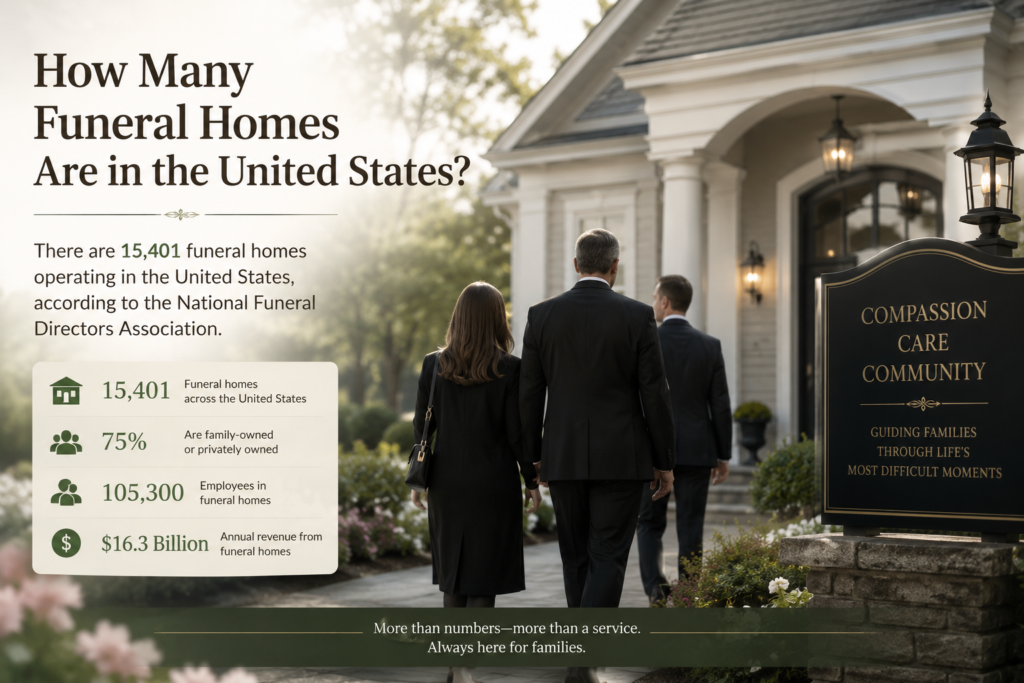
The latest National Funeral Directors Association media data lists 15,401 funeral homes operating in the United States. That is the best current number to cite when someone asks how many funeral homes are in the United States.
That answer needs one important caveat: not every source counts the same thing.
Some sources count establishments operating specifically as funeral homes. Others count the broader funeral-services industry, deathcare establishments, cemeteries, crematories, or older industry estimates. That is why figures such as 15,703, 19,000, or 29,015 may appear in different reports.
For families, the exact count is less important than what it says about choice. The United States still has a large funeral-home network, and many providers remain local, family-owned, or privately owned.
At the same time, cremation, industry consolidation, online planning, and changing memorial preferences are reshaping how funeral homes serve families.
“There are 15,401 funeral homes operating in the United States, according to the National Funeral Directors Association.”
The Number to Cite: 15,401 Funeral Homes
The National Funeral Directors Association’s media data reports 15,401 funeral homes operating in the United States.
The same NFDA industry summary reports that:
- Approximately 75% of funeral homes are family-owned or privately owned
- Funeral homes employ approximately 105,300 people
- Funeral homes generate approximately $16.3 billion in revenue
This makes NFDA one of the strongest primary sources for a direct answer. It is an industry-association source, uses current media data, and specifically refers to funeral homes rather than the wider deathcare economy.
Why Do Other Sources Show Different Funeral Home Counts?
Different figures are not always direct contradictions. They usually result from different definitions, years, or data sets.
For example:
- A trade association may count operating funeral homes.
- A market-research company may count all businesses within the funeral-services industry.
- A consumer article may repeat an older estimate that is still circulating online.
- Another report may combine funeral homes, crematories, cemeteries, or related deathcare establishments.
The figure you use should match the question you are trying to answer.
Use NFDA for the current number of operating funeral homes. Use broader market-research figures only when discussing the funeral-services industry as a larger business category.
| Source | Count | What It Appears to Count | Best Use |
|---|---|---|---|
| NFDA Media Center | 15,401 | Funeral homes operating in the United States | Best direct answer for the article |
| Funeral Director Daily / older economic-impact data | 15,703 | An older funeral-home count used in a 2022 industry calculation | Historical context only |
| Consumer and industry blog estimates | About 19,000 | Often an older or broader estimate repeated in consumer-facing content | Use only with a date and definition caveat |
| IBISWorld | 29,015 | Businesses in the U.S. Funeral Services industry in 2026 | Broader industry or business-market discussions |

What the Count Says About the Funeral Home Industry
A national funeral-home count is more than a piece of industry trivia.
It provides context for:
- How families find local funeral care
- How funeral homes compete within their communities
- How ownership affects local service models
- How cremation is changing traditional funeral services
- How the industry is adapting to online planning and personalization
Most Funeral Homes Are Still Privately Owned
NFDA reports that approximately 75% of U.S. funeral homes are family-owned or privately owned.
Local or private ownership may affect:
- How involved the owner is in day-to-day arrangements
- How pricing and service packages are presented
- How closely the funeral home is connected to local churches and cemeteries
- How long the provider has served the community
- How decisions and complaints are handled locally
Private ownership does not automatically guarantee better service, just as corporate ownership does not automatically mean poor service.
The practical takeaway is that families should understand who owns the funeral home, compare written prices, and ask whether services are performed locally or coordinated through another provider.
Families can also use the Honor You funeral home reviews directory to explore providers, compare available information, and narrow down local options before making contact.
The Funeral Industry Is Large, but Families Experience It Locally
NFDA reports approximately 105,300 funeral-home employees and $16.3 billion in funeral-home revenue.
Crematories and cemeteries contribute another approximately $4.274 billion in related revenue.
These figures show that deathcare is a substantial national industry. However, most families experience funeral service one local provider and one arrangement conference at a time.
A funeral home may help a family:
- Transfer and care for the deceased
- Choose burial or cremation
- Plan a funeral, memorial, or celebration of life
- Review service and merchandise options
- Coordinate with cemeteries, crematories, and clergy
- Complete required administrative documents
- Arrange obituary and memorial materials
Funeral-home staff may also assist with important documentation, including the process of obtaining a funeral-home death certificate and ordering certified copies for the family.
Cremation Is Changing Funeral Home Services
Cremation has become a major influence on the funeral industry.
The Cremation Association of North America reports that the U.S. cremation rate was 62.8% in 2025 and is projected to reach 69.1% by 2030.
As more families choose cremation, funeral homes may offer:
- Direct-cremation packages
- Memorial services held after cremation
- Shorter or more flexible arrangement timelines
- Online planning and authorization options
- Urns and cremation keepsakes
- Scattering, burial, and inurnment coordination
- More personalized celebrations of life
Cremation does not eliminate the need for funeral homes. It changes the type of services many families expect from them.
Families are also becoming more interested in documenting and funding arrangements before death. Those considering advance planning can review HonorYou’s guide to pre-need funeral plans before deciding whether advance arrangements are appropriate.
Cremation is not removing funeral homes from the process. It is encouraging providers to offer more flexible, personalized, and technology-supported services.
What the Number Means for Families Choosing a Funeral Home
A large funeral-home network can give families more choices. It can also make the search confusing because providers may use different ownership structures, packages, facilities, and pricing language.
When comparing funeral homes, look for a provider that makes the basics easy to understand.
Ownership and Local Service
Ask:
- Who owns the funeral home?
- Is it independently owned, family-owned, or part of a larger company?
- Are arrangements handled by staff at this location?
- Does the provider use an outside crematory or preparation facility?
- Who will be responsible for your family’s arrangements?
Pricing and the General Price List
Ask for a General Price List and confirm:
- What is included in the basic services fee
- What transportation charges apply
- Whether embalming or refrigeration is included
- Which viewing and ceremony fees are separate
- What third-party cemetery or crematory expenses may be added
- Whether package items can be removed
Available Service Options
The funeral home should clearly explain:
- Traditional burial
- Direct cremation
- Immediate burial
- Viewing and visitation options
- Memorial services
- Celebrations of life
- Religious and cultural accommodations
Personalization and Family Communication
Consider how the funeral home supports:
- Obituaries
- Online memorial pages
- Livestreaming
- Photograph and video tributes
- Funeral programs
- Prayer cards and bookmarks
- Communication with relatives who live elsewhere
Reputation and Transparency
Look for:
- Recent and credible reviews
- Licensing information
- Staff biographies
- A clear community history
- Transparent facilities and service locations
- Clear written estimates and contracts
How the FTC Funeral Rule Helps Families Compare Providers
The federal FTC Funeral Rule requires covered funeral providers to give consumers accurate, itemized price information and required disclosures about funeral goods and services.
In practical terms, families generally have the right to:
- Ask for funeral prices by telephone
- Receive a General Price List during an in-person discussion
- Choose individual goods and services rather than an unwanted package
- Receive required disclosures about embalming
- Use an alternative container for direct cremation
- Purchase a casket or urn from an outside provider
- Receive an itemized statement showing selected goods and services
HonorYou’s guide to the FTC Funeral Rule explains these protections in more detail.
Memorial Materials Are Also Part of the Decision
Families should ask how memorial and printed materials are handled.
Understanding the importance of a funeral program can help families decide what information, photographs, readings, and service details should be included for guests.
Memorial materials may include:
- Funeral programs
- Prayer cards
- Wake cards
- Memorial bookmarks
- Register books
- Memorial posters
- Online memorials and QR-code tributes
HonorYou can help families think about remembrance, memorialization, and the story they want to preserve—not only the logistics of the service.
Families working within a limited budget can also explore practical guidance for creating affordable funeral programs that remain personal, dignified, and meaningful.
How to Use the Funeral Home Count Correctly
Choose the figure that matches the question being answered.
- Use 15,401 when the question is: “How many funeral homes are operating in the United States?”
- Use a broader business count only when discussing the funeral-services industry as an overall market category.
- Avoid repeating older estimates such as 19,000 unless the source identifies the year, methodology, and definition.
- Use state-specific sources when researching the number of funeral homes in a particular state.
- Do not apply the national count evenly across states, because funeral-home distribution depends on population, geography, licensing, and local demand.
The most useful number is not always the largest one. It is the number whose definition matches the question being asked.
Final Thoughts
The best current figure to cite is 15,401 funeral homes operating in the United States, based on National Funeral Directors Association media data.
Other reports may show higher or lower figures because they use older information or count a broader group of funeral-services businesses.
The national total reflects a large and established funeral-care network. It also shows that the industry remains highly local, with approximately 75% of funeral homes described as family-owned or privately owned.
Cremation, consolidation, online planning, consumer-protection rules, and changing memorial preferences continue to reshape the industry. However, families still make the most important decisions at a local level.
When choosing a funeral home, compare ownership, pricing, services, reviews, facilities, staff, and communication. The number of funeral homes in the country shows that families have options, but the right provider will depend on their specific needs, beliefs, location, and budget.
Frequently Asked Questions
How many funeral homes are in the United States?
There are 15,401 funeral homes operating in the United States, according to the latest National Funeral Directors Association media data. This is the clearest current figure to cite for the direct question.
Why do some sources say there are 19,000 funeral homes?
Some older or consumer-facing sources cite approximately 19,000 funeral homes. This may be an older estimate or a broader count. Use it only when the source identifies the year and what types of establishments were included.
Why does IBISWorld show a much higher number?
IBISWorld reports 29,015 businesses in the U.S. Funeral Services industry in 2026. This appears to be a broader business-category count rather than the same measure as NFDA’s count of operating funeral homes.
Are most funeral homes family-owned?
NFDA reports that approximately 75% of U.S. funeral homes are family-owned or privately owned. Families should still confirm the ownership of an individual provider because ownership can influence pricing, policies, and service structure.
How many people work in funeral homes?
NFDA’s industry summary reports approximately 105,300 funeral-home employees in the United States.
How much revenue do funeral homes generate?
NFDA reports approximately $16.3 billion in funeral-home revenue. Crematories and cemeteries contribute additional related industry revenue.
Is the number of funeral homes increasing or decreasing?
The total can change because of acquisitions, consolidation, owner retirements, new businesses, cremation growth, and changes in industry classifications. Source definitions should be reviewed carefully when comparing counts over time.
Does the funeral-home count include cemeteries?
The NFDA figure refers specifically to funeral homes operating in the United States. Broader market data may include cemeteries, crematories, or other funeral-services businesses.
Does the funeral-home count include crematories?
Not necessarily. A funeral home may operate its own crematory, but independent crematories may be counted separately in broader deathcare or funeral-services data.
What percentage of Americans choose cremation?
The Cremation Association of North America reports a U.S. cremation rate of 62.8% in 2025 and projects that it may reach 69.1% by 2030.
How should families compare funeral homes?
Compare clear written pricing, ownership, available services, licensing, reviews, staff experience, facilities, cultural accommodations, and how comfortable the provider makes the family feel.
Where can families research local funeral homes?
Families can use the Honor You funeral home reviews directory to explore local providers and available information before contacting individual funeral homes.