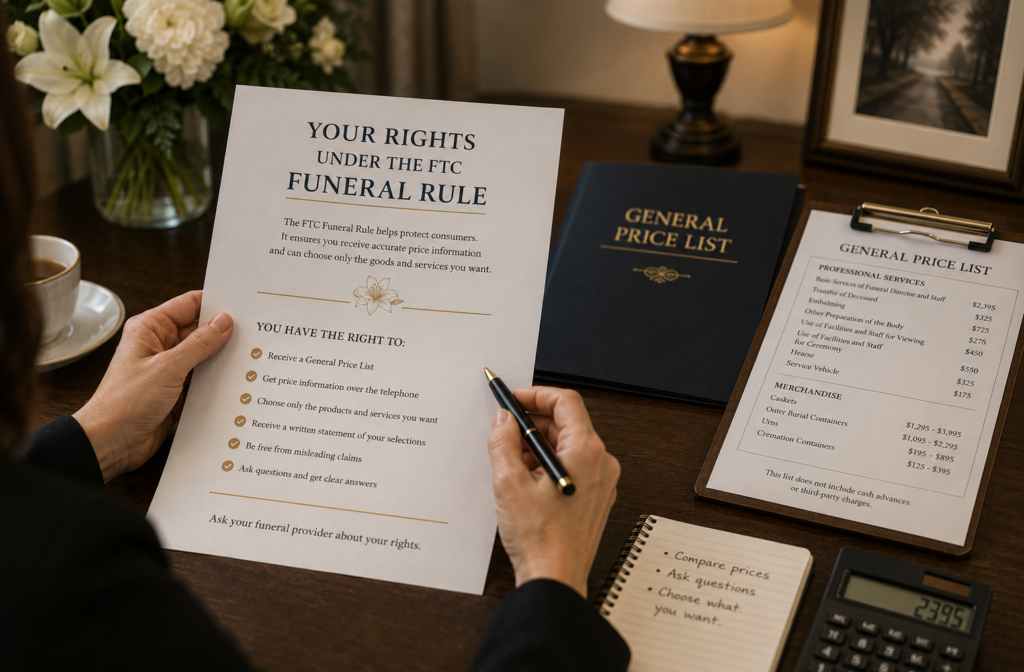
The FTC Funeral Rule is a federal consumer-protection regulation that helps families understand funeral prices and choose only the goods and services they want. It applies whether someone is making arrangements after a death or planning a funeral in advance.
Under the Funeral Rule, covered funeral providers must disclose prices accurately, provide certain written price lists, explain legal or cemetery requirements truthfully, and give consumers an itemized statement of their selections. The Rule also protects families from being forced to purchase certain unwanted products or bundled funeral packages.
These protections can be especially important because funeral decisions are often made under emotional pressure and within a limited amount of time. Understanding your rights can help you compare providers, question unclear charges, and select arrangements that fit your family’s needs and budget.
Important: This article provides general educational information and is not legal advice. State funeral, cemetery, cremation, and pre-need laws may provide additional rights or requirements.
What Is the FTC Funeral Rule?
The Funeral Rule is formally known as the Funeral Industry Practices Rule. It appears in federal regulations at 16 CFR Part 453 and is enforced by the Federal Trade Commission.
The Rule requires covered funeral providers to:
- Give consumers accurate, itemized price information
- Provide required funeral price lists at the appropriate time
- Give price information over the telephone when requested
- Allow consumers to select individual goods and services
- Make required disclosures about embalming, caskets, and legal requirements
- Provide a written statement showing the goods and services selected
- Avoid misleading claims about what families are legally required to purchase
The Funeral Rule originally took effect on April 30, 1984. Revised requirements became effective in 1994.
Families unfamiliar with the broader role of a provider may also find HonorYou’s guide explaining what funeral homes do helpful.
“The Funeral Rule does not set funeral prices. It requires covered providers to disclose their prices and respect a consumer’s right to make informed choices.”
Why Was the Funeral Rule Created?
Planning a funeral can be emotionally and financially difficult. Families may have only a few days to compare providers, make decisions, complete paperwork, and arrange burial or cremation.
This pressure can make it harder to:
- Compare prices between funeral homes
- Understand which services are optional
- Question claims about legal requirements
- Recognize charges included in a package
- Decline products the family does not want
- Separate funeral-home fees from cemetery or crematory costs
The Funeral Rule was created to make funeral purchasing more transparent and to prevent unfair or deceptive sales practices.
It helps consumers compare providers, understand individual charges, and make burial or cremation choices that reflect their personal preferences, beliefs, and budget.
Who Must Follow the FTC Funeral Rule?
The Funeral Rule generally applies to businesses that offer both funeral goods and funeral services to the public.
Coverage depends on what the business sells and does—not simply whether the business calls itself a funeral home. A covered funeral provider may offer products such as caskets or urns together with services related to caring for the deceased and arranging final disposition.
Does the Rule Apply to Pre-Need Funeral Plans?
Yes. The Funeral Rule applies to qualifying arrangements made in advance as well as arrangements made after someone has died.
A provider selling pre-need funeral plans must provide the applicable price information and disclosures when arrangements are discussed.
The Rule may also apply when surviving relatives later change the goods or services listed in a pre-need agreement or must pay additional amounts.
Because pre-need contracts vary, consumers should carefully review:
- Which prices are guaranteed
- Which costs may increase
- Cancellation and refund terms
- Whether the agreement can be transferred
- What happens if the provider closes
Does the Rule Apply to Cemeteries?
The federal Funeral Rule generally does not apply to a cemetery that does not have an on-site funeral home.
It also generally does not apply to independent third-party businesses that sell only funeral products, such as caskets, monuments, or memorial items, without providing covered funeral services.
However, state law may regulate cemeteries, product sellers, crematories, and pre-need arrangements separately.
What Rights Does the Funeral Rule Give Consumers?
The Funeral Rule provides several important rights designed to help families understand funeral pricing and avoid unwanted purchases.
The Right to Buy Only What You Want
Consumers generally have the right to select individual funeral goods and services instead of being forced to accept a package containing unwanted items.
A funeral home may charge a permitted non-declinable basic services fee and may include goods or services that are genuinely required by law. However, it generally cannot require unrelated purchases as a condition of providing another requested service.
For example, a provider should not tell a family that it must purchase an expensive funeral package when the family wants only a direct cremation.
The Right to Get Prices by Telephone
Covered funeral providers must provide accurate price information over the telephone when asked.
A consumer does not have to provide a name, address, or telephone number before receiving the requested pricing information.
When calling a funeral home, ask for the individual price of:
- The basic services fee
- Transfer of the deceased
- Refrigeration
- Embalming
- Other preparation
- Viewing or visitation
- Funeral or memorial ceremony
- Hearse or transportation
- Direct cremation
- Immediate burial
The Right to Receive a General Price List
When an in-person discussion begins about funeral goods, funeral services, or prices, the provider must give the consumer a written General Price List to keep.
The list must be provided without requiring the family to complete arrangements or purchase anything.
The Right to See Casket Prices Before Viewing Caskets
A funeral provider must show consumers a Casket Price List or otherwise provide access to the required casket price information before displaying caskets or photographs of caskets.
This requirement helps families see the complete range of available prices before being directed toward particular models.
The Right to See Outer Burial Container Prices
When outer burial containers are discussed, the provider must show consumers an Outer Burial Container Price List.
Outer burial containers include products such as burial vaults and grave liners. State law generally does not require an outer burial container, although an individual cemetery may require one.
The funeral provider should accurately explain whether a requirement comes from:
- State or local law
- A cemetery policy
- A crematory policy
- The funeral home’s own policy
The Right to Receive an Itemized Statement
At the conclusion of the arrangements discussion, the funeral provider must give the consumer a written Statement of Funeral Goods and Services Selected.
The statement should identify:
- Each selected good and service
- The price of each selection
- The total cost
- Applicable cash-advance items
- Any legal, cemetery, or crematory requirement responsible for a charge
Do not rely only on a verbal total. Ask for the written, itemized statement and review every charge before authorizing payment.
What Is a General Price List?
The General Price List, often called the GPL, is the main funeral pricing document required by the Funeral Rule.
It helps families understand the provider’s charges and compare individual services instead of relying only on package totals.
A compliant GPL should include:
- The funeral provider’s business name and address
- The heading “General Price List”
- The date on which the prices became effective
- Required consumer disclosures
- Itemized prices for the goods and services offered
What Information Must Appear on the GPL?
Depending on the services offered, the General Price List commonly includes prices for:
- Basic services of the funeral director and staff
- Forwarding remains to another funeral home
- Receiving remains from another funeral home
- Transfer of the deceased
- Embalming
- Other preparation of the deceased
- Viewing or visitation
- Funeral ceremony
- Memorial service
- Graveside service
- Hearse and limousine services
- Direct cremation
- Immediate burial
The three primary price lists identified by the FTC are:
- General Price List
- Casket Price List
- Outer Burial Container Price List
Families comparing these charges can also review HonorYou’s guide to common funeral-home expenses.

Is Embalming Required by Law?
Embalming is not automatically required for every funeral.
The Funeral Rule prohibits funeral providers from falsely claiming that embalming is legally required. Providers also generally may not charge for embalming without authorization, except in limited circumstances allowed by law.
Whether embalming is appropriate may depend on:
- Whether there will be a public viewing
- The time before burial or cremation
- Transportation requirements
- Specific state or local requirements
- The funeral home’s policies for certain services
- The family’s religious or cultural beliefs
A provider should explain the specific reason embalming is being recommended instead of making a broad statement that every deceased person must be embalmed.
Ask:
- Is this required by law or recommended by the funeral home?
- Which specific law or policy applies?
- Is refrigeration available as an alternative?
- Can we hold a private identification without embalming?
HonorYou’s guide to what embalming involves provides more information about the process.
Can a Funeral Home Require a Casket for Cremation?
A funeral home cannot require a traditional casket for direct cremation.
The provider must make an alternative container available and disclose that consumers may use an alternative container for direct cremation.
An alternative container may be made from materials such as:
- Unfinished wood
- Pressed wood
- Fiberboard
- Cardboard
- Another material accepted by the crematory
Consumers should ask what container is included in the quoted direct-cremation price and whether the crematory has specific size or construction requirements.
Additional information about provider options is available in HonorYou’s guide to funeral-home cremation services.
Can You Buy a Casket or Urn From Somewhere Else?
Consumers may generally purchase a casket or urn from an outside seller.
A covered funeral home generally may not:
- Refuse to handle an outside casket or urn
- Require the family to be present when it is delivered
- Charge a fee merely because the product came from another seller
Before purchasing from an outside provider, confirm:
- The required delivery date and location
- Product measurements
- Cemetery or crematory requirements
- Who will inspect the product after delivery
- What happens if delivery is delayed
- What happens if the item arrives damaged
Families comparing options may find HonorYou’s guide on how much a casket costs useful.
Can Funeral Homes Force Families to Buy a Package?
Funeral homes may offer packages for convenience, but consumers generally have the right to choose individual goods and services.
A package may combine:
- Transportation
- Preparation of the deceased
- Viewing or visitation
- Use of the funeral-home facilities
- A funeral ceremony
- A hearse
- A casket or urn
Consumers should be able to compare the package price with the itemized cost of the individual services.
Ask whether:
- Every item in the package is necessary
- An unwanted item can be removed
- Removing an item changes the package discount
- A simpler direct cremation or immediate burial option is available
What Is the Non-Declinable Basic Services Fee?
A funeral home may charge a basic services fee that consumers generally cannot decline when using that provider.
This fee may cover professional and administrative responsibilities such as:
- Conducting the arrangement conference
- Planning and coordinating the funeral
- Coordinating with clergy and other providers
- Obtaining permits and authorizations
- Sheltering the deceased
- Maintaining records
- Administrative and business overhead
This is generally the only funeral-home fee that may be required regardless of which other services the family selects.
The fee and the required disclosure should appear clearly on the General Price List.
Are Funeral Homes Required to Post Prices Online?
The current federal Funeral Rule requires covered providers to disclose prices during in-person discussions and to provide accurate price information over the telephone.
It does not currently require every covered funeral provider to publish its complete General Price List online.
Some funeral homes voluntarily provide online prices, and certain state laws may impose additional online disclosure requirements.
The FTC has considered possible changes involving online funeral pricing. However, a proposal or regulatory review should not be treated as an existing federal requirement unless a final rule has taken effect.
Even when prices are available online, families should request an updated General Price List and confirm that the listed prices are still effective.
What Funeral Practices Does the Rule Prohibit?
Depending on the circumstances, prohibited conduct may include:
- Misrepresenting legal, cemetery, or crematory requirements
- Claiming that embalming is always required
- Charging for unauthorized embalming except where legally permitted
- Requiring a traditional casket for direct cremation
- Requiring unrelated products as a condition of another service
- Refusing to provide requested prices by telephone
- Failing to provide required price lists
- Charging a handling fee merely for using an outside casket
- Failing to provide the required itemized statement
- Providing unclear or contradictory required disclosures
Whether a particular charge violates the Rule depends on the facts, applicable law, the provider’s disclosures, and the services selected.
Does the Funeral Rule Control Funeral Prices?
The Funeral Rule does not establish maximum prices for funerals, caskets, cremations, or other services.
Funeral homes generally set their own prices. The Rule focuses on how those prices are disclosed and how goods and services are sold.
This distinction is important:
- The FTC regulates required disclosures and certain sales practices.
- The FTC does not create one standard funeral price.
- The same service may cost different amounts at different funeral homes.
- Consumers benefit from comparing several itemized price lists.
For regional cost context, families can review information about average funeral costs, while remembering that prices vary significantly by provider and arrangement.
How to Use the Funeral Rule When Comparing Funeral Homes
A practical comparison process can help families avoid unexpected costs.
- Contact several funeral homes when possible.
- Ask for individual prices by telephone.
- Request the basic services fee.
- Ask for direct-cremation and immediate-burial prices.
- Obtain the General Price List when meeting in person.
- Compare itemized charges rather than only package totals.
- Ask which charges are required by law.
- Request written confirmation of cemetery, crematory, or other third-party fees.
- Review the Statement of Funeral Goods and Services Selected.
- Keep all price lists, contracts, receipts, and correspondence.
HonorYou’s guide to choosing the right funeral home provides additional factors to compare beyond price.In addition to evaluating itemized costs, checking an independent platform like HonorYou reviews can help you gauge a provider’s reputation and customer service standards based on real family feedback. HonorYou’s guide to choosing the right funeral home provides additional factors to compare beyond price.
A lower package total does not always mean a lower final cost. Compare what is included, what is excluded, and which third-party charges may be added later.
Questions to Ask a Funeral Home
Helpful questions include:
- May I receive your General Price List?
- What is your non-declinable basic services fee?
- What is included in your direct-cremation price?
- Is embalming required for the service we selected?
- Which law, cemetery rule, or provider policy requires this charge?
- Can we provide our own casket or urn?
- Are there fees for using outside merchandise?
- Which cemetery or crematory fees are separate?
- Can we select services individually?
- Will we receive an itemized statement before payment?
- Are there additional weekend, evening, or mileage fees?
- Which charges may change before the service?
HonorYou’s complete list of questions to ask a funeral home can help families prepare before meeting with a provider.

What Should You Do If a Funeral Home Violates the Rule?
If you believe a funeral provider has not followed the Funeral Rule:
- Save every price list, contract, invoice, and receipt.
- Keep emails, text messages, and written communications.
- Write down the names of staff members and what was said.
- Record the date and time of telephone conversations.
- Ask the funeral-home manager to explain or correct the issue.
- Contact the applicable state funeral licensing board.
- Contact a state or local consumer-protection office.
- Report a suspected violation to the Federal Trade Commission.
Reporting a concern does not guarantee a refund or a particular enforcement result. For advice about an individual contract, disputed charge, or possible legal claim, consider consulting a qualified attorney in the appropriate state.
Official resources include:
- FTC Funeral Rule consumer guide
- Official Funeral Industry Practices Rule
- FTC guidance for complying with the Funeral Rule
- FTC funeral industry resources
FTC Funeral Rule vs. State Funeral Laws
The Funeral Rule establishes federal consumer protections. States may create additional requirements involving:
- Funeral-director and embalmer licensing
- Embalming and refrigeration
- Transportation of the deceased
- Cremation authorization
- Pre-need contracts
- Cemetery operations
- Additional price disclosures
- Complaint procedures
A funeral provider may need to comply with both federal and state requirements.
For a specific dispute, consumers should consult the relevant state regulator or an attorney who can evaluate the particular documents and circumstances.
Final Thoughts
The FTC Funeral Rule helps families make more informed decisions during an emotionally difficult time. It requires covered funeral providers to disclose itemized prices, provide certain information by telephone, supply required price lists, and respect a consumer’s right to choose individual goods and services.
Families should request the General Price List, compare multiple providers, question claims that a service is legally mandatory, and review every item on the written Statement of Funeral Goods and Services Selected.
Remember that the Rule does not control the amount a funeral home may charge. Its purpose is to promote transparency and prevent certain unfair or deceptive practices.
Keep copies of all documents and ask for clarification before authorizing an unfamiliar charge. For broader assistance with arrangements, HonorYou’s complete funeral planning guide explains the main decisions families may need to make.
Frequently Asked Questions
Does the FTC Funeral Rule apply in every state?
Yes. The Funeral Rule is a federal regulation that applies to covered funeral providers throughout the United States. State laws may provide additional protections or requirements.
Can a funeral home refuse to give prices over the phone?
A covered funeral provider must provide accurate price information over the telephone when asked. Consumers do not have to provide their name, address, or telephone number before receiving the requested information.
Must a funeral home give me a printed price list?
A covered provider must give an in-person consumer a General Price List to keep when a discussion begins about funeral goods, services, or prices.
Is embalming always required before a viewing?
No. Embalming is not automatically required for every viewing. The funeral provider should explain whether it is required by a specific law, required under a disclosed provider policy, or simply recommended.
Can I decline a funeral package?
Consumers generally have the right to choose individual funeral goods and services instead of accepting a package. A provider may still charge its permitted basic services fee and charges for items genuinely required by law.
Do I need to buy a casket for direct cremation?
No. A traditional casket cannot be required for direct cremation. The provider must make an alternative container available and disclose the consumer’s right to use one.
Can a funeral home charge me for using an outside casket?
A covered provider generally may not impose a handling fee merely because a casket was purchased from an outside seller.
Does the Funeral Rule apply to prepaid funerals?
Yes. The Rule applies to qualifying pre-need arrangements as well as arrangements made after a death.
Does the Funeral Rule require online pricing?
The current federal Rule focuses on in-person and telephone price disclosures. It does not universally require every covered funeral provider to publish its complete General Price List online.
Does the Funeral Rule apply to cemeteries?
It generally does not apply to cemeteries that lack an on-site funeral home. State cemetery laws may provide separate requirements and protections.
Does the FTC set maximum funeral prices?
No. Funeral providers generally establish their own prices. The Funeral Rule regulates required disclosures and certain sales practices rather than setting maximum prices.
What document shows my final funeral selections?
The funeral provider must give you a written Statement of Funeral Goods and Services Selected showing the items chosen, their individual prices, and the total cost.