
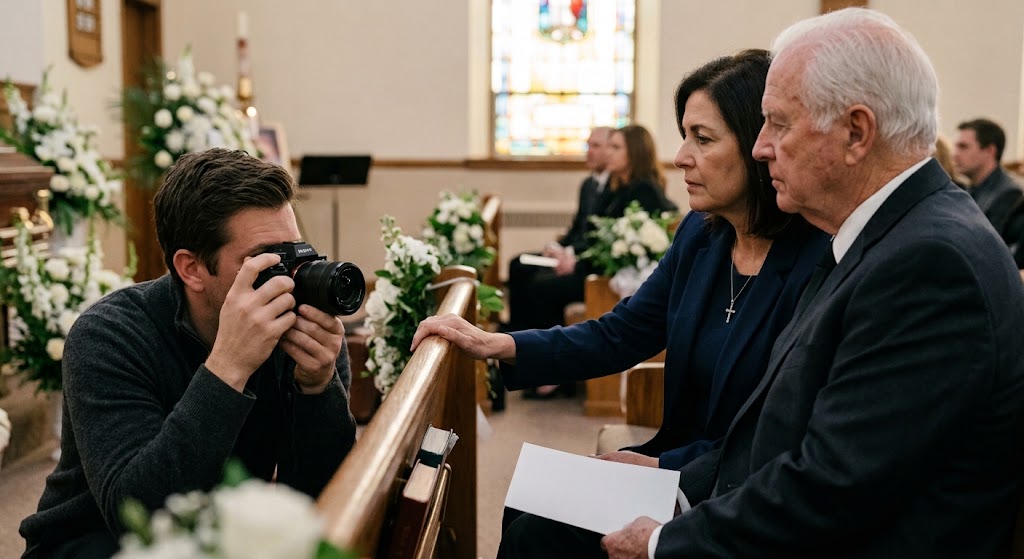
Photographing a funeral can be appropriate and deeply meaningful when the immediate family has asked for it and set clear boundaries.
The goal is not to document every expression of grief. It is to preserve the people, tributes, details, and acts of care that the family may not be able to take in during an emotional day.
That responsibility calls for consent, preparation, and restraint. Professional photographers and trusted friends who have been asked to help should let the family’s wishes guide every decision before, during, and after the service.
“Respectful funeral photography is less about capturing everything and more about knowing what the family wants remembered, what should remain private, and when to lower the camera.”
Quick answer: Funeral photography can be appropriate when the immediate family or authorized representative has clearly approved it. The photographer should agree on boundaries in advance, follow venue and religious rules, work discreetly, avoid private moments unless specifically approved, and share the images privately unless the family authorizes public use.
Is It Appropriate to Photograph a Funeral?
Yes, if the family has explicitly chosen to have the funeral or memorial service photographed.
Some families want a visual record because relatives cannot attend, because the gathering brings together people who rarely see one another, or because grief can make the details of the day difficult to remember.
Other families want no photography at all.
Neither choice needs to be justified.
A professional photographer’s presence does not give every guest permission to take pictures.
The family may prefer one designated person so photography stays quiet and the images remain private.
Why Families May Choose Funeral Photography
Funeral photographs can preserve more than the ceremony itself.
They may show:
- Who came to offer support
- Flowers and personal objects chosen for the tribute
- Military or veteran honors
- A meaningful reading or musical selection
- Relatives and friends comforting one another
The photographs can also help family members who could not be present understand how their loved one was honored.
With the family’s approval, selected images may later become part of a private album, a memorial photo board, a funeral program, or a digital tribute.
Photography is not right for every family, and it should never become another task they feel pressured to accept.
A good photographer makes the process easier, keeps choices simple, and gives the family control over what is captured and shared.
What to Discuss Before the Service
The most important work happens before anyone lifts a camera.
A short planning conversation prevents confusion and gives the photographer a clear understanding of the family’s priorities.
Get Clear Permission From the Family
Ask who has authority to approve the photography and who should be the photographer’s point of contact on the day.
The point of contact can answer questions without repeatedly approaching the closest mourners.
Confirm that the family wants photography at each part of the day.
Permission for the visitation does not automatically mean permission for the service, procession, graveside committal, or repast.
Create a Photo Plan and a Do-Not-Photograph List
Ask the family which people, moments, and details matter most.
Then ask the equally important question: What should not be photographed?
The plan may cover:
- Key relatives, friends, speakers, clergy, pallbearers, or military honor guards
- Flowers, memorial displays, the program, guest book, awards, uniforms, and meaningful objects
- Arrivals, readings, musical selections, eulogies, the procession, or graveside rites
- Any request for a family group portrait before or after the service
- Moments, people, rituals, or views that are off limits
- Whether the casket, urn, or deceased person may appear in any image
Separate approval: Explicit permission is especially important for an open casket or any photograph of the deceased. A general request to photograph the funeral should never be treated as automatic permission for those images.
Coordinate With the Funeral Home, Officiant, and Venues
Photography rules can differ among funeral homes, houses of worship, cemeteries, military services, and cultural traditions.
For a service in the United States, ask each venue and the officiant what is permitted.
Confirm:
- Where the photographer may stand
- Whether movement is restricted
- Which sacred or private moments should not be photographed
- Whether flash or other equipment is prohibited
Review the order of service and travel plan.
If the day includes more than one location, the photographer should know the route, parking arrangements, and timing before guests begin to move.
Decide How Guests Will Be Informed
Some families include a short note in the program or ask the officiant to announce that a designated photographer is present.
The message can explain that the photographs are for the family and will not be posted publicly without permission.
Guests should have a simple way to opt out.
The photographer can avoid clearly identifiable images of anyone who does not want to be included.
A Respectful Funeral Photography Shot List
A shot list is a guide, not a demand to capture every item.
The photographer should follow the family’s priorities and leave room for privacy.
Details Before Guests Arrive
Arriving early makes it possible to photograph meaningful details without intruding on mourners.
Depending on the family’s wishes, these images may include:
- The exterior and entrance of the venue
- Flowers, sympathy cards, and tribute arrangements
- A framed portrait, memorial table, or collection of personal items
- The funeral program, prayer card, guest register, or order of service
- Reserved seats, ceremonial objects, awards, medals, or a folded flag
- A wide view of the prepared room before the service begins
Detail photographs can tell the story of the day without exposing anyone’s grief.
They are also useful when the family wants to remember the careful choices made for the tribute.
People, Support, and Connection
When the family has approved photographs of guests, focus on connection rather than distress.
Quiet images of arrivals, embraces, hands held, speakers preparing, or friends gathered at the reception may feel more respectful than close views of a person in an intensely private moment.
Use distance and careful framing.
Photographing from the side or behind can preserve a gesture without making a grieving person feel observed.
The Service and Committal
The photo plan may include readings, music, the eulogy, religious or cultural rituals, the recessional, military honors, or the placement of flowers at the graveside.
The photographer should already know where to stand and when movement is appropriate.
At the cemetery, stay clear of the family’s sightlines and the funeral staff’s work.
Weather, uneven ground, and a moving procession can add practical challenges, so the photographer should prepare without turning the moment into a production.
A Group Portrait, Only When Requested
Some families value a photograph of relatives who have traveled from different places and may not gather again soon.
If the family requests one, plan it for a natural transition before or after the service.
Use calm direction and neutral language.
There is no need to ask anyone to smile.
What Should Not Be Photographed Without Explicit Approval?
Even when a family has requested funeral photography, certain images require separate discussion.
Do not photograph or share the following unless the family has clearly approved them:
- The deceased person or an open casket
- Close views of people in acute distress
- Children or other guests whose inclusion has not been cleared
- Private prayers, blessings, washing, dressing, or sacred rites
- Personal documents, addresses, phone numbers, or other identifying details
- Images that the venue, officiant, or cemetery prohibits
- Behind-the-scenes photographs intended for the photographer’s marketing
If a moment feels too private, lower the camera. Missing one image is better than creating a photograph the family wishes had never been taken.
How to Photograph a Funeral Quietly
Technical skill matters, but discretion matters more.
The photographer should be prepared to work in low light, make few adjustments, and avoid drawing attention.
Use Minimal, Quiet Equipment
Turn off the flash, focus-assist light, camera sounds, and review beeps.
Use silent or quiet shutter mode when the camera supports it and when that mode works reliably under the venue’s lighting.
Bring equipment you already know well.
A compact setup is easier to manage than a large collection of lenses, bags, and stands.
Low light may require:
- A wider aperture
- A slower shutter speed
- A higher ISO setting
Test the room before the service so technical decisions do not interrupt important moments.
Plan Positions and Limit Movement
Arrive early and identify a few locations that provide clear views without blocking guests.
Move during natural transitions, such as a musical selection ending or attendees changing locations.
Avoid walking across the center aisle, standing in front of the family, or repeatedly changing sides of the room.
Longer focal lengths can help the photographer work from the edges, but distance should never replace consent.
A discreet camera can still capture an unwanted image.
Dress to Blend In
Wear quiet, comfortable clothing that matches the tone the family has set.
Dark or neutral colors are often appropriate, but cultural expectations may differ.
Choose shoes that will not squeak or call attention to movement.
Stay Responsive to the Room
The photo plan is not more important than the people present.
If a guest turns away, raises a hand, or appears uncomfortable, stop.
If the officiant or funeral director asks the photographer to move, comply promptly.
Respect over coverage: Good funeral photography depends as much on recognizing when not to take a photograph as it does on technical ability.
What to Do With the Photos After the Funeral
The family’s control should continue after the service.
Handle the files with the same care used while taking them.
Back Up and Edit With Restraint
Create a backup as soon as practical.
Remove:
- Duplicates
- Test frames
- Unflattering expressions
- Accidental exposures
- Any image that crosses the boundaries discussed before the service
Editing should keep skin tones and the atmosphere natural rather than applying dramatic effects.
Before delivering sensitive images, consider asking the family contact whether they want them included.
A separate private folder can allow the family to review those images without placing them in the main gallery.
Share Privately First
Use a password-protected gallery, private download link, encrypted storage, or another delivery method the family approves.
Do not post funeral photographs on social media, a portfolio, or a business page without specific permission for the exact images being shared.
Give the family time.
They may want the images quickly, or they may not be ready to view them right away.
Agree on a realistic delivery date and let the family choose when to open the gallery.
Preserve Approved Images in a Lasting Tribute
When the family is ready, approved photographs can become part of a printed or digital remembrance.
Honor You helps families create personalized memorial products, including photo-rich programs, large displays, keepsakes, and digital tributes.
A carefully chosen image may work well in a reprinted program, a memorial keepsake, or a Memorial Scan that links relatives to family-approved memorial materials.
Confirm that the family has the right to use the images and that everyone pictured is treated with care.
Should You Hire a Professional or Ask a Friend?
A trusted friend may be a good choice when the family wants a few detail photographs and that person is comfortable with the responsibility.
The tradeoff is that the friend may spend much of the service working instead of mourning with the family.
A professional may be better when:
- The service spans several locations
- The lighting is difficult
- Important rituals must be anticipated
- The family wants a more complete, discreet record
When speaking with a photographer, ask about:
- Experience with funerals or quiet ceremonies
- Privacy practices
- Gallery security
- Backup equipment
- Turnaround time
- How image-use permission is handled
Review a full relevant gallery if one is available, not just a few dramatic portfolio images.
The photographer’s manner and willingness to follow boundaries matter as much as visual style.
Funeral Photography Planning Checklist
Before the service, confirm:
- The family has clearly approved photography.
- One person is the photographer’s point of contact.
- Every location and officiant has been consulted.
- The photographer has the timeline and travel plan.
- Priority people, moments, and details are listed.
- Off-limits moments and people are listed.
- Open-casket or deceased-person images have a separate yes or no.
- Guests will be notified and can opt out when appropriate.
- Flash, sound, and distracting equipment will be avoided.
- Delivery, storage, social sharing, and portfolio use are agreed upon.
Frequently Asked Questions About Photographing Funerals
Is It Okay to Take Pictures at a Funeral?
It is okay only when the immediate family or authorized family representative has given clear permission.
Guests should not assume that photography is welcome because someone else has a camera.
Who Can Give Permission for Funeral Photography?
Permission should come from the family member or representative responsible for the service.
The photographer must also follow each venue’s rules.
Can You Photograph an Open Casket or the Deceased?
Only with explicit approval.
A general request to photograph the funeral should not be treated as permission to photograph the deceased.
Confirm the family’s wishes in advance and follow them exactly.
Should Funeral Photos Be Posted on Social Media?
Not without specific family approval.
Private delivery should be the default, and identifiable guests in sensitive images should also approve any public sharing.
How Many Funeral Photos Should Be Taken?
There is no ideal number.
A careful selection that covers the family’s priorities matters more than a high image count.
Can Funeral Photos Be Used in Programs or Memorial Keepsakes?
Yes, when the family approves the use and has the necessary permission from the photographer.
High-resolution images with clear faces and uncluttered backgrounds usually reproduce best.
Honor You can help families turn selected photographs into custom funeral programs and other memorial pieces.
Preserve the Day With Consent and Care
Photographing a funeral is an act of service when guided by consent and care.
Let the family set the boundaries, follow the rules of each venue and faith tradition, work quietly, and give the family control over how the photographs are delivered and shared.
The most meaningful images are not necessarily the most dramatic. They are the photographs that help a family remember the people, details, and acts of support that surrounded them.
Honor You offers design-online and custom-help options for turning approved photographs into lasting tributes, including personalized memorial products, keepsakes, and digital memorial options.
