
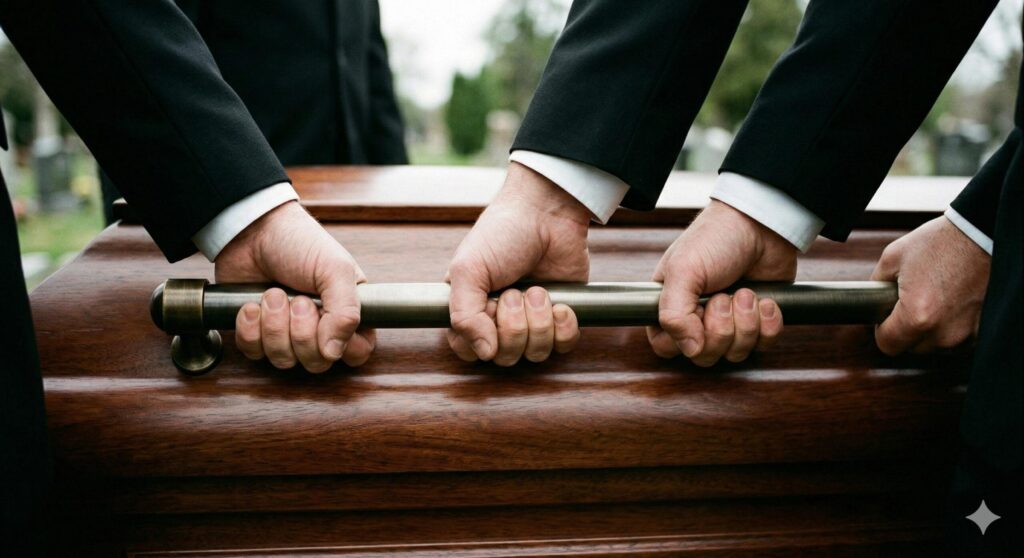
The pallbearer’s meaning refers to a person chosen to carry or escort a casket during a funeral or burial service. A pallbearer serves both a practical and symbolic role, assisting with transporting the deceased while representing honor, respect, and support for the grieving family.
Being asked to serve as a pallbearer is often considered a meaningful responsibility. Pallbearers are entrusted with helping during key moments of the funeral procession and graveside ceremony. They are typically selected by close family members and play an important part in funeral roles and responsibilities that ensure the service proceeds with dignity and order. While the role includes physical coordination and timing, it also carries emotional weight, as it represents a final gesture of care and tribute.
In this blog, you will learn what a pallbearer does, how many are needed, who can serve, what to wear, how honorary roles work, and how this position fits into the overall structure of a funeral service.
What Is a Pallbearer?
A pallbearer is a person selected to help carry a casket during a funeral or burial service. The term is often used interchangeably with casket bearer, meaning that both describe individuals responsible for transporting the coffin at specific stages of the ceremony.
The word “pall” originates from a cloth that was historically draped over a coffin. In earlier traditions, selected individuals would carry or hold the edges of this cloth as part of the procession. Over time, the role evolved to include physically lifting and transporting the casket itself.
Today, when people ask, “What is a pallbearer?” they are usually referring to someone who helps move the casket from the hearse into the service location and later to the gravesite. Pallbearers are commonly close friends, family members, or respected members of the community. Their presence reflects trust, closeness, and a final act of service to the person who has passed.
Image: https://imgur.com/a/eVVnQdJ
Alt: What is Pallbearer- The coffin is carried by pallbearers.
What Does a Pallbearer Do at a Funeral?
Understanding pallbearer duties provides clarity about both the logistical and ceremonial aspects of the role. While the responsibilities are straightforward, attention to detail and coordination are essential.
Before the Service
Pallbearers are typically expected to:
- Arrive early at the funeral home, church, or chapel
- Meet with the funeral director
- Receive instructions on positioning and lifting
- Coordinate their assigned handle placement
- Ask questions if unsure about timing or procedures
The funeral director will usually explain how to lift properly, how to move in unison, and where to stand during the ceremony. Being punctual is important, as delays can affect the entire service schedule.
During the Funeral Service
During the service, pallbearers typically:
- Carry the casket from the hearse into the venue
- Walk in the funeral procession at a slow, steady pace
- Maintain synchronized steps with the group
- Place the casket at the front of the chapel or church
- Stand respectfully if requested during certain moments
In many services, immediate family members either walk ahead of or behind the casket. Pallbearers must remain composed and focused, even during emotionally difficult moments.
At the Cemetery or Burial Site
At the graveside ceremony, responsibilities include:
- Carrying the casket from the hearse to the gravesite
- Placing it carefully on the lowering device
- Ensuring balanced placement before stepping aside
Once the casket is secured at the burial site, the pallbearers’ formal duties usually conclude. They then join the other guests in the remainder of the ceremony.
How Many Pallbearers Are Needed?
In most traditional funeral services, six pallbearers are selected. In some cases, eight may be chosen.
The number depends on several factors:
- The design and size of the casket
- The number of available handles
- The total weight being carried
- Family preference or cultural tradition
An empty casket can weigh between 150 and 250 pounds. When combined with the weight of the deceased, the total can exceed 300 pounds. Because of this, having enough individuals to evenly distribute weight is important for safety and balance.
If needed, funeral staff may discreetly assist with lifting. In some services, additional individuals are named as honorary pallbearers to recognize their closeness to the deceased without requiring them to participate in the physical task.
Who Can Be a Pallbearer?
There are no official qualifications required to serve as a pallbearer. The decision is typically made by the immediate family.
Common choices include:
- Adult children or grandchildren
- Siblings
- Close friends
- Colleagues
- Longtime community members
Physical ability should be considered, as the role involves lifting and walking steadily. Age is not strictly defined, but most pallbearers are physically mature adults.
Cultural and religious traditions may influence who is selected. However, many modern services prioritize closeness and trust over strict traditional expectations.
If someone feels uncertain about accepting the role due to physical limitations or emotional strain, it is appropriate to communicate openly with the family. Honesty ensures the ceremony proceeds smoothly and safely.
Can a Female Pallbearer Serve at a Funeral?
Yes, a female pallbearer can absolutely serve at a funeral.
Modern funeral services are not restricted by gender. While historical customs sometimes limited the role to men, contemporary practices reflect inclusivity and flexibility. Many families today choose both men and women to serve based on their relationship with the deceased.
Strength and coordination vary by individual, not by gender. What matters most is the person’s ability to safely assist and their connection to the departed.
Certain religious or cultural customs may differ, but in most communities, women serving as pallbearers is common and widely accepted.
Image: https://imgur.com/a/v4D7E1l
Alt: Female Pallbearers
Honorary Pallbearer Meaning and Role
The honorary pallbearer’s meaning refers to someone who participates symbolically without physically carrying the casket.
Honorary pallbearers may:
- Walk behind or alongside the casket
- Be acknowledged in the program
- Stand during specific portions of the ceremony
This role is often given to:
- Elderly family members
- Individuals with health concerns
- Close friends, when there are more than six or eight people who wish to be involved
Although honorary pallbearers do not assist with lifting, the recognition itself is meaningful. It allows more people to be formally honored without creating logistical challenges.
Funeral Roles and Responsibilities
A funeral service involves coordinated participation from several individuals. Understanding funeral roles and responsibilities helps clarify how pallbearers contribute to the overall ceremony.
Key participants often include:
- The funeral director, who oversees planning and logistics
- Clergy or officiant, who leads prayers and readings
- Musicians or vocalists
- Ushers, who guide guests
- Immediate family members
Pallbearers work closely with the funeral director to ensure smooth transitions between locations, whether from the funeral home to the church or from the chapel to the graveside.
During the planning process, families often recognize those serving in meaningful roles. When designing funeral program materials, it is customary to list the names of pallbearers and honorary pallbearers. Many funeral pamphlets include a section acknowledging these individuals as a sign of appreciation.
When deciding what include in a funeral program, families typically add the order of service, obituary, readings, acknowledgments, and the names of those entrusted with responsibilities such as casket carrying.
Including pallbearers in printed materials highlights their contribution and provides a lasting record of their role in honoring the deceased.
Is Being a Pallbearer an Honor?
Yes, serving as a pallbearer is widely considered an honor.
It represents:
- Trust placed by the family
- A close personal connection
- A final act of loyalty
- Visible support during a difficult time
For many people, this role becomes a deeply meaningful memory. While it can be emotionally challenging, it also provides a sense of purpose and participation in the farewell process.
What Should a Pallbearer Wear?
Appropriate attire is an important part of fulfilling the role respectfully.
Pallbearers are typically expected to wear:
- A dark suit or conservative formal attire
- A collared shirt and tie, when applicable
- A modest dress or formal suit for women
- Closed-toe, stable formal shoes
Footwear should provide balance, especially for outdoor graveside ceremonies. Avoid bright colors, flashy patterns, or distracting accessories.
In some cases, families may request coordination among pallbearers to maintain a uniform appearance.
Can You Decline Being a Pallbearer?
Yes, it is acceptable to decline being a pallbearer if necessary.
Valid reasons may include:
- Physical limitations
- Medical conditions
- Emotional difficulty
- Travel conflicts
- Scheduling constraints
If declining, communicate honestly and respectfully. Express appreciation for being asked and offer another way to support the family, such as helping with arrangements or attending the service.
Families generally understand that not everyone can safely perform the physical responsibilities.
Final Thoughts
Understanding the pallbearer’s meaning reveals that the role is both practical and symbolic. Pallbearers assist with carrying the casket during key moments of the funeral while representing honor, respect, and closeness to the deceased.
If you are planning a service and wish to thoughtfully recognize those serving in special roles, professionally prepared memorial materials can make a meaningful difference. Whether you are designing funeral program layouts, creating personalized funeral pamphlets, or deciding what include in funeral program details, having a carefully crafted tribute helps preserve memories with dignity.
You can explore personalized memorial and funeral program services at Honor You to create a beautifully presented remembrance that honors both your loved one and those who stand beside you.
Frequently Asked Questions About Pallbearers
Do pallbearers get paid?
Pallbearers are usually volunteers chosen by the family. They are not paid. If additional assistance is needed, funeral homes may provide professional staff.
Do pallbearers ride in the hearse?
No, pallbearers do not ride in the hearse. They typically travel separately and follow in the funeral procession.
How heavy is a casket?
An empty casket can weigh 150 to 250 pounds. With the weight of the deceased included, it can exceed 300 pounds.
Do pallbearers have to be family?
No. Pallbearers can be close friends, colleagues, or community members selected by the family.
What happens if someone cannot lift the casket?
Funeral staff can assist, or the individual may serve as an honorary pallbearer instead.
Do pallbearers stand during the service?
Sometimes. In some ceremonies, pallbearers stand briefly near the casket, then sit with other attendees.
What is the difference between a pallbearer and a casket bearer?
There is no difference. The terms are commonly used interchangeably.
