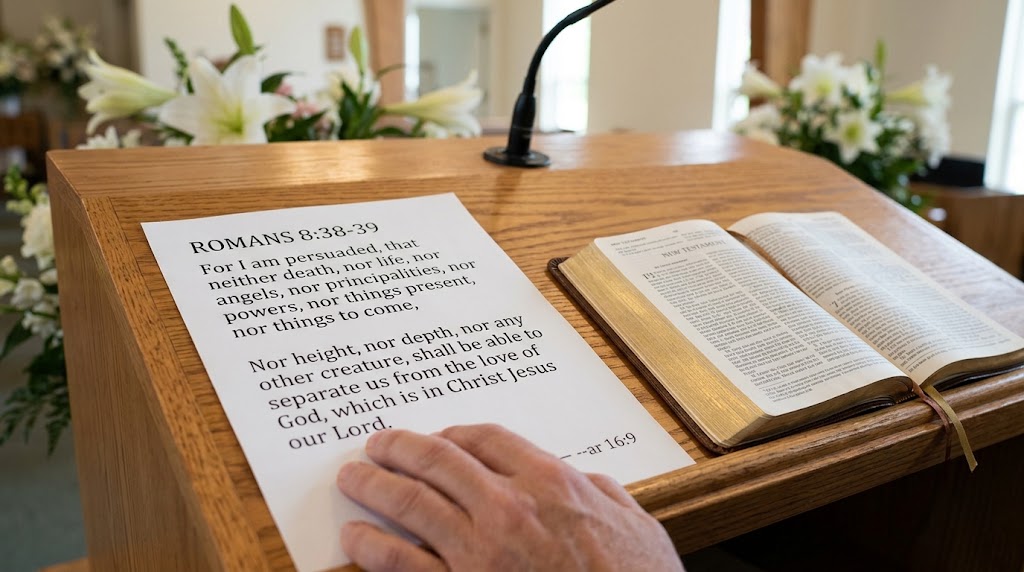
Choosing a New Testament scripture for funeral readings can be difficult when your family is grieving. The words of Jesus and the apostles offer a way to acknowledge sorrow while expressing the Christian hope of resurrection, lasting love, and eternal life. Whether you are preparing a funeral Mass, a Protestant memorial service, or a simple graveside farewell, the most meaningful reading is one that speaks clearly to your family and the life you are honoring.
Four familiar starting points are John 14:1–3, in which Jesus promises a place in his Father’s house; Romans 8:38–39, about the love of God that death cannot sever; 1 Corinthians 15:54–57, celebrating victory over death; and Revelation 21:4, envisioning an end to tears and mourning. Below, these and other passages are organized by biblical book and their practical place in a service.
Top New Testament Funeral Readings (Quick Reference)
John 14:1–3 — A place prepared
“Let not your heart be troubled.” (KJV, verse 1)
Jesus reassures his disciples that he is preparing a place for them. It is especially appropriate as a Gospel reading when the family wishes to emphasize heavenly welcome and continuing faith.
Romans 8:38–39 — Inseparable love
“Neither death, nor life” can separate believers from the love of God (KJV excerpt).
Paul’s assurance offers steadiness when a death has left loved ones feeling vulnerable or afraid. It emphasizes God’s enduring relationship with his people.
1 Corinthians 15:54–57 — Victory over death
“Death is swallowed up in victory.” (KJV, verse 54)
Paul’s resurrection teaching provides a powerful conclusion to a Christian service, particularly when the family wants to proclaim hope rather than treat death as the final word.
Revelation 21:4 — No more mourning
“And God shall wipe away all tears from their eyes.” (KJV excerpt)
This vision of renewal is often chosen for closing reflections, printed programs, and memorial cards because it gives sorrow a future horizon.
For a wider selection that includes Psalms and other books, see our funeral Bible verses guide.
Gospel Readings: The Words and Promises of Jesus
The Gospels provide particularly personal readings because they preserve Jesus’ words to people facing fear, bereavement, and uncertainty. In liturgical churches, a Gospel passage often forms the centerpiece of the Scripture readings and is proclaimed by an authorized minister.
John 11:25–26 — I am the resurrection and the life
Jesus speaks to Martha after the death of her brother Lazarus. The passage is not detached from grief: Martha is mourning when Jesus declares his authority over death. It is a strong choice for a funeral focused on resurrection, and the wider scene in John 11:21–27 gives a reader useful context.
John 14:1–6 — The way, the truth, and the life
Speaking to troubled disciples, Jesus describes his Father’s house and promises to prepare a place. Verse 6 continues with his declaration that he is the way, the truth, and the life. The passage is well suited to a formal Gospel reading, especially where the family wants a clear statement of Christian faith.
Matthew 11:28–30 — Rest for the weary
“Come unto me, all ye that labour and are heavy laden, and I will give you rest.” (KJV, verse 28). These words invite people carrying emotional and spiritual burdens to find rest in Christ. They are gentle enough for a small memorial or a family service marked by exhaustion and sadness.
Matthew 5:3–12 — The Beatitudes
Jesus blesses those who mourn, the merciful, the meek, and the peacemakers. This passage may reflect a loved one remembered for compassion, humility, or peacemaking. It also reminds those attending that mourning is not a failure of faith.
John 6:37–40 — Raised on the last day
Jesus speaks of receiving those who come to him and raising them up on the last day. Its direct connection between belonging to Christ and resurrection makes it particularly appropriate for traditional Christian funeral liturgies.
Luke 23:39–43 — Remember me
In the crucifixion account, Jesus responds to the repentant criminal with a promise of paradise. This reading may be meaningful when the family wishes to emphasize grace and mercy rather than a catalogue of earthly accomplishments.
John 10:27–30 — Held securely
Jesus describes his sheep hearing his voice and receiving eternal life. The image of being held in his care may comfort families who feel overwhelmed by the finality of separation.
The Epistles: Faith, Comfort, and the Hope of Resurrection
The letters of Paul and other New Testament writers explain what the resurrection of Jesus means for believers. They offer rich readings for a sermon, a family tribute, or the New Testament reading before the Gospel in a formal service.
Romans 8:31–39 — Nothing can separate us from God’s love
This passage asks who can separate believers from the love of Christ and answers with a sweeping assurance. It does not promise a life without hardship; it declares that hardship, including death, cannot undo God’s love. Romans 8:31b–35, 37–39 is also a recognized Catholic funeral reading selection.
1 Thessalonians 4:13–18 — Grieving with hope
Paul addresses the sorrow of a community whose members have died. His point is not that Christians should never mourn, but that resurrection hope changes the way they face loss. This is an especially suitable passage for families who want to acknowledge their sadness honestly.
2 Corinthians 5:1–8 — An eternal home
Paul compares the present body to an earthly tent and speaks of an enduring dwelling from God. His language about being away from the body and at home with the Lord is familiar at funerals. A reader can emphasize the contrast between the fragility of earthly life and the hope of lasting communion with Christ.
1 Corinthians 15:20–26, 51–57 — Resurrection and transformation
This chapter develops Paul’s teaching that Christ has been raised and that death will ultimately be defeated. The shorter closing section is especially memorable when read aloud. It is fitting for a committal service or a funeral sermon that looks beyond burial to resurrection.
2 Timothy 4:7–8 — I have finished the race
“I have fought a good fight, I have finished my course, I have kept the faith.” (KJV, verse 7). This tribute works well when remembering someone who served faithfully for many years. It is also a natural anchor for a personal eulogy, although its original context is Paul’s reflection on his own ministry.
Philippians 1:21–23 — To live is Christ
Paul reflects on living in service and his desire to be with Christ. This passage can suit a memorial for someone whose faith shaped daily choices. Because it speaks directly about death and devotion, it should be introduced sensitively rather than used to minimize the family’s loss.
Philippians 3:20–21 — Our citizenship is in heaven
Paul speaks of heavenly citizenship and the transformation of the body. It can provide a brief, clear reading for a graveside committal or the end of a service.
2 Corinthians 1:3–4 — Comfort shared with others
God is described as the source of mercy and comfort, and believers are encouraged to comfort others. This reading places special value on the family, friends, and community who gather around those who mourn.
If you need something briefer, browse our short comforting Bible verses for the death of a loved one.
Revelation: The Promise of a New Heaven and New Earth
The book of Revelation uses vivid symbolic imagery to describe God’s ultimate renewal of creation. At a funeral, its visions can move the focus from present pain toward promised peace without dismissing the reality of loss.
Revelation 21:1–7 — Every tear wiped away
John describes a new heaven and new earth, with God dwelling among his people. The promise that death, mourning, crying, and pain will pass away makes this a moving final reading. The full passage offers a richer setting than quoting verse 4 alone.
Revelation 14:13 — Rest from labor
This verse blesses those who die in the Lord and speaks of rest from their labors. It is often meaningful when honoring a person remembered for lifelong service, caregiving, or faithful work.
Revelation 7:15–17 — The Lamb who shepherds
The Lamb guides his people to living water, and God wipes away their tears. Its shepherd imagery creates a connection with Psalm 23, making it a thoughtful choice when a family wants both Old and New Testament readings.
New Testament Readings by Service Placement
The same scripture can serve different purposes depending on where it appears. Use the following reference table when planning a service folder or discussing readings with your officiant. The exact order and permitted selections depend on the denomination.
| Service Element | Recommended Scripture | Primary Theme |
|---|---|---|
| New Testament / Epistle reading | Romans 8:31b–35, 37–39; 1 Thessalonians 4:13–18 | Assurance and hope amid grief |
| Gospel reading | John 11:21–27; John 14:1–6 | Jesus’ promise of resurrection and a prepared home |
| Eulogy or personal tribute | 2 Timothy 4:7–8; Philippians 1:3–6 | Faithful perseverance and grateful remembrance |
| Graveside committal | 1 Corinthians 15:51–57; Philippians 3:20–21 | Resurrection and transformation |
| Printed program or memorial card | Matthew 11:28; Revelation 21:4 | Rest, comfort, and lasting peace |
Practical Tips for Selecting and Reading New Testament Passages
Check denominational requirements
Catholic, Anglican or Episcopal, Lutheran, and Orthodox traditions may follow appointed readings and prescribed roles for readers. A Catholic parish will normally provide options from its funeral lectionary; a Protestant or nondenominational congregation may allow broader choices. Before printing the order of service, confirm the scripture references and reader assignments with the officiant. For Catholic families, the USCCB New Testament readings for Masses for the Dead provide a useful official reference.
Choose a translation the congregation can follow
The NIV, ESV, and NRSV or NRSVue offer readable modern English, while the King James Version has a traditional cadence that many families find familiar. Catholic liturgies typically require the approved lectionary translation rather than an independently chosen Bible edition. The brief direct quotations in this guide use the public-domain KJV; always identify the translation when reproducing a passage.
Prepare the reader with care
Print the reading in a large, clear font and rehearse it aloud at least once. Mark pauses at the end of sentences and give important phrases room to settle. Speak slightly more slowly than in ordinary conversation, project toward the back of the room, and avoid rushing when emotion rises. If you become tearful, pause, breathe, and continue when ready. Having a backup reader can relieve pressure.
Keep the reading personal without changing the text
A family member may introduce a reading by saying why it mattered to the person who died, but should avoid altering the scripture itself. In a eulogy, a brief personal story can be followed by 2 Timothy 4:7 or Philippians 1:3. For printed memorial materials, check the length, readability, and copyright permissions before selecting a full modern translation.
Our funeral prayer card verse ideas and uplifting Bible verses may help with shorter keepsake wording.
Frequently Asked Questions About New Testament Funeral Scriptures
What is the difference between Old Testament and New Testament funeral readings?
Old Testament passages such as Psalm 23 and Ecclesiastes 3 often express lament, trust, and the changing seasons of life. New Testament readings place particular emphasis on Jesus’ resurrection, God’s grace through Christ, and the Christian hope of eternal life. Both can provide meaningful comfort.
What is the best Gospel reading for a Catholic funeral Mass?
John 14:1–6 and John 11:21–27 are familiar and meaningful choices because they speak directly about the Father’s house and Jesus as the resurrection and the life. Your parish can confirm which readings are approved and available for the service.
What is a short New Testament verse for a funeral card or bookmark?
2 Corinthians 5:7, “For we walk by faith, not by sight” (KJV), and Revelation 21:4, about God wiping away tears, are concise choices. Matthew 11:28 is another gentle option, particularly for a family seeking words of rest.
Can a non-clergy family member read New Testament scripture at the service?
In many Protestant and nondenominational services, a chosen family member or friend may read scripture. At a Catholic funeral Mass, qualified lay readers may proclaim non-Gospel readings, while the Gospel is reserved for a deacon or priest. Other traditions have their own rules, so check with the officiant.
How many New Testament readings should a funeral include?
The number varies by denomination and service format. A brief memorial might use one Gospel passage and one additional reading, while a formal liturgy follows its prescribed structure. A shorter, thoughtfully chosen selection is often more meaningful than many overlapping passages.
Choosing Words of Hope for a Lasting Farewell
There is no single New Testament funeral reading that fits every family. John 14 may express the reassurance you need, Romans 8 may reflect the strength of a loved one’s faith, and Revelation 21 may provide words for the hope you carry forward. Select a passage that honors the person who has died and makes room for the grief of those who remain.
Explore more funeral scripture inspiration, and visit Honor You reviews when considering memorial stationery and keepsakes.