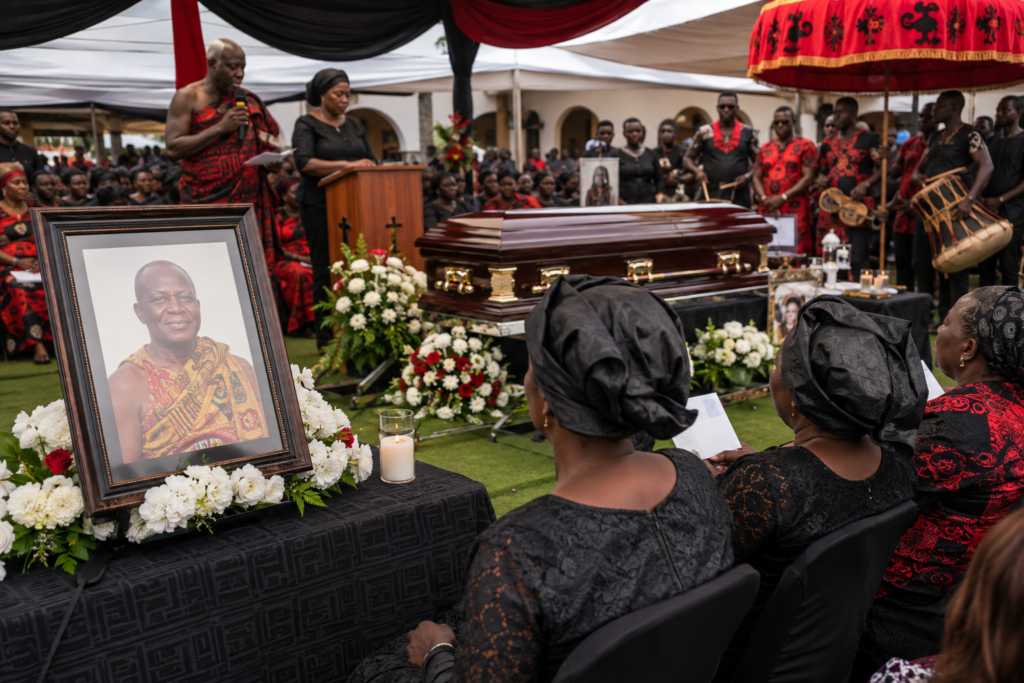
A Ghanaian funeral can bring together grief, faith, family responsibility, cultural identity, and public remembrance. A family may hold several gatherings rather than one ceremony, with relatives and community members taking active roles in planning, mourning, worship, music, hospitality, and remembrance.
For Ghanaian families in the United States, honoring these traditions may require adapting the timing and format to local funeral homes, churches, mosques, cemeteries, work schedules, and travel needs. The aim is not to recreate every custom. It is to understand what matters to the family and preserve those elements with care.
“There is no single Ghanaian funeral format. Traditions vary by family, ethnic community, faith, hometown, and the circumstances of the death.”
Quick answer: Ghanaian funerals may include family consultations, a one-week observance, wake or viewing, religious or traditional rites, burial, food, music, dancing, thanksgiving services, and later remembrance. Customs vary widely, so families and guests should follow the guidance of relatives, elders, clergy, and community leaders rather than assume one tradition applies to everyone.
Why Ghanaian Funeral Traditions Vary
There is no single format followed at every Ghanaian funeral.
Customs can differ by ethnic group, hometown, region, religious faith, family lineage, age or status of the deceased, and the circumstances of the death.
Ghana’s 2021 census recognizes nine major ethnic groups and several religious affiliations, a useful reminder that no one ceremony can represent the whole country.
An Akan Christian family may organize a service differently from a Ga family, an Ewe family, a Frafra family, or a Muslim family from northern Ghana. Even two families from the same community may make different choices.
Diaspora families may also combine Ghanaian and American practices. University of Ghana research describes how migration can create multiple sites for funeral rites and transform how families participate across distance.
What Happens at a Ghanaian Funeral?
Many Ghanaian funeral customs reflect the idea that a death affects an extended network of relatives and community members.
The funeral honors the deceased, supports those who are grieving, and recognizes the person’s relationships to family, faith, profession, hometown, and social community.
Mourning and celebration of a life can exist together. Tears, solemn prayers, and quiet reflection may be followed by drumming, singing, dancing, storytelling, or a shared meal.
Livelier moments do not mean the loss is taken lightly. Music, dancing, storytelling, and food may express gratitude for the life that was lived while giving the community a way to carry grief together.
Family Consultation and the Death Announcement
News of the death may first be shared with key relatives and family leaders.
The family can then discuss responsibilities, burial wishes, religious guidance, finances, and the location and timing of the funeral.
In the United States, that conversation may include relatives in Ghana and other countries. A small authorized decision-making group can prevent confusion when many people want to contribute.
Once the family agrees on the details that can be shared, a printed or digital funeral announcement can communicate:
- The deceased person’s name
- A photograph
- Service dates and times
- Venue information
- Family or organizer contact details
Funeral announcements are especially useful when relatives are spread across several states or countries.
The One-Week Observance
Some Ghanaian families, particularly in Akan communities, hold a gathering around a week after the death.
The observance may allow relatives to mourn together, formally acknowledge the death, receive visitors, collect contributions, and begin or confirm plans for the main funeral.
The exact date and format vary. Some families hold a large public event. Others keep it small or adapt it to a prayer service, family meeting, or virtual gathering.
Important: A one-week observance is associated with some Ghanaian families and communities, particularly certain Akan traditions, but it should not be presented as a practice followed by every Ghanaian family.
Wake, Viewing, or Laying in State
Some funerals include a wake, viewing, vigil, or laying in state before burial.
This may take place at a funeral home, church, family residence, or community venue.
The gathering can include:
- Hymns
- Traditional songs
- Prayers
- Scripture readings
- Tributes
- Opportunities to view the deceased
Close relatives may wear coordinated cloth or clothing selected by the family.
Photographs, memorial posters, and keepsakes may help tell the person’s story. The family should approve which images and cultural symbols are displayed.
Funeral Service, Procession, and Burial
The main service may be Christian, Muslim, traditionally led, or shaped by more than one tradition.
A Christian service might include:
- A procession
- Prayers
- Hymns
- Scripture readings
- A biography or obituary
- Tributes
- A sermon
- Acknowledgments
- A committal
Other families may include libation, traditional music, or rites led by elders.
Muslim services may follow a shorter timeline and Islamic requirements for prayer and burial.
At the burial, the mood may become more solemn. Family members and guests should follow the directions of the clergy, funeral director, elders, or designated master of ceremonies.
Post-Burial Gathering, Thanksgiving, and Later Remembrance
A gathering after burial may include food, music, dancing, speeches, and contributions to the family.
Some Christian families also hold a Sunday thanksgiving service. Other families observe final rites or later anniversaries.
Each gathering can serve a different religious, social, or commemorative purpose.
Differences by Community, Faith, and Family
A respectful guide or funeral plan should distinguish examples from rules.
Akan Communities
Among many Akan families, including Ashanti, Fante, Akuapem, Akyem, and Bono communities, the extended family may play a strong role in decisions.
One-week observances, coordinated mourning cloth, family contributions, wake-keeping, and large community gatherings may be important, but not every Akan family uses the same format.
Ga Communities
Ga funeral traditions are often associated with Accra and surrounding coastal communities.
International media frequently focuses on figurative or fantasy coffins shaped to represent a person’s occupation, identity, or interests.
These coffins have a strong connection to some Ga artisans and traditions, but they are not used at every Ga funeral and are not a custom shared by all Ghanaians.
Ewe and Northern Ghanaian Traditions
Ewe customs can differ across communities and may include particular family, spiritual, musical, and post-burial practices.
Northern Ghana includes many ethnic and religious traditions, including Muslim communities whose funeral timing and rites may differ from the longer schedule associated with some southern Ghanaian funerals.
Religion and Family Practice
Christianity, Islam, and traditional religions may each influence a service.
Some families combine church worship with cultural rites, while others follow one faith tradition closely.
Ask what the family practices instead of assuming that ethnicity alone determines the ceremony.
Ghanaian Funeral Attire, Colors, and Guest Etiquette
Black, red, white, and combinations of these colors appear in many photographs and descriptions of Ghanaian funeral clothing, but their use is not fixed across every family.
In some Akan and Asante settings, black and red cloth may be connected with mourning or a close family role.
White or black-and-white clothing may be selected for a thanksgiving service or another gathering focused on gratitude and peaceful transition.
Meanings vary, and the family’s invitation or designated spokesperson is the authority.
Guest Etiquette
Guests can show respect through a few practical choices:
- Arrive at the requested time, recognizing that different gatherings may have different schedules.
- Follow family instructions about seating, processions, greetings, and participation.
- Offer condolences briefly and sincerely.
- Ask before photographing or recording the deceased, mourners, rituals, children, or private family moments.
- Do not describe music and dancing as entertainment without recognizing their role in remembrance.
- Avoid assumptions about the family’s faith, ethnic identity, dress code, or ceremonial expectations.
- Confirm whether a financial contribution, sympathy card, flowers, food, or another form of support is preferred.
How to Plan a Ghanaian Funeral in the United States
A Ghanaian funeral in the U.S. may combine traditional expectations with local requirements. Clear roles and early communication make that process easier.
1. Identify the Family Decision-Makers
Choose a small group authorized to approve dates, venues, expenses, printed materials, and ceremonial details.
Include relevant relatives in Ghana, but give one person responsibility for collecting and sharing final decisions.
2. Define the Cultural and Religious Priorities
Ask which elements are essential.
These may include:
- A one-week observance
- Wake or viewing
- Church or mosque service
- Traditional music
- Coordinated clothing
- Burial gathering
- Sunday thanksgiving
- Anniversary remembrance
Separate essential elements from optional ones so the plan reflects the family without placing every decision under equal pressure.
3. Decide What Will Happen in the U.S., Ghana, or Both
A family may hold the main service and burial in one country, divide events between two countries, or organize parallel remembrance gatherings.
Confirm which site has responsibility for each rite, announcement, payment, and approval.
4. Coordinate With Local Professionals
Discuss the planned schedule with the funeral home, clergy, cemetery, musicians, caterer, venue, and other providers.
Confirm which cultural practices can be accommodated, who will lead each part, and how much time the venue allows.
If remains will be transported from the United States to Ghana, obtain current instructions from the funeral director, airline, and Embassy of Ghana.
International transport: Documentation, airline, health, and transport requirements can change. Use current instructions from the funeral director, carrier, and Embassy of Ghana rather than relying on an old checklist.
5. Build One Shared Schedule
Create a single timeline showing:
- Each gathering
- Venue
- Start time
- Contact person
- Expected participants
Include time-zone information for relatives joining from Ghana or elsewhere.
If an event will be streamed, assign one person to manage the link, sound check, access instructions, and recording permissions.
6. Gather Photos, Tributes, and Service Information Early
Ask relatives to submit photographs, the obituary, acknowledgments, scripture, songs, tributes, and the order of service by a firm deadline.
Choose one editor to confirm:
- Name spellings
- Titles and honorifics
- Dates
- Ghanaian place names
- Family relationships
- Translations
Families can use guidelines for writing an obituary or seek professional obituary writing support when they need help shaping the life story.
7. Approve Materials Before Printing or Sharing
Have the authorized family reviewers check:
- Names and honorifics
- Lineage or clan references
- Translations
- Symbols and colors
- Photographs
- Livestream access
- QR links
A final family review protects both accuracy and privacy.
What to Include in a Ghanaian Funeral Program
A funeral program guides guests through the service and preserves details that may matter to the family for years.
A custom funeral program can include:
- The deceased’s full name, photograph, and birth and death dates
- Service dates, times, locations, and contact details
- A clear order of service
- An obituary or life story
- Family, church, association, and community tributes
- Scripture, prayers, poems, proverbs, or traditional sayings approved by the family
- Hymns, songs, and musical selections
- Names of clergy, speakers, pallbearers, flower bearers, and other participants
- Acknowledgments from the family
- Burial, reception, thanksgiving, or later-event information
- Family-approved clothing guidance, symbols, and colors where appropriate
- An optional livestream or QR-code digital memorial link, shared with the family’s consent
Ghanaian names, honorifics, hometowns, stool or family titles, and the names of associations or churches should be carefully proofread.
Ask relatives familiar with the language and family history to review Twi, Ga, Ewe, Fante, or other Ghanaian-language text before printing.
Families who prefer a do-it-yourself starting point can review free funeral program templates.
Prayer cards, wake cards, memorial posters, or photo boards may also help guests remember the person’s family life, work, faith, and community contributions.
Create a Tribute That Reflects the Person
The most meaningful memorial materials begin with the person’s own story, not a generic idea of Ghanaian culture.
Gather the details that family and friends will recognize:
- Favorite photographs
- Work and service
- Faith
- Relationships
- Hometown connections
- Music
- Favorite sayings
- Colors
- Family-approved cultural symbols
Honor You creates funeral programs, announcements, prayer cards, memorial displays, keepsakes, and digital tributes for families across the United States.
Families can personalize materials online or request design assistance, then review a proof before printing.
When your family is ready, begin with the approved names, dates, photos, readings, tributes, and order of service, then explore custom funeral programs or submit a custom order for designer support.
Families can also visit Honor You’s grief and loss resources for additional support.
Frequently Asked Questions About Ghanaian Funerals
How Long Does a Ghanaian Funeral Last?
There is no standard length.
The main service and burial may occur in one day, while related observances can span a weekend or take place on separate dates. Family, ethnic, religious, and travel considerations all affect the schedule.
What Should a Guest Wear to a Ghanaian Funeral?
Ask the family for the designated colors and clothing guidance.
Black, red, white, and black-and-white may be used in some settings, but a family may choose a specific cloth or color for each event.
Why Are Red, Black, or White Worn at Some Ghanaian Funerals?
Meanings differ by family and community.
In some Akan and Asante contexts, black and red cloth may be associated with mourning, while white or black-and-white may be used for thanksgiving or another later gathering.
Follow the family’s guidance rather than applying one meaning nationwide.
What Is a Ghanaian One-Week Observance?
Some families hold a gathering around a week after the death.
It may allow the family to mourn, receive visitors, announce the death formally, collect support, and begin or confirm funeral arrangements.
The practice and timing are not universal.
Are Ghanaian Funerals Celebrations?
A funeral may include music, dancing, food, storytelling, and gratitude for the person’s life, but it is also a time of real grief.
It is more accurate to say that mourning and celebration of a life can coexist in some ceremonies.
Do Guests Give Money at a Ghanaian Funeral?
Financial contributions are customary in some families and communities, but expectations and recordkeeping vary.
Ask a trusted family contact what support is appropriate and how a contribution should be given.
Do All Ghanaian Funerals Use Fantasy Coffins?
No.
Figurative coffins are strongly associated with some Ga traditions and artisans in the Accra area, but they are not used by every Ga family or by all Ghanaians.
Can Remains Be Sent From the U.S. to Ghana?
Yes, when current legal, health, documentation, airline, and transport requirements are met.
Confirm the process with the funeral director, airline, and Embassy of Ghana before making plans.
Final Thoughts
Ghanaian funerals can bring together faith, ancestry, extended family, community responsibility, music, clothing, remembrance, and hospitality in deeply meaningful ways.
At the same time, there is no single Ghanaian funeral tradition that applies to every family.
For families planning in the United States, the strongest approach is to identify the traditions that matter most, involve the right relatives and community leaders, coordinate early with local providers, and carefully review every printed or digital detail before it is shared.
The goal is not to reproduce a generic version of Ghanaian culture. It is to create a respectful tribute that reflects the person, the family, their faith, and the traditions they want to carry forward.