There is no reliable scientific evidence that funeral homes are haunted or more likely to contain paranormal activity than other buildings.
Still, people sometimes report:
- Footsteps
- Voices
- Moving shadows
- Cold sensations
- The feeling that someone else is in the room
Those experiences may be interpreted as spiritual, psychological, environmental, or some combination of the three.
A person’s faith, culture, grief, expectations, and knowledge of the building can all shape what the experience means.
Are Funeral Homes Really Haunted?
No reliable evidence shows that working funeral homes are inherently haunted.
Reports of paranormal activity are personal accounts rather than scientific proof that a spirit is present.
That distinction does not mean an experience felt unreal to the person who had it.
A:
- Noise in an empty chapel
- Familiar scent
- Sudden sense that a loved one is nearby
- Shadow seen at the edge of someone’s vision
can feel vivid and emotionally powerful.
The emotional impact of an experience can be real even when its cause cannot be confirmed.
People also approach death through different belief systems.
One person may understand a sensed presence as a comforting visit from someone who died. Another may understand the same experience as part of grief, memory, expectation, or the environment.
A respectful answer leaves room for those differences while remaining clear about the limits of available evidence.
“An unexplained experience can be meaningful without automatically becoming proof of paranormal activity.”
Why Funeral Homes Can Feel Haunted
Funeral homes bring together several conditions that can make ordinary sensations feel unusual.
The setting is associated with death, visitors may be grieving or tired, and many parts of the building are quiet or unfamiliar.
Death Makes Us More Alert to the Unfamiliar
Most people do not spend much time in funeral homes.
When someone enters one, they may already feel tense because they are:
- Facing a recent loss
- Preparing to view a deceased loved one
- Entering an unfamiliar social setting
- Unsure what will happen during the service
That heightened emotional state can increase attention to details that might pass unnoticed elsewhere.
A settling floorboard, reflection in a glass door, or movement at the edge of someone’s vision may seem more significant in a place already strongly connected with death.
Quiet Buildings Produce Ambiguous Sights and Sounds
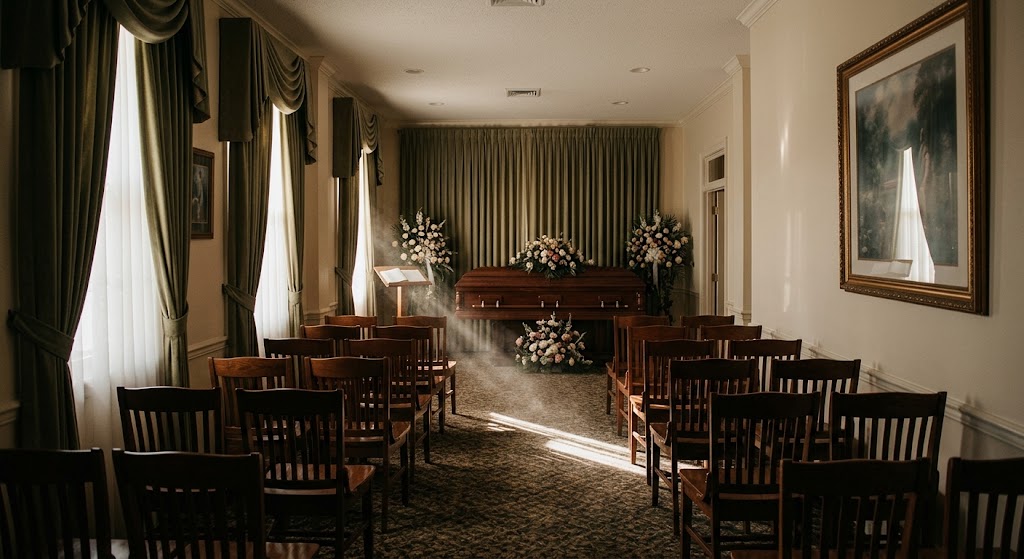
Some funeral homes operate inside older houses or historic buildings.
They may contain:
- Long hallways
- Aging pipes
- Radiators
- Heating and ventilation systems
- Elevators
- Refrigeration equipment
- Doors affected by air pressure
- Wood floors and walls that expand or contract
After a service or late at night, small sounds can become easier to hear.
A building may creak as temperature changes, plumbing may knock, and reflections may move across windows when a vehicle passes outside.
A review in Frontiers in Psychology examining research on allegedly haunted environments discusses factors including:
- Lighting
- Air quality
- Temperature
- Infrasound
- Electromagnetic fields
The research findings across this literature have often been inconsistent or weak, so no single environmental factor explains every report.
However, the research demonstrates why ordinary environmental conditions should be considered before reaching a paranormal conclusion.
Stories Shape What We Expect to Notice
Expectations can influence attention.
If someone is told that a funeral home is haunted before entering, they may begin listening for footsteps, watching doorways, or paying special attention to shadows.
A sound that would be ignored inside an office may feel much more significant inside a funeral chapel.
This does not mean the person is inventing the experience.
It means that expectations influence what people notice and how they interpret ambiguous information.
Funeral homes are also strongly associated with ghosts in:
- Movies
- Television
- Folklore
- Halloween attractions
- Urban legends
That cultural association gives people a ready-made explanation for unusual sights or sounds.
Grief Can Include a Sense of Presence
A bereaved person may:
- Dream about someone who died
- Briefly hear their voice
- Notice a familiar scent
- Feel that the person is nearby
Researchers use several terms for these experiences, including sensory experiences of the deceased and a sensed presence.
An interdisciplinary review published in Schizophrenia Bulletin found that these experiences are frequently reported during bereavement and that the vast majority are benign.
The authors emphasize that each experience should be understood within the person’s relationships, life story, and cultural context.
A funeral home may be where the reality of death feels especially close.
For some people, a sense of connection is comforting. For others, it may feel unsettling.
Neither response should be mocked, and neither response by itself proves that a haunting has occurred.
Grief-related experiences can feel vivid and meaningful. Treating them respectfully does not require claiming that they prove the existence of ghosts.
Why Funeral Homes Attract So Many Ghost Stories
Funeral homes occupy an unusual place between private loss and public ritual.
They care for the deceased while helping the living gather, remember, mourn, and say goodbye.
That role naturally attracts stories about spirits and questions about what may happen after death.
Several factors help funeral-home ghost stories persist:
- Death remains mysterious even when the practical work surrounding it is understood.
- Some funeral homes operate in large historic buildings that once served as family residences.
- Funeral professionals may work during quiet evening or overnight hours.
- Visitors rarely see staff-only areas, which can make funeral work feel secretive.
- Horror stories frequently use mortuaries, cemeteries, and funeral parlors as settings.
- Communities may preserve ghost stories as part of local history or personal belief.
Online collections often describe:
- Doors opening
- Lights flickering
- Voices in apparently empty rooms
- Figures appearing in hallways
- Objects appearing to move
Most such stories depend primarily on personal testimony or retelling rather than independent documentation.
The more dramatic a story becomes, the easier it is to lose an important distinction:
Active Funeral Homes and Former Funeral Homes Are Different
Many stories about haunted funeral homes actually involve former mortuaries that were later converted into:
- Private houses
- Bars or restaurants
- Hotels
- Tourist attractions
- Halloween attractions
- Abandoned properties
The history of the building may be documented while the claim that it is haunted remains disputed.
An active funeral home is very different.
It is a functioning workplace where staff coordinate:
- Care of the deceased
- Family arrangements
- Transportation
- Paperwork
- Visitations and funerals
- Burial and cremation arrangements
- Communication with families and service providers
It is also useful to correct a common assumption.
People generally die in places such as:
- Private homes
- Hospitals
- Hospice facilities
- Nursing homes
- Assisted-living facilities
- Other locations
before being transferred into a funeral home’s care.
A funeral home is therefore usually not the place where the death itself occurred.
That fact does not resolve a spiritual question, but it does correct one assumption behind some funeral-home ghost stories.
What a Funeral Home Is Actually Like
A working funeral home is a place of care, coordination, administration, and remembrance.
Staff may:
- Confirm the identity of the deceased
- Meet with relatives
- Complete authorizations and paperwork
- Prepare the deceased for burial or cremation
- Coordinate visitations
- Arrange funeral ceremonies
- Coordinate with cemeteries and crematories
- Arrange transportation
- Help families with memorial details
In the United States, exact duties, authorizations, and operating requirements vary by state and provider.
Honor You’s guide to how funeral homes work explains that process in more detail.
Behind the quiet public rooms is an active professional environment.
Much of what can seem mysterious from the outside is ordinary work performed discreetly to protect:
- Family privacy
- Confidential information
- Health and safety
- The dignity of the deceased
How to Think About an Unexplained Experience
An unexplained event does not require an immediate conclusion.
If you hear or see something strange inside a funeral home, consider a few questions before deciding what caused it.
- Could the sound have come from plumbing, heating, cooling, refrigeration equipment, an elevator, or another room?
- Could a reflection, passing vehicle, curtain, screen, or changing light explain the movement?
- Are you exhausted, anxious, grieving, or unfamiliar with the building?
- Did someone tell you a ghost story about the property before the experience?
- Is there a staff member who knows the building well enough to identify the likely cause?
Checking ordinary explanations does not disrespect spiritual belief.
It simply helps separate what can be explained from what remains uncertain.
What If a Sensed Presence Feels Comforting?
If a sense of a deceased loved one’s presence brings comfort during grief, there may be no need to solve or label the experience.
People interpret such experiences differently depending on:
- Faith
- Culture
- Personal beliefs
- The relationship with the deceased
What If the Experience Becomes Frightening?
If experiences:
- Become frightening
- Continue repeatedly
- Interfere with sleep
- Disrupt everyday activities
- Make someone feel unsafe
speaking with a grief counselor, physician, or mental health professional can provide support without requiring the person’s spiritual beliefs to be dismissed.
Looking for practical explanations and respecting spiritual meaning are not mutually exclusive. An experience can be approached thoughtfully without ridicule or premature certainty.
What to Do If You Feel Nervous About Visiting a Funeral Home
You do not have to pretend to feel comfortable.
Funeral homes can be emotionally difficult places, especially if you:
- Have never attended a viewing
- Recently experienced a loss
- Feel uncomfortable around death
- Are uncertain about funeral customs
- Are nervous about seeing the deceased
A few practical steps may make the visit easier.
- Ask what will happen before you arrive. The family or funeral home may be able to explain the service.
- Attend with someone you trust. Having a familiar person nearby may reduce anxiety.
- Visit during daylight. You may feel more comfortable arriving earlier rather than after dark.
- Ask whether the casket will be open. Knowing in advance can reduce uncertainty.
- Sit near an exit. This can make it easier to step outside quietly if needed.
- Focus on a familiar photograph or memorial item. This can redirect attention toward the person being remembered.
- Take a break when necessary. It is acceptable to step outside quietly.
You can also review Honor You’s guide to what to expect at a funeral or memorial service before attending.
Familiarity can reduce some of the fear created by uncertainty.
Respecting Spiritual and Cultural Beliefs
Beliefs about:
- The soul
- Ancestors
- Spirits
- The afterlife
- The period immediately after death
vary widely between cultures, religions, families, and individuals.
There is no single belief shared by everyone.
Some families may request:
- Prayers
- Blessings
- Sacred objects
- Private time with the deceased
- A religious or spiritual leader
- Specific rituals before burial or cremation
Other families may want an entirely secular service.
A thoughtful funeral director should ask what matters to the family rather than assuming one belief system or funeral format applies to everyone.
If a family has concerns about spiritual practices, it can speak with:
- The funeral director
- A clergy member
- A trusted cultural leader
- Another appropriate community representative
The funeral home can explain which requests it can accommodate and whether health, safety, facility, or legal requirements affect the plan.
Honor You’s resource on cultural sensitivity in funeral homes offers additional guidance on making space for different customs.
Respect does not require everyone to agree about ghosts or the afterlife. It requires listening carefully, distinguishing belief from verified fact, and treating grief with dignity.
A Place of Care, Not a Place to Fear
So, are funeral homes haunted?
Stories and personal experiences certainly exist, but there is no reliable evidence that funeral homes are inherently haunted.
Their association with death, emotional intensity, quiet rooms, older architecture, unfamiliar sounds, and cultural ghost stories can make these spaces feel very different from everyday environments.
A funeral home’s practical purpose is to:
- Care for the deceased
- Help families make arrangements
- Provide a place for people to gather
- Coordinate funeral or memorial services
- Help people remember and say goodbye
Understanding that work may not settle every question about the supernatural, but it can replace some fear with clarity.
For families planning a service, meaningful details can also make an unfamiliar funeral-home environment feel more personal.
Photographs, readings, music, memorial displays, and personalized funeral programs can help keep the focus where it belongs: on the life being remembered.
Frequently Asked Questions
Are Bodies More Likely to Make a Building Haunted?
There is no reliable evidence that the presence of a deceased person causes a haunting.
Funeral homes care for many deceased people, but that fact does not establish that the buildings contain paranormal activity.
Do Funeral Directors Report Seeing Ghosts?
Some funeral directors and staff members share stories about:
- Voices
- Shadows
- Moved objects
- A sensed presence
Other funeral professionals report no paranormal experiences at all.
These accounts reflect individual experiences and beliefs rather than a demonstrated pattern across the profession.
Why Do Old Funeral Homes Seem Especially Frightening?
Older buildings may contain:
- Unfamiliar layouts
- Dim areas
- Drafts
- Settling wood
- Aging plumbing
- Mechanical noises
Their history and appearance may also create expectations that influence how visitors interpret ordinary sounds and movements.
Is It Normal to Feel the Presence of Someone Who Died?
A sense that a deceased loved one is nearby can occur during bereavement.
Research suggests that these experiences are often benign and may be understood differently according to personal, spiritual, and cultural beliefs.
Professional support may be helpful if the experience is distressing, persistent, or interfering with daily life.
Are Morgues More Likely to Be Haunted Than Funeral Homes?
No reliable evidence shows that morgues or funeral homes are more likely to be haunted than other locations.
A morgue is generally used for temporary storage, identification, examination, or investigation of deceased people.
A funeral home primarily focuses on care, arrangements, ceremonies, and support for families.
Can a Funeral Home Accommodate Spiritual Rituals?
Many funeral homes can accommodate prayers, blessings, sacred objects, private observances, and other family traditions when discussed in advance.
Available options depend on:
- The facility
- Timing
- Safety considerations
- Applicable laws
- The type of burial or cremation selected
Ask the funeral director and, when helpful, involve a trusted faith or cultural leader.
Does Feeling Afraid in a Funeral Home Mean Something Paranormal Is Happening?
No.
Funeral homes can naturally produce anxiety because they are associated with death, grief, unfamiliar customs, and emotionally intense experiences.
Feeling nervous does not by itself indicate paranormal activity.
Can Grief Make Someone Hear or Sense a Loved One?
Bereaved people sometimes report hearing a familiar voice, noticing a scent, dreaming vividly about the deceased, or feeling that the person is nearby.
Research suggests these experiences are relatively common and are often benign.
Are Haunted Funeral Home Stories Always False?
A personal story may accurately describe what someone experienced without proving the explanation they gave for it.
The appropriate distinction is between the report of an unexplained event and evidence that the event was paranormal.
Why Are Funeral Homes Used So Often in Horror Movies?
Funeral homes combine themes of death, unfamiliar spaces, silence, restricted areas, and rituals that many viewers rarely encounter in daily life.
Those qualities make them effective fictional settings for horror stories, even though a real funeral home is primarily a professional workplace serving grieving families.
Sources Reviewed
- Dagnall, N., Drinkwater, K., Denovan, A., and Walsh, R. Things That Go Bump in the Literature: An Environmental Appraisal of Haunted Houses. Frontiers in Psychology, 2020.
- Kamp, K. S., Steffen, E. M., Alderson-Day, B., and colleagues. Sensory and Quasi-Sensory Experiences of the Deceased in Bereavement. Schizophrenia Bulletin, 2020.
- Are These Former Funeral Homes Haunted?, Frazer Consultants.
- Funeral Home and Cemetery Superstitions and Misconceptions, James H. Cole Home for Funerals.