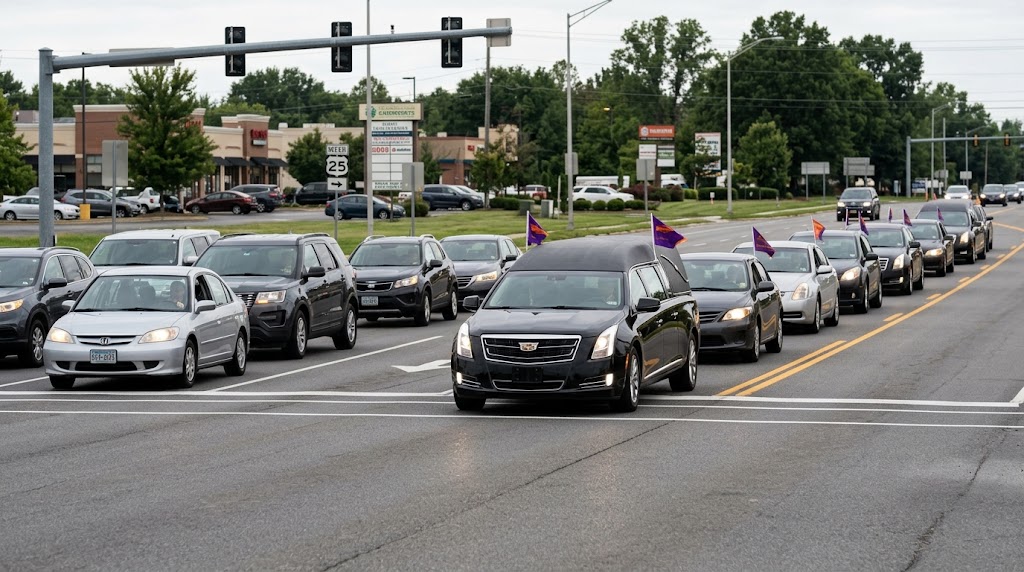
Driving down a busy boulevard or quiet rural road, you suddenly spot a motorcade of vehicles moving at a steady, measured pace. Their headlights are turned on in broad daylight, hazard lights are blinking in unison, and small flags flutter from their hoods. As the convoy approaches, an instinctive question strikes almost every motorist: do you have to pull over for a funeral procession?
For generations, drivers across the country were taught that pulling over to the shoulder was a mandatory sign of respect. However, as modern traffic volume has surged and high-speed multi-lane highways have become the norm, the line between traditional road courtesy and legal obligation has blurred. Whether a grieving family is en route from traditional religious funeral services or traveling to a cemetery following types of funeral services like immediate burial, navigating around the cortege requires a solid grasp of traffic statutes and safety protocols.
Understanding proper funeral procession etiquette and statutory regulations prevents moving violations, protects grieving families, and keeps every driver safe. In this comprehensive road safety guide, we will break down state right-of-way laws, clarify what to do when an official funeral escort is present, and examine whether pulling over is truly required by law.
Legal Disclaimer: Motor vehicle codes governing funeral processions vary substantially across state, county, and municipal jurisdictions. The guidance provided below is for educational and driver safety purposes only. For specific traffic regulations in your area, consult your state’s motor vehicle code or a qualified traffic attorney.
Do You Have to Pull Over for a Funeral Procession?
In most states, drivers are not legally required to pull over to the shoulder for a funeral procession as they would for an emergency vehicle. However, motorists are legally required to yield the right-of-way at intersections, refrain from cutting through or joining the convoy, and obey all instructions from law enforcement or certified escort officers.
Quick Answer: Is Pulling Over Required by Law?
The short answer is no: in the vast majority of U.S. jurisdictions, you do not have a statutory obligation to pull your vehicle onto the shoulder and come to a complete stop when encountering a funeral procession.
A common misconception among drivers is that funeral processions possess the same emergency status as ambulances, fire trucks, and police cruisers with active sirens and flashing lights. Under standard motor vehicle codes, funeral vehicles do not classify as emergency response vehicles. While statutory law heavily protects a procession’s legal right to travel together through intersections without interruption, it rarely mandates that opposing or adjacent drivers pull off the roadway entirely.
Instead, pulling over to the side of the road is largely an enduring cultural custom and act of community respect—particularly in the American South and rural communities. While polite, abruptly slamming on your brakes or pulling onto a narrow shoulder on a busy, high-speed road can create a severe traffic hazard. Modern driver safety emphasizes predictability over politeness: yielding the right-of-way where legally required, but maintaining a safe, predictable flow of traffic everywhere else.
How Right-of-Way Works for Funeral Processions
While you rarely have to pull onto the shoulder, understanding funeral procession right of way laws is essential when sharing the road with a cortege. Traffic codes in states that regulate processions focus on one primary objective: keeping the mourning convoy united as a single, unbroken line from the service venue to the final resting place.
The Lead Vehicle Rule
The legal cornerstone of most funeral procession statutes is known as the “lead vehicle rule.” Under this principle:
- The lead vehicle (typically a hearse, lead limousine, or official escort vehicle) must obey standard traffic control signals, stop signs, and posted speed limits when approaching an intersection.
- Once the lead car legally enters the intersection—usually on a green light—the entire remainder of the procession acquires the immediate right-of-way.
- Even if the traffic light turns yellow or red while the motorcade is moving through, all trailing vehicles in the verified procession are legally permitted to proceed through the red light without stopping.
Identifying Procession Vehicles
To claim right-of-way protections under the law, participating vehicles must be clearly identifiable to surrounding traffic. State statutes generally require participants to display specific visual markers:
- Illuminated Headlights: All vehicles must drive with their low-beam headlights turned on during daytime hours.
- Hazard Warning Flashers: Many states require or encourage emergency flashers to signal continuous convoy movement.
- Procession Flags & Markers: Official purple or orange funeral flags affixed to vehicle hoods, side mirrors, or antennas, or specialized windshield stickers provided by the funeral director.
Intersecting Traffic Requirements
When you approach an intersection and see a marked procession proceeding across your path, you must yield the right-of-way—even if your traffic signal is solid green. Entering the intersection, attempting to turn in front of oncoming procession cars, or honking your horn violates traffic statutes in states with procession right-of-way laws. Motorists must remain stationary until the final car in the line has completely cleared the intersection.
State Law Variations: Do Rules Differ Where You Drive?
Because traffic regulations are established at the state level rather than federally, funeral procession rules by state differ across the country. Understanding what is expected of you depends on how your state categorizes procession movements.
Generally, state statutes fall into three primary legal categories:
| Legal Category | Statutory Approach | Example States | What Drivers Must Do |
|---|---|---|---|
| Explicit Statutory Right-of-Way | State traffic code explicitly grants processions right-of-way at intersections and bans outside vehicles from cutting in. | Florida, Ohio, Illinois, Virginia, North Carolina, Georgia, Pennsylvania | Yield right-of-way completely; do not enter intersections on green; do not cut through or pass on two-lane roads. |
| Escort-Dependent Processions | Special right-of-way and red-light exemptions apply only if the convoy is led by a sworn law enforcement officer. | California, Texas (varies by local city ordinance) | Obey standard traffic lights unless explicitly directed otherwise by an active police officer controlling the intersection. |
| No Specific Statute (Common Law / Etiquette) | State traffic code contains no formal exemption for processions; standard right-of-way and signal laws technically govern. | New York, Massachusetts, Kansas, Vermont | Follow standard traffic signals, exercise extreme caution, and yield as a voluntary driving courtesy without blocking traffic. |
Driving Scenarios: What to Do in Common Situations
Knowing what to do when you encounter a funeral procession depends largely on the road layout, traffic density, and direction of travel. Here is how to handle the most common everyday driving scenarios safely and legally:
Oncoming Traffic on a Two-Lane Road
On two-lane undivided roads, it is customary in many regions to slow down or gently pull toward the shoulder to let oncoming processions pass without feeling crowded. However, you should only pull over if you can do so safely without braking abruptly, swerving, or endangering cyclists and pedestrians. If pulling off onto a narrow or uneven shoulder poses a risk, simply maintain a cautious, reduced speed with both hands on the wheel until the line passes.
Multi-Lane Highways and Freeways
A frequent query among highway commuters is: can you pass a funeral procession on the highway?
- Divided Highways & Freeways: You are never required to pull over to the shoulder on a multi-lane highway or divided expressway. Doing so on a high-speed road creates an extreme risk of multi-vehicle collisions.
- Passing Legally: You are legally permitted to pass a procession moving in the right lane if you travel in an adjacent left lane at a reasonable, safe speed. However, you must not cut into the convoy, tailgate the rear vehicle, or weave aggressively between mourning cars.
Approaching an Intersection with a Green Light
If you approach a traffic light that turns green in your favor, but a marked funeral procession is already moving across the intersection, do not accelerate into the junction. Under statutory right-of-way rules, the procession’s momentum overrides your green signal. Wait patiently behind the stop line until the last car displaying flags and headlights has fully exited the intersection.
What Is Strictly Prohibited? (Fines & Penalties)
While pulling over to the shoulder is usually voluntary, interfering with an active procession is not. Most state vehicle codes outline explicit actions that are strictly illegal when interacting with a funeral motorcade:
1. Cutting In or Driving Between Procession Vehicles
Many drivers ask: is it illegal to cut off a funeral procession? Yes. In nearly every state with procession statutes, breaking into, merging through, or driving between cars in an active funeral line is an explicit traffic violation. Law enforcement officers treat this maneuver as an illegal lane change or failure to yield, carrying traffic fines, moving violation points, and potential liability if a collision occurs.
2. Passing on a Single-Lane Undivided Road
Attempting to pass an entire funeral procession on a two-lane road by crossing double yellow lines or accelerating into oncoming traffic lanes is extremely dangerous and strictly illegal. Passing a cortege on an undivided road can result in severe citations for reckless or careless driving.
3. Passing or Interfering with Escort Units
Passing the lead vehicle or overtaking a marked police motorcycle escort that is actively blocking an intersection or guiding the motorcade is a serious offense. Disobeying an officer directing traffic can lead to misdemeanor citations, hefty fines, and license suspension.
Road Etiquette vs. Road Safety: Finding the Balance
Practicing respectful funeral procession etiquette driving is a meaningful way to acknowledge a grieving family’s loss, but courtesy should never come at the expense of public safety.
Traffic safety experts emphasize a foundational rule of driving: be predictable, not polite. When well-meaning drivers slam on their brakes in 55 mph traffic or stop dead in the middle of a busy multi-lane thoroughfare to “let a funeral through,” they often cause devastating chain-reaction rear-end crashes.
To show meaningful respect while prioritizing road safety, follow these considerate driving habits:
- Turn Down Audio Systems: Lower the volume of your car stereo or radio while waiting alongside or passing a procession.
- Avoid Honking or Tailgating: Exercise patience. Honking your horn or revving your engine near grieving family members is deeply disrespectful.
- Do Not Join the Convoy: Never turn on your hazard lights to blend into the procession simply to bypass traffic lights or congestion.
- Give Ample Following Distance: Leave generous space behind the final car in the line to prevent accidental rear-end collisions as the convoy slows to turn into cemetery grounds.
Frequently Asked Questions (FAQs)
Here are clear, definitive answers to the most common questions motorists ask regarding funeral motorcades and road rules.
Can you get a ticket for cutting through a funeral procession?
Yes. In states with explicit funeral procession laws, cutting through, joining, or driving between vehicles in an active procession is classified as a moving traffic violation. Drivers cited for cutting off a procession typically face traffic fines ranging from $50 to over $250, along with moving violation points added to their driving records.
Do funeral processions have to stop for emergency vehicles?
Yes. Funeral processions never supersede authorized emergency vehicles. If an ambulance, fire engine, or police vehicle approaches with active emergency sirens and flashing lights, all vehicles in the funeral procession—including the lead escort—must yield the right-of-way, slow down, and pull to the right shoulder until the emergency responder has passed.
Can you turn right on red in front of a funeral procession?
No. Turning right on red requires drivers to yield the right-of-way to all oncoming cross-traffic that has legally claimed the intersection. Because a verified funeral procession holds continuous right-of-way through an intersection, making a right turn on red that cuts into or disrupts the line of cars is illegal.
Do oncoming drivers have to pull over for a funeral procession on a divided highway?
No. Oncoming traffic traveling on the opposite side of a physical median, barrier, or divided highway has no statutory obligation to stop, slow down, or pull over. Procession right-of-way rules apply only to intersecting cross-traffic and vehicles traveling on undivided streets directly alongside the convoy.