Writing a tribute is just one part of planning a meaningful farewell. If you are also helping to organize the service itself, our guide to officiating a funeral walks through every element of the ceremony so the day flows with the care and dignity your grandfather deserves.
What Is a Funeral Tribute for a Grandfather?
A funeral tribute is a spoken or written expression of love, remembrance, and gratitude for someone who has passed. It is distinct from a formal eulogy in that it does not need to follow a strict structure or cover every chapter of a life story. A tribute can be as simple as a few sentences shared at a graveside, or as detailed as a full speech delivered at the service.
For a grandfather, a tribute serves three quiet but powerful purposes. It honors the man he was — his character, his values, and the way he moved through the world. It connects the people in the room through shared memory and shared loss. And it gives the person delivering it a way to say goodbye in their own words, which is one of the most healing things grief allows us to do.
You do not need to be a writer. You do not need to be composed. You simply need to speak truthfully about someone you loved.
How to Write a Tribute to Your Grandfather
The blank page can feel impossible when you are grieving. Breaking the writing process into a few clear steps makes it more manageable — and often, once you start, the words come more naturally than you expected.
Start With a Personal Memory
The most effective tributes begin with a specific moment rather than a general statement. Instead of opening with “My grandfather was a wonderful man,” try to recall a single memory that captures who he was — a Saturday morning ritual, a piece of advice he gave you at exactly the right time, the smell of his workshop, the way he laughed.
Think about childhood moments that shaped you, traditions you shared, lessons he taught you through his actions rather than his words. These concrete details are what make a tribute feel alive and personal rather than generic. They are also what people in the room will remember long after the service has ended.
Highlight His Character
Once you have your opening memory, reflect on what it says about who he was. What values did your grandfather live by? Was he patient, stubborn in the best way, quietly generous, endlessly curious? Did he show love through actions — fixing things, feeding people, showing up without being asked?
Choose two or three character traits that felt most true to him and build around them. Avoid a long list of adjectives; instead, let a story or detail do the work. “He never raised his voice, but when he spoke, everyone listened” tells you more about a man than “he was calm and respected.”
Acknowledge His Legacy
A grandfather’s legacy lives in the people he shaped. Think about the ways he influenced your family — the values he modeled, the wisdom he passed down, the traditions that will continue because of him. If he had a phrase he returned to often, a belief he lived by, or a way of seeing the world that changed yours, this is the place to name it.
Legacy does not have to mean grand achievement. For many grandchildren, a grandfather’s legacy is something quieter: the feeling of being safe in his presence, knowing that someone in the family always had time for you, or inheriting a love of something — the land, the game, the kitchen — that you will now carry forward.
Express Gratitude and Say Goodbye
Close your tribute with something direct and personal. Thank him for something specific. Tell him — and the room — what he meant to you. This does not need to be elaborate. Some of the most moving final lines are the simplest ones.
“Thank you for teaching me that showing up is enough.”
“I will spend the rest of my life trying to be half the person you were.”
“We will keep telling your stories, Grandpa. That is how we will keep you close.”
A goodbye does not have to be final to be meaningful. End in a way that feels true to your relationship with him.
Short Tribute Examples for a Grandfather
Not everyone is in a position to deliver a full speech. These shorter examples can be read aloud at the service, included in a printed program, or shared as a written message. Use them as they are or as a starting point for your own words.
Short and Simple Tribute
“My grandfather didn’t need many words to make you feel loved. He had a way of being present — fully, quietly present — that made you feel like the most important person in the room. I have never felt more safe than I did sitting next to him. I will carry that feeling for the rest of my life.”
Emotional Tribute
“Losing you is the hardest thing our family has ever faced. You were the one who held us all together — the steady center around which everything else revolved. I am not sure how we move forward without you, but I know we will try, because that is what you would have expected of us. Thank you for everything, Grandpa. We will love you every single day.”
Religious Tribute
“My grandfather was a man of deep faith. He lived by the belief that how you treat people is how you honor God, and every single day of his life, he honored Him well. We take comfort in knowing that he is at peace now, and that one day we will see him again. Until then, his faith becomes ours to carry.”
Light-Hearted / Warm Tribute
“Grandpa had a joke for every occasion — most of them terrible, all of them delivered with enormous satisfaction. He thought he was funnier than anyone else in the room, and honestly, he usually was. I am going to miss his laugh most of all. The kind that started in his belly and took over his whole face. If laughter really is medicine, then he gave us a lifetime supply.”
Full Funeral Tribute Examples
If you have been asked to deliver a full tribute at the service, the following examples offer a complete structure you can adapt. Change the details to reflect your own grandfather’s life and your relationship with him.
Example One: A Tribute From a Grandchild
“My grandfather had hands that could fix anything. A leaking faucet, a broken bicycle, a grandchild having a bad day — nothing was beyond him. I spent more hours than I can count in his garage, watching him work, handing him tools I couldn’t name, listening to him explain things with a patience I have never been able to replicate.
He was not a man of grand speeches. He showed love by doing — by showing up, by staying, by making sure everyone around him had what they needed before he thought about himself. He taught me that strength is quiet. That reliability is a form of devotion. That the most important thing you can do for the people you love is simply be there.
I am going to miss him every day. I am going to miss his handshake, which was more of an event than a greeting. I am going to miss the way he said my name. I am going to miss sitting next to him at the table and feeling, without him ever saying it, that I was exactly where I was supposed to be.
Thank you, Grandpa. For all of it. We will carry everything you gave us.”
Example Two: A Tribute Honoring a Long Life
“My grandfather lived [X] years, and every single one of them counted.
He was born into a different world — one that asked more of people, expected less comfort, and rewarded hard work with a kind of dignity that is harder to find today. He met that world with everything he had, and he never stopped giving.
He raised a family. He built a home. He showed his grandchildren, by example, what it means to be a person of integrity. He never missed a birthday that mattered. He never left without saying I love you. And in the quiet moments — the ones between the big events — he was the most present person I have ever known.
We did not lose him suddenly. We had time to prepare, or so we thought. But grief does not work on a schedule, and the space he has left behind is larger than any of us were ready for.
What I know is this: he lived a full life, a good life, and a life worth every word we speak today. We are better people for having known him. And the best way to honor him now is to live the way he taught us — with kindness, with consistency, and with love that does not need to announce itself to be real.”
If you are looking for additional inspiration for messages and sentiments to include, explore our collection of funeral messages to find words that match the tone of your tribute.

Tips for Delivering a Tribute at a Funeral
Writing the tribute is one challenge. Standing up and delivering it is another. These practical tips will help you get through it with steadiness and grace.
- Speak slowly. Grief makes it genuinely harder for people to process words. Slow down more than feels natural — your pace will still feel appropriate to the room, and the extra time gives both you and your audience a moment to breathe.
- Bring a printed copy. Even if you have memorized every word, print your tribute and bring it with you. Emotion can blank a mind that was perfectly prepared ten minutes earlier. Having the page in front of you is not a weakness — it is good planning.
- It is okay to show emotion. If your voice catches or you need to pause, let it happen. A moment of honest emotion in a tribute is not a disruption — it is a reflection of the love that brought everyone into the room. Take a breath, find your place on the page, and continue.
- Pause when you need to. Silence is not failure. A pause after a meaningful sentence gives the room time to absorb what you have said. Some of the most powerful moments in a tribute are the ones where nothing is spoken.
- Look up when you can. If you are reading from a page, try to lift your eyes occasionally and make contact with the room. Even a few moments of direct connection make a tribute feel more intimate and present.
What Not to Say
There are a few things worth avoiding when writing and delivering a tribute, not because any topic is forbidden, but because some choices can unintentionally take the focus away from honoring your grandfather.
- Avoid over-used phrases. Lines like “he is in a better place” or “he lived a good long life” are not wrong, but they are so familiar that they can feel hollow. Where possible, replace them with something specific and true to him.
- Avoid very long stories. A single, well-chosen anecdote lands far more powerfully than three or four stories strung together. If you have too many memories to choose from, that is a gift — but for the tribute itself, select the one that best captures who he was and let the others live in private conversation.
- Avoid anything that might cause discomfort. Family dynamics are complicated, and a funeral is not the place to surface old tensions, revisit painful history, or make jokes that only a portion of the room will understand. Keep the tribute warm, inclusive, and focused on what united people rather than what divided them.
- Avoid speaking about yourself more than about him. It is natural to talk about your relationship with your grandfather, but the tribute should be primarily about who he was, not about your experience of losing him. Keep the balance tilted toward him.
Ways to Personalize Your Tribute
The most memorable tributes are the ones that could only have been written for one specific person. These are a few ways to make yours feel entirely his.
- Use his actual words. If your grandfather had a saying he repeated often — a piece of advice, a response to difficulty, a phrase the whole family knows — include it. Hearing his words spoken aloud at the service is one of the most moving things a tribute can do.
- Use his nickname or the name you called him. “Grandpa,” “Pop,” “Gramps,” “Papa” — whatever you called him, use it throughout. It instantly makes the tribute feel personal rather than formal.
- Mention a shared tradition. Sunday dinners, fishing trips, a particular card game, a holiday ritual — these shared traditions carry enormous emotional weight for the people in the room who were part of them. Name them specifically.
- Include humor if it fits. If your grandfather was funny, if laughter was part of your relationship with him, do not be afraid to let that show. A moment of genuine warmth or a well-placed memory that makes people smile is not disrespectful — it is often the most honest thing in the room.
- Reference something he loved. A sport, a hobby, a place, a food, a song. Grounding the tribute in the specific details of his life makes it feel vivid and real rather than general and distant.
Honoring Your Grandfather Beyond Words
A spoken tribute is one of the most meaningful ways to honor a grandfather at a funeral, but it does not have to stand alone. Several other elements can work alongside it to create a service that feels complete and deeply personal.
- Memorial keepsakes. Printed cards, bookmarks, or prayer cards bearing a photo of your grandfather and a short tribute message give guests something tangible to take home — a small, lasting reminder of who he was.
- Photo displays. A memory board or photo display placed near the entrance invites guests to gather, look, and remember. Arranged chronologically or around a central theme — his family, his work, his favorite places — a photo display tells a life story visually and gives people something to talk about before and after the service.
- Music selections. A song that meant something to him, played during the service or at the reception, can carry emotion in a way that words sometimes cannot. Ask family members if there was a piece of music he returned to, or one that always reminds them of him.
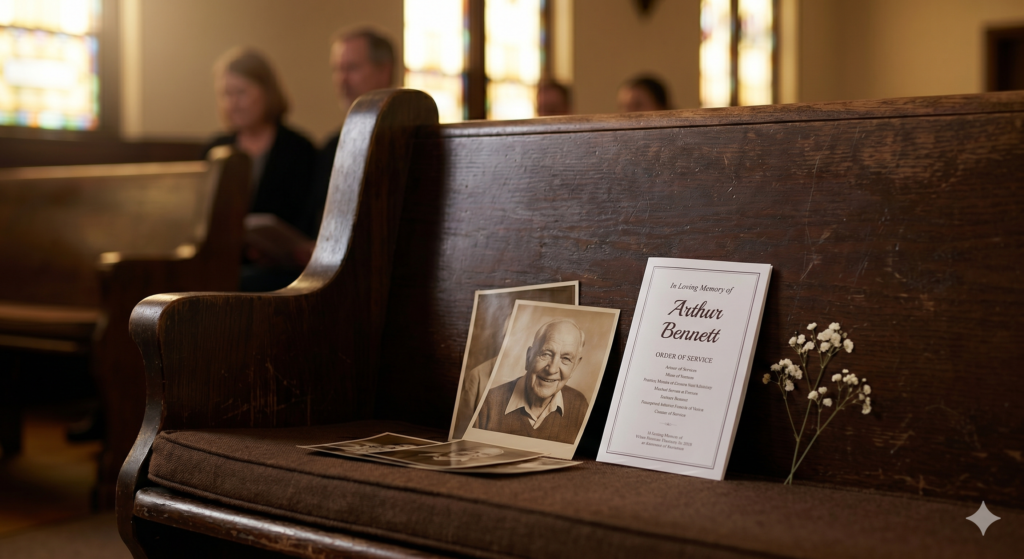
- Printed programs. A well-designed funeral program gives guests a guide through the service and becomes a keepsake in its own right. Including a photo, a short biography, and a line from your tribute inside the program creates a cohesive experience from the moment guests arrive. Explore funeral program ideas to find a design that honors his memory beautifully.
Not sure how a tribute fits into the broader structure of the service? Learn more about what a tribute is and how it differs from other types of memorial speeches so you can prepare with confidence.
Honoring Every Part of the Service
From the words you speak to the program guests take home, every element of a funeral can reflect the life of the person you loved. Explore our guides to help you plan a service that feels complete and deeply personal.
Final Thoughts
There is no perfect tribute. There is no combination of words that fully captures a person, or fully accounts for what it means to lose them. And yet, the attempt itself — the act of standing up and trying to say what someone meant to you — is one of the most profound things we do for each other in grief.
Your grandfather does not need a polished speech. He needs your honesty. He needs the specific memories that only you carry. He needs the people who loved him to hear, one more time, why he mattered.
Speak from the heart. Use his name. Tell the truth about who he was. That is enough — more than enough. And long after the service ends, the people in that room will remember that someone stood up and found the courage to say it out loud.