
Planning a funeral involves many moving parts. Before selecting pallbearers, it helps to understand the full picture. Learn about the sequential order of a funeral program so every moment of the service feels intentional and well-organized.
What Is a Pallbearer?
A pallbearer is a person who helps carry or escort a casket during a funeral service. The word itself has deep historical roots—the “pall” refers to the cloth draped over a casket, and “bearer” simply means the one who carries it. In medieval times, pallbearers would physically hold the corners of this cloth as the body was carried to its resting place. Today, funeral services are supported by many professionals and businesses, and families who are curious about the industry may also want to understand whether funeral homes are profitable and what factors influence their financial performance.
In modern funerals, the role has evolved but remains just as meaningful. Today’s pallbearers are typically close family members or friends who have been chosen by the deceased’s family to accompany the casket from the hearse to the burial site or place of service. Families making funeral arrangements may also have practical questions about the providers handling these services, including whether funeral homes are tax exempt and how their business structure may affect certain tax obligations. Serving as a pallbearer is considered one of the highest honors a family can bestow upon someone during one of the most difficult days of their lives.
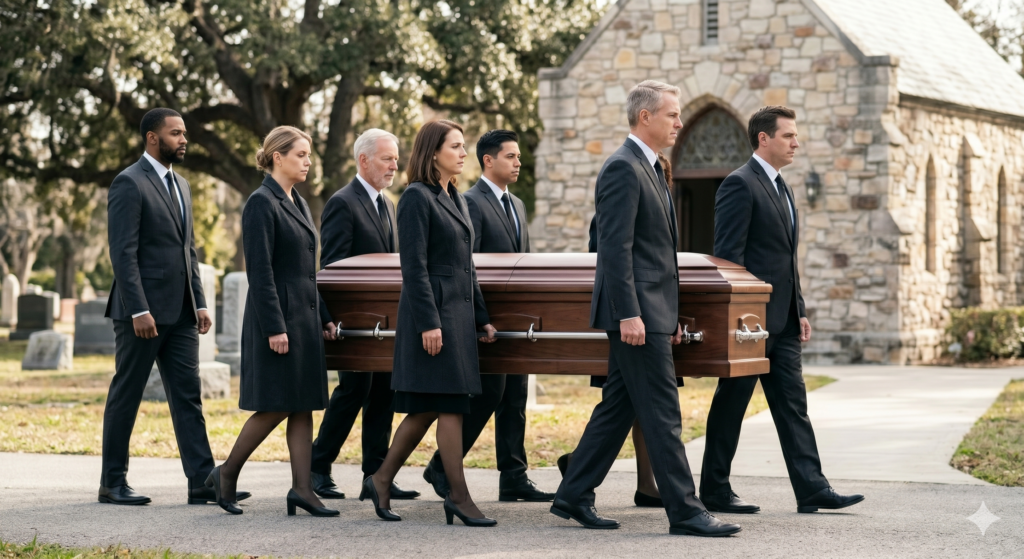
What Does a Pallbearer Do?
The responsibilities of a pallbearer are both physical and symbolic. On a practical level, pallbearers work together to carry the casket — a task that requires coordination, steadiness, and physical ability. They typically receive guidance from the funeral director before the service begins.
Beyond the physical act, pallbearers play an important role in the emotional tone of the ceremony. They walk in procession, often leading the casket into the chapel or graveside service, which signals the beginning of the formal farewell. Their presence is a visible act of love and respect for both the deceased and the grieving family. Simply put, they are the ones who ensure the departed is guided with dignity on their final journey.
- Carrying the casket from the hearse to the service venue, and from the venue to the gravesite.
- Walking in procession alongside or behind the casket as directed by the funeral home staff.
- Arriving early to receive instructions from the funeral director and practice positioning.
- Supporting the family simply by being present and showing solidarity during the service.
How Many Pallbearers Are Needed?
The standard number of pallbearers at a funeral is six to eight. This number is not arbitrary — a full-size casket can weigh anywhere from 150 to 400 pounds depending on the material, and having six to eight people ensures the weight is distributed safely and the carry is stable.
The exact number may vary based on several factors:
- Casket type: Heavier caskets (such as those made of solid hardwood or metal) may require more carriers.
- Service location: Longer distances between the hearse and the burial site, or navigating stairs, may warrant additional pallbearers.
- Family preference: Some families choose fewer pallbearers for a more intimate feel, particularly for smaller or graveside-only services.
If a family cannot find enough people able to physically carry the casket, the funeral home can typically assist with additional staff.
Who Can Be a Pallbearer?
There are no strict rules about who can serve as a pallbearer. Traditionally, the role was filled by adult male relatives or close friends of the deceased. That tradition, however, has shifted considerably in recent decades.
Today, pallbearers can be:
- Family members — adult children, siblings, grandchildren, cousins, or in-laws.
- Close friends — people who shared a long or meaningful relationship with the deceased.
- Colleagues or community members — coworkers, teammates, or fellow members of an organization.
Can women be pallbearers? Absolutely yes. Female pallbearers are entirely appropriate and increasingly common. There is no tradition or etiquette that restricts the role by gender. What matters far more than gender is the depth of the relationship and the person’s ability to fulfill the physical and emotional demands of the role.
Age is also worth considering. While there is no minimum age requirement, younger teenagers or elderly individuals may find the physical demands challenging. In those cases, they can still be honored through the role of honorary pallbearer (see below).
What Is an Honorary Pallbearer?
An honorary pallbearer holds a symbolic version of the role. Rather than physically carrying the casket, they walk alongside or ahead of it in the procession, acknowledging their close connection to the person who has passed. In some services, honorary pallbearers are seated in a place of distinction near the family.
This role is ideal for individuals who:
- Are elderly or have physical limitations that prevent them from carrying weight.
- Are young children who hold a meaningful place in the deceased’s life.
- Were deeply significant to the deceased but may not be able to attend in a fully active capacity.
Choosing honorary pallbearers is a beautiful way to include more people in the ceremony without placing physical demands on them. It allows the family to honor a wider circle of love.
Pallbearer Etiquette
Being asked to serve as a pallbearer is a privilege, and honoring that responsibility with appropriate etiquette shows respect for the family and the occasion.
Dress Code
Pallbearers should dress in formal or semi-formal attire unless the family specifies otherwise. For most traditional funerals, this means a dark suit, dress shoes, and a subdued tie. Women serving as pallbearers should wear modest, dark-colored clothing. When in doubt, ask the family or funeral director what is expected.
Punctuality
Arrive at least 30 minutes before the service begins. The funeral director will need time to brief all pallbearers on their positions, the route, and the logistics of the carry. Arriving late creates unnecessary stress on an already difficult day.
Behavior During the Service
Pallbearers should remain composed, attentive, and respectful throughout the entire service — not just during the carry itself. Silence your phone, avoid side conversations, and follow the lead of the funeral director at all times. If you feel overwhelmed by emotion, that is entirely human. Take a quiet breath and continue as best you can.
Funerals involve many unspoken customs. Brushing up on funeral etiquette and acknowledgement card traditions can help you support the family in all the right ways.
How to Choose Pallbearers
Selecting pallbearers is one of many decisions a family must make while planning a funeral. It can feel daunting, but focusing on a few key qualities will help guide the choice.
- Close relationships: Choose people who genuinely loved or deeply respected the deceased. Their presence should feel meaningful, not merely obligatory.
- Reliability: Select individuals you trust to follow through. A pallbearer who cancels at the last minute creates real logistical challenges on the day of service.
- Emotional readiness: This is a demanding role emotionally. Consider whether the person is in a place to carry this responsibility, particularly if they are experiencing acute grief.
- Physical ability: Ensure that each active pallbearer is capable of the physical task. When in doubt, opt for the honorary role instead.
It is a kind and thoughtful gesture to ask someone privately and in person, rather than by text. Let them know it is okay to decline if they do not feel they are in a position to take on the role.

What to Expect If You Are Asked to Be a Pallbearer
Being asked to serve as a pallbearer is a deeply meaningful honor. It means the family views you as someone who was important in the life of the person who has passed. Here is what you can expect on the day of the service.
Before the service: Arrive early and check in with the funeral director. You will be shown where to stand, how to position yourself around the casket, and the route you will take. Do not be afraid to ask questions — the funeral staff has guided many people through this process before.
During the carry: Move slowly and in step with your fellow pallbearers. The funeral director will typically walk alongside you. Focus on your footing, especially on uneven ground or stairs. Grip the casket handle firmly but without tension.
Emotionally: It is completely normal to feel overwhelmed. You are not expected to be stoic. If your eyes well up or your voice catches, that is a reflection of your love — and there is nothing more appropriate at a funeral than authentic grief.
After the service: Your role concludes once the casket is in place at the burial site or returned to the care of the funeral home. Many families express gratitude to their pallbearers personally after the service, though a simple, quiet acknowledgment is equally meaningful.
Funerals often include printed programs that list the pallbearers by name. Learn more about what to include in a funeral program and how to create one that truly honors a life well lived.
Honoring Every Detail of the Day
From the order of service to the cards handed out at the door, every element of a funeral carries meaning. Explore our guides to help you plan a service that feels complete.
Final Thoughts
The role of a pallbearer is one of the most quietly powerful acts of love that exists in the human experience of loss. It asks something real of you — your time, your presence, your physical steadiness, and your emotional courage — precisely because it means something real. To carry someone you love on their final journey is to say, without words, that they mattered deeply.
Whether you are choosing pallbearers for a loved one’s service or you have been asked to fill the role yourself, approach it with the care and gravity it deserves. There is no perfect way to grieve, and there is no perfect way to serve. Being present, being sincere, and showing up — that is enough.