

An obituary is a written notice that announces a person’s death and shares a short account of their life. It usually includes key facts, family details, and service information, but it also does something more personal: it helps people remember who that person was.
In that sense, an obituary is both practical and emotional. It tells people what has happened, while also honoring a life with care and respect.
If you have never written one before, the term can feel formal or intimidating. In reality, an obituary does not need to sound complicated. It just needs to be clear, accurate, and true to the person being remembered.
If you need support writing one, Honor You offers a professional obituary writing service that helps families shape the right message with care.
Why Do Families Write Obituaries?
Families write obituaries for a few different reasons.
To inform: An obituary lets people know that someone has passed away. It gives relatives, friends, neighbors, colleagues, and community members the information they may need, especially if funeral or memorial details are being shared.
To tell a story: An obituary gives shape to a person’s story. It may mention where they were born, what mattered to them, the work they did, the people they loved, and the way they will be remembered. Even when it is brief, it becomes an important summary of a life.
To create a lasting record: Long after the funeral is over, the obituary may still be read, shared, saved, and revisited by the people who loved them.
What Is Usually Included in an Obituary?
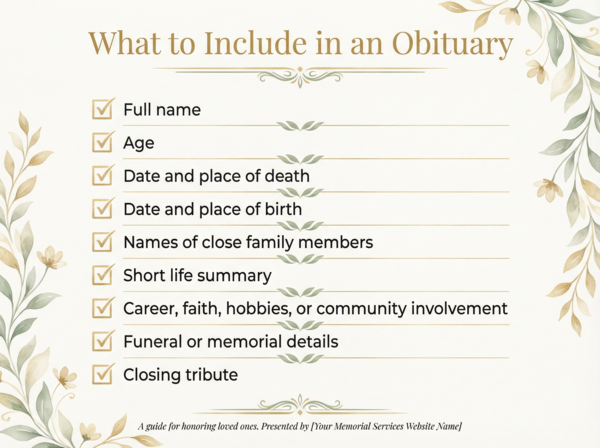
There is no one perfect template, but most obituaries include the same core elements. A typical obituary may include:
- The person’s full name
- Their age
- The date and place of death
- The date and place of birth
- Names of close family members
- A short life summary
- Career, faith, hobbies, or community involvement
- Funeral, memorial, or celebration of life details
- A closing tribute or acknowledgment
Some families want a short and direct obituary. Others want something warmer and more reflective. Both are valid. What matters is that it feels respectful and accurate.
What Is the Difference Between an Obituary and a Death Notice?
This is one of the most common points of confusion.
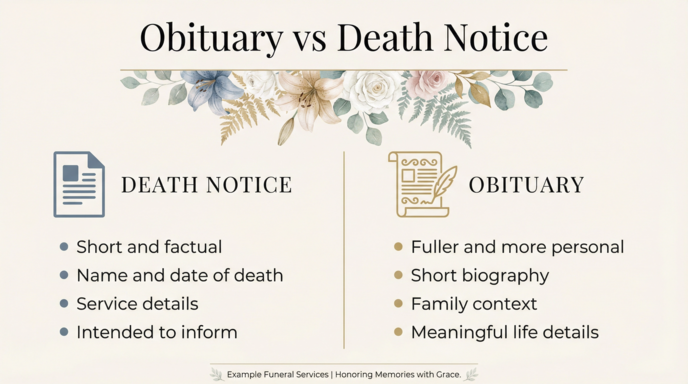
A death notice is usually shorter and more factual. It often includes the person’s name, date of death, and service details. In many cases, it is only intended to inform people.
An obituary is usually fuller and more personal. It often includes a short biography, family context, and a few meaningful details about the person’s life and character.
A simple way to think about it: a death notice tells people that someone has died, while an obituary helps people understand who that person was. Depending on the publication or platform, a family may use one, the other, or both.
Who Usually Writes an Obituary?
An obituary is often written by a close family member, such as a spouse, adult child, sibling, or another relative. Sometimes a close friend helps write it. In other cases, a funeral director or obituary writer helps organize the information and shape the final wording.
There is no single right person to write it. What matters is that the final version reflects the person honestly and respectfully.
For many families, the hardest part is not knowing what they feel. It is trying to turn those feelings and memories into clear words while they are grieving. That is why professional help can be valuable, especially when time is short or emotions are high.
Where Can an Obituary Be Published?
Today, obituaries can appear in several places:
- Local newspapers
- Funeral home websites
- Memorial websites
- Family or community social media posts
- Printed funeral programs or memorial booklets
Some families use a shorter notice publicly and a fuller obituary in a printed memorial piece. Others use one version across both digital and print spaces.
If the obituary will also appear inside a printed memorial piece, explore our funeral program and memorial booklet options here.
How Long Should an Obituary Be?
An obituary can be brief or detailed. The right length depends on where it will be published, how much the family wants to include, and how the information will be used.
A shorter obituary may work well for a newspaper or quick public notice. A longer obituary may be more suitable for a memorial site or printed funeral program, where there is room to share more of the person’s story.
If you are not sure how long it should be, it helps to start with the essentials and then add the details that feel most meaningful.
What Makes a Good Obituary?
A good obituary is not about sounding impressive. It is about sounding true. The strongest obituaries are usually the ones that are clear, accurate, respectful, warm, and personal without becoming confusing or overly long.
A good obituary gives people a sense of the person, not just a list of dates and relatives. Even a simple obituary can feel meaningful if it captures something real about the life being remembered.
A Simple Obituary Example
Here is a short example of the kind of wording families often use:
In loving memory of Sarah Anne Jacobs, who passed away peacefully on April 5, 2026 at the age of 72. Sarah was a devoted mother, grandmother, teacher, and friend. She will be remembered for her kindness, steady faith, and the way she made people feel welcome. She is survived by her children, grandchildren, and extended family. A memorial service will be held on Friday, April 12, 2026 at 11:00 AM.
This example is simple, but it does what it needs to do. It shares the key facts while still giving the reader a sense of the person.
When Families Need Help Writing an Obituary
Writing about someone you love just after losing them can feel heavy. Even when you know what you want to say, it can be hard to organize it into something polished and ready to publish.
That is where support can help. A good obituary service does not replace the family’s voice. It helps shape it, so the final piece feels clear, respectful, and ready to share.
Need Help Writing an Obituary?
If writing an obituary feels overwhelming right now, Honor You can help you turn key details and memories into a clear, respectful obituary that is ready to share with family, friends, and your wider community.
Final Thoughts
So, what is an obituary? It is a written tribute that announces a death, shares the outline of a person’s life, and helps others remember them with dignity.
It can be simple or detailed, but at its best, it gives people something honest to hold onto, both in the moment and long after.
