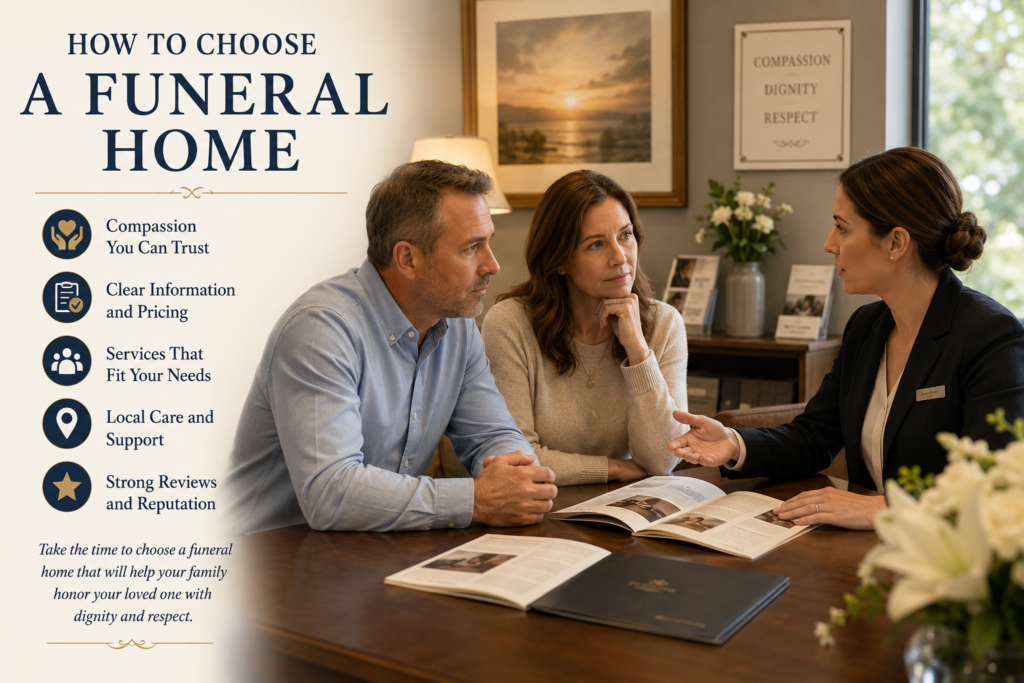
Choosing a funeral home is one of the most important decisions a family may need to make during a difficult time. Whether you are planning after the passing of a loved one or preparing arrangements in advance, knowing how to choose a funeral home can help you feel more confident, informed, and supported.
A good funeral home should offer more than services and facilities. It should provide compassion, clear communication, transparent pricing, and guidance that respects your family’s wishes. The right provider will help you understand your options, answer your questions patiently, and make the planning process feel less overwhelming.
This guide explains what to look for when choosing a funeral home, what questions to ask, how to compare services and pricing, and why funeral home reviews can be helpful before making a decision.
Start With Your Family’s Needs
Before contacting a funeral home, take a moment to think about what your family needs most. Every family’s situation is different. Some families need immediate help after a death, while others are pre-planning for the future. Some may want a traditional funeral service, while others may prefer cremation, a memorial service, or a simple graveside gathering.
Thinking through your needs first can make it easier to choose a funeral home that offers the right type of support.
Common questions to consider include:
- Do we want burial, cremation, or another type of arrangement?
- Do we need a traditional funeral, memorial service, celebration of life, or graveside service?
- Are there religious, cultural, military, or family traditions we want to honor?
- Do we need help quickly, or are we planning ahead?
- Will family members need to travel to attend the service?
- Do we need help with paperwork, permits, obituary writing, or death certificates?
Once you understand your priorities, you can compare funeral homes based on what matters most to your family instead of feeling pressured into decisions too quickly.
“The best funeral home for your family is one that listens carefully, explains your options clearly, and helps you make decisions that feel respectful, manageable, and right for your loved one.”

Look for Funeral Homes Near You
Location is often one of the first things families consider when choosing a funeral home. A local funeral home can make planning easier, especially if family members need to visit in person, meet with the funeral director, view the facilities, or coordinate with a nearby cemetery, church, crematory, or place of worship.
Searching for funeral homes near you can also help you understand what options are available in your area. Some communities may have several providers, while others may have only a few. Comparing nearby funeral homes gives your family a better sense of services, pricing, availability, and reputation.
When reviewing local funeral homes, consider:
- Distance: Is the funeral home close to your family, cemetery, church, or service location?
- Accessibility: Is the building easy for elderly relatives or guests with mobility needs to access?
- Facilities: Does the funeral home have enough space for your expected number of guests?
- Availability: Can they support your preferred service date and timeline?
- Local experience: Are they familiar with nearby cemeteries, churches, clergy, florists, and local requirements?
Families can also use online resources to search local funeral homes and compare providers before making calls or scheduling visits.
Compare the Services Each Funeral Home Offers
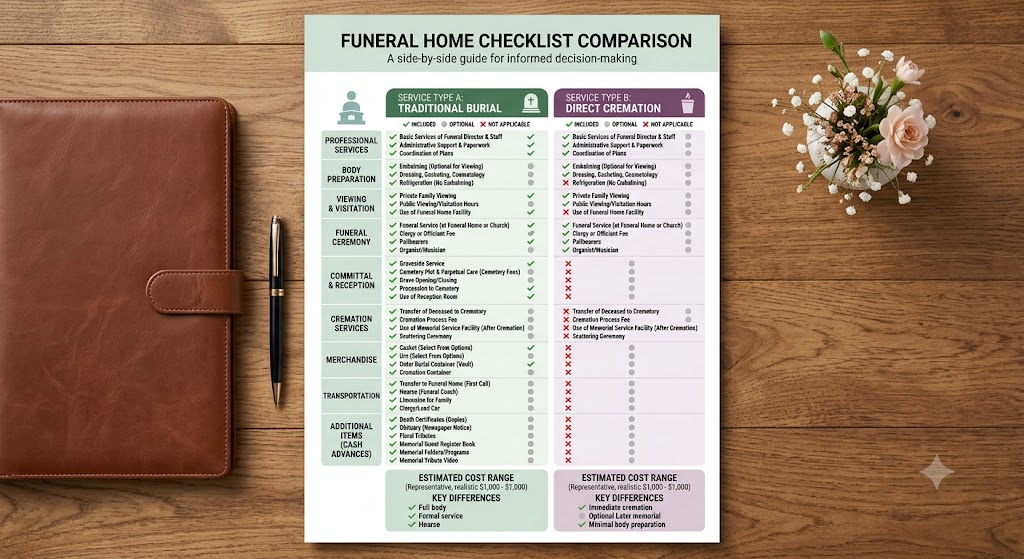
Not all funeral homes offer the same services. Some provide full-service funeral planning, while others may focus on cremation, direct burial, memorial services, or pre-planning. Before choosing a provider, make sure they can support the type of service your family wants.
Common funeral home services include:
- Traditional funeral services
- Cremation services
- Memorial services
- Celebration of life services
- Direct burial
- Direct cremation
- Graveside services
- Transportation of the deceased
- Obituary assistance
- Help with death certificates and permits
- Pre-planning funeral arrangements
- Veteran, religious, or cultural service support
If your family has specific wishes, ask the funeral home directly whether they have experience handling those arrangements. For example, if you need a religious service, military honors, out-of-state burial, or cremation followed by a memorial, the funeral director should be able to explain how they would manage the process.
For more context on what modern providers may offer, you can also review resources about family support services at funeral homes and how they help families during planning.
Ask About Pricing and Transparency
Funeral costs can vary depending on the services selected, the location, the type of arrangement, the casket or urn, transportation, viewing, embalming, facility use, flowers, printed materials, and other details. That is why pricing transparency is an important part of choosing a funeral home.
A trustworthy funeral home should be willing to explain costs clearly. They should provide written pricing information, answer questions about packages, and help you understand what is required, optional, or customizable.
When discussing pricing, ask:
- Can you provide a written price list?
- What is included in your basic service fee?
- Are there separate charges for transportation, viewing, cremation, burial, or paperwork?
- Do you offer packages, and can they be customized?
- What costs are paid to third parties, such as cemeteries, churches, clergy, florists, or newspapers?
- Can we choose only the services we need?
Clear pricing helps families make decisions without confusion. It also reduces the risk of unexpected expenses later in the planning process.
| What to Compare | Why It Matters |
|---|---|
| Basic service fee | This may cover the funeral director’s professional services, planning, coordination, and administrative support. |
| Burial or cremation costs | These costs can vary depending on the type of arrangement and provider used. |
| Facility fees | Viewing rooms, chapels, reception spaces, and service areas may have separate charges. |
| Merchandise | Caskets, urns, memorial products, and printed materials can affect the total cost. |
| Third-party costs | Cemetery, clergy, obituary, flowers, permits, and death certificates may be billed separately. |
Read Funeral Home Reviews
Funeral home reviews can help families understand what it may be like to work with a provider. While pricing and services are important, reviews often reveal details about compassion, communication, professionalism, responsiveness, and how well the funeral home supports families during emotional moments.
When reading reviews, look for patterns rather than relying on a single comment. A funeral home with repeated praise for kindness, patience, organization, and clear communication may be a strong option. Before making a final decision, it is incredibly helpful to read reviews from real families and compare how different funeral homes are experienced by the people they serve. For example, reading dedicated community resources like Ball Family Chapel funeral home reviews can show you exactly how a highly rated care team interacts with families during high-stress moments.
Helpful things to look for in reviews include:
- Did families feel respected and cared for?
- Was the funeral director responsive and easy to reach?
- Were costs explained clearly?
- Did the funeral home handle details professionally?
- Were the facilities clean, comfortable, and appropriate?
- Did families feel pressured or supported?
Before making a decision, it can be helpful to read reviews from families and compare how different funeral homes are experienced by the people they serve.
Reviews are not just about star ratings. The most useful reviews describe how a funeral home communicated, handled details, supported the family, and helped create a meaningful service.
Pay Attention to Communication and Compassion
The first phone call or meeting with a funeral home can tell you a lot. A caring funeral director or funeral mortician should listen carefully, answer questions clearly, and help your family understand what happens next. They should not make you feel rushed, confused, or pressured.
Good communication is especially important because funeral planning often involves many details in a short period of time. Families may need help with transportation, paperwork, service planning, obituary writing, flowers, music, readings, clergy, cemetery coordination, and guest arrangements.
Signs of compassionate communication include:
- They explain each step in simple language.
- They answer questions patiently.
- They provide written information when possible.
- They are respectful of your budget and wishes.
- They do not pressure you into services you do not want.
- They make your family feel heard and supported.
A funeral home may have beautiful facilities and many services, but if the staff does not communicate with kindness and clarity, it may not be the right fit for your family.
Check Their Experience With Your Type of Service
Different families need different types of arrangements. Some may want a formal religious funeral. Others may want a simple cremation, a celebration of life, a veterans service, or a culturally specific ceremony. Choosing a funeral home with experience in your preferred type of service can make the process smoother.
Ask whether the funeral home has handled similar services before. If your family has specific traditions or customs, the funeral director should be open, respectful, and willing to learn what matters to you.
Types of experience to ask about include:
- Traditional funerals: Services with viewing, visitation, funeral ceremony, procession, and burial.
- Cremation services: Direct cremation, cremation with memorial service, or cremation after viewing.
- Religious funerals: Services that follow specific faith traditions, prayers, readings, or rituals.
- Cultural arrangements: Customs related to preparation, viewing, timing, clothing, music, food, or family participation.
- Veteran services: Military honors, flags, cemetery coordination, and veteran benefits guidance.
- Out-of-state arrangements: Transportation, permits, and coordination with another funeral home or cemetery.
The more specific your family’s needs are, the more important it is to choose a funeral home that can explain how they will support them.
Visit or Call Before You Decide
If time allows, contact two or three funeral homes before making a final choice. Even a brief phone call can help you compare responsiveness, tone, pricing clarity, and overall comfort level. If you are able to visit in person, you can also evaluate the facilities and meet the staff.
During the call or visit, pay attention to how the funeral home makes you feel. Do they listen? Do they answer questions directly? Do they explain options without pressure? Do they seem organized and compassionate?
Questions to ask before choosing a funeral home:
- What services do you offer?
- What is included in your basic package?
- Can you provide a written price list?
- Do you help with permits, death certificates, and paperwork?
- Can you support our religious, cultural, or family traditions?
- How quickly can arrangements begin?
- Who will be our main point of contact?
- Can the service be personalized?
- Do you coordinate with cemeteries, churches, clergy, or crematories?
- What happens if we need to make changes to the arrangements?
Writing down answers can help your family compare each funeral home more clearly after the conversations are complete.
Watch for Red Flags
Most funeral homes want to support families with care, but it is still important to watch for signs that a provider may not be the right fit. Choosing a funeral home during grief can feel urgent, but families should still feel respected, informed, and comfortable.
Common red flags include:
- Unclear pricing: The funeral home avoids giving written costs or does not explain fees clearly.
- Pressure to upgrade: Staff push expensive packages or products that do not match your wishes or budget.
- Poor communication: Calls are not returned, answers are vague, or next steps are unclear.
- Lack of written information: Important details are only discussed verbally and not confirmed in writing.
- Negative review patterns: Multiple families mention the same concerns about service, pricing, or communication.
- Dismissive staff: Your questions, traditions, budget, or concerns are not treated with respect.
- Limited explanations: The funeral home does not clearly explain burial, cremation, memorial, or planning options.
A funeral home should help reduce stress, not add to it. If something feels uncomfortable, it is okay to keep looking for a provider that better fits your family’s needs.
Funeral Home Comparison Checklist
A simple checklist can help your family compare providers side by side. Use the table below when reviewing funeral homes by phone, online, or in person.
| Comparison Point | What to Look For |
|---|---|
| Location | Convenient for family, guests, cemetery, church, or memorial location. |
| Services | Offers burial, cremation, memorial, traditional funeral, or specialty services your family needs. |
| Pricing | Provides clear written pricing and explains what is included. |
| Reviews | Shows consistent feedback about compassion, professionalism, and communication. |
| Communication | Responds promptly, answers questions clearly, and provides next steps. |
| Facilities | Clean, comfortable, accessible, and suitable for the type of service planned. |
| Personalization | Allows meaningful details such as music, readings, photos, videos, keepsakes, and cultural traditions. |

How to Make the Final Decision
After comparing your options, choose the funeral home that feels most aligned with your family’s needs, values, and budget. The right provider should make you feel supported, not pressured. They should explain the process clearly and help your family create arrangements that honor your loved one with dignity.
Before making the final decision, review:
- Whether the funeral home offers the services you need
- Whether pricing is clear and manageable
- Whether reviews show consistent family satisfaction
- Whether staff communicate with kindness and patience
- Whether the facilities and location work for your family
- Whether your traditions, wishes, and budget are respected
Trust is an important part of the decision. If your family feels comfortable asking questions and confident in the funeral home’s guidance, that is a strong sign you have found the right provider.
Find Trusted Funeral Homes with HonorYou
HonorYou helps families compare funeral homes, explore local providers, and read helpful information before making an important decision. When you are unsure where to begin, having access to funeral home information and family-focused resources can make the process feel less overwhelming.
Whether you are planning a traditional funeral, cremation, memorial service, or pre-planned arrangement, comparing your options can help you choose a provider with confidence.
Find trusted funeral homes near you and learn more about choosing the right provider for your family.
Final Thoughts
Learning how to choose a funeral home can help your family make decisions with more clarity during an emotional time. The right funeral home should offer compassionate care, transparent pricing, clear communication, and services that match your loved one’s wishes.
Take time to compare local funeral homes, ask questions, read reviews, and understand what each provider offers. Even when decisions need to be made quickly, your family deserves guidance that feels respectful, honest, and supportive.
A funeral home is not only helping with arrangements. It is helping your family honor a life, support one another, and move through a difficult moment with care.
Frequently Asked Questions
How do I choose the right funeral home?
Choose a funeral home by comparing services, pricing, location, reviews, communication, facilities, and experience with the type of service your family needs. The right funeral home should make you feel informed, respected, and supported.
What should I ask a funeral home before choosing one?
Ask about services, pricing, burial and cremation options, paperwork support, timelines, religious or cultural accommodations, personalization options, and who will be your main point of contact during the planning process.
Should I read funeral home reviews before deciding?
Yes. Funeral home reviews can help you understand how other families experienced the provider’s communication, compassion, professionalism, pricing clarity, and overall support.
Is it better to choose a funeral home near me?
A nearby funeral home can make planning easier, especially if family members need to visit, attend meetings, coordinate with a local cemetery, or hold services close to home.
What are red flags when choosing a funeral home?
Red flags include unclear pricing, pressure to buy expensive packages, poor communication, lack of written information, repeated negative reviews, dismissive staff, and limited explanation of your options.
Can I compare more than one funeral home?
Yes. When time allows, it is helpful to contact two or three funeral homes. Comparing services, pricing, reviews, and communication can help your family make a more confident decision.
What makes a good funeral home?
A good funeral home is compassionate, organized, transparent, responsive, and respectful of your family’s budget, traditions, and wishes. It should guide you through the process without pressure or confusion.