There is no reliable national average salary for funeral home owners.
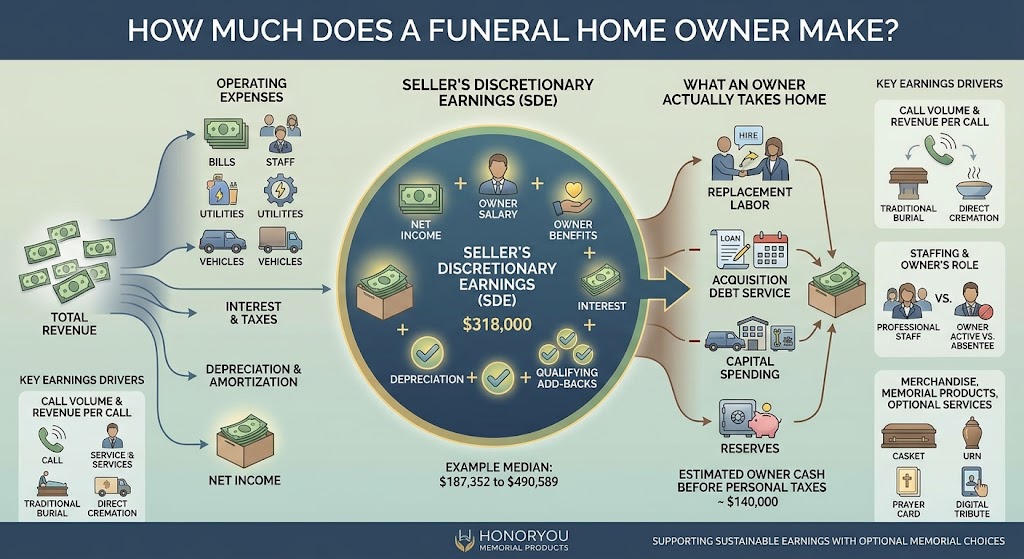
The Bureau of Labor Statistics reports a $76,830 median wage for employee funeral home managers, while BizBuySell reports $318,000 median seller’s discretionary earnings (SDE) for funeral homes sold from 2021 through 2025.
SDE includes owner compensation and add-backs, so it is not the same as salary or post-tax take-home pay.
The most accurate answer is therefore a range, not one number. A funeral home owner may earn an employee-like wage in a smaller or heavily financed operation, while a well-established owner-operator can receive substantially more through salary, distributions, and benefits.
The result depends on call volume, service mix, staffing, overhead, debt, and how much of the work the owner performs.
“A funeral home owner’s income cannot be reduced to one salary figure. The owner’s role, the business’s earnings, debt, staffing, and reinvestment needs all affect how much cash ultimately reaches the owner.”
Quick answer: There is no reliable national average salary for funeral home owners. As reference points, the BLS reported a $76,830 median wage for employee funeral home managers in May 2024, while BizBuySell reported $318,000 median SDE for funeral homes and mortuaries sold from 2021 through 2025. SDE is broader than salary and does not equal the owner’s actual take-home pay.
Salary, Profit, SDE, and Take-Home Pay Are Different
Income estimates become misleading when several financial terms are treated as interchangeable.
- Salary: Payroll compensation paid to the owner for work performed.
- Net profit: The business’s revenue minus operating expenses, interest, depreciation, taxes, and other costs recorded on its financial statements.
- Distributions or draws: Amounts the owner takes from the business outside payroll. Their tax treatment depends on the business structure and the owner’s circumstances.
- Seller’s discretionary earnings, or SDE: An estimate of the total financial benefit available to one owner-operator. It commonly starts with net income and adds back owner salary, owner benefits, interest, depreciation, amortization, and qualifying one-time or discretionary expenses.
- Take-home pay: What the owner keeps after business obligations, acquisition debt, taxes, required capital spending, and reserves.
SDE is useful when comparing owner-operated businesses, but it can overstate the cash a new buyer will personally keep.
A financed buyer must make loan payments. An absentee owner may need to hire a licensed manager or funeral director. A growing operation may need to retain cash for vehicles, facilities, equipment, staffing, or technology.
Current Funeral Home Earnings Benchmarks
The best public benchmarks answer different questions. They should not be collapsed into a single average.
| Benchmark | Current Figure | What It Means |
|---|---|---|
| Funeral home manager wage | $76,830 median in May 2024 | An employee wage benchmark from the U.S. Bureau of Labor Statistics. It excludes self-employed workers. |
| Sold funeral home SDE | $318,000 median | Median discretionary earnings for funeral homes and mortuaries reported sold on BizBuySell from 2021 through 2025. |
| Sold-business SDE range | $187,352 lower quartile to $490,589 upper quartile | The spread in BizBuySell’s selected sold-business sample, not a guaranteed national owner-income range. |
| Sold funeral home revenue | $750,000 median | Revenue for the same BizBuySell sold-business sample before expenses. It is not owner income. |
The BLS reported a May 2024 median wage of $76,830 for funeral home managers, with the lowest 10 percent below $45,820 and the highest 10 percent above $132,470.
That is a helpful benchmark for the value of management work. It is not an owner-income statistic.
The BLS notes that 56 percent of funeral home managers were self-employed in 2024, while its occupational wage data exclude self-employed workers.
BizBuySell provides a closer view of owner economics.
Its 2021-2025 sold-business data show median revenue of $750,000 and median SDE of $318,000. The lower- and upper-quartile SDE figures were $187,352 and $490,589.
These figures are useful for acquisition analysis, but they represent businesses that were listed and reported sold on one marketplace. Stronger, sale-ready businesses may be overrepresented.
Employee wages, business SDE, revenue, and owner take-home pay answer different questions. Use each benchmark only for the purpose it actually measures.
How to Estimate What an Owner Can Actually Take Home
Start with the funeral home’s financial statements rather than a web salary estimate.
This is a simplified bridge.
The starting net-income definition and treatment of income taxes vary by statement and business structure, so the calculation should be reconciled to tax returns and reviewed by a qualified accountant.
Only add back a cost if it would genuinely disappear under the new ownership structure.
If a buyer must hire a funeral director, manager, bookkeeper, or removal staff member to replace work performed by the seller, that labor remains an economic cost.
Worked Example
Consider an owner-operated funeral home with the following illustrative figures:
- Net income: $110,000
- Owner salary and benefits: $120,000
- Valid one-time and noncash add-backs: $30,000
- SDE: $260,000
If a new owner performs the same management and funeral-director work, the $260,000 is a starting measure of total owner benefit.
It is still not spendable cash.
Suppose:
- Annual acquisition debt service is $85,000
- Planned equipment and facility reserves are $20,000
- The business retains $15,000 for working capital
Estimated cash before the owner’s personal taxes would be about $140,000.
If the owner is not active in the business and must hire a manager at a fully loaded annual cost of $100,000, the estimated cash falls to about $40,000 before personal taxes.
What the example shows: The same funeral home can generate very different income for an owner-operator and an absentee investor. Seller-reported SDE should always be adjusted for debt, replacement labor, capital needs, and working-capital requirements.
What Changes a Funeral Home Owner’s Income?
Annual Call Volume and Revenue per Call
Call volume affects how widely fixed costs are spread.
Property costs, vehicles, insurance, licenses, utilities, software, and a base level of staffing continue even during a slow month.
More calls can improve earnings when pricing covers the incremental labor, merchandise, transportation, and third-party costs associated with each case.
Revenue per call is not enough on its own.
Owners should track contribution margin per call, which is revenue minus costs that change with that service.
A high-revenue service may contribute less than expected if merchandise, overtime, facility use, or outsourced services consume much of the fee.
For a deeper review of the business model, see HonorYou’s guide to funeral home profitability.
Burial, Cremation, and Service Mix
The National Funeral Directors Association projected a 63.4 percent U.S. cremation rate for 2025, compared with a 31.6 percent burial rate.
That shift matters because direct cremation usually produces less revenue than a traditional burial service.
It does not automatically make a cremation-heavy funeral home unprofitable.
Owners can respond by:
- Designing transparent cremation arrangements that match family preferences
- Controlling outsourced crematory costs
- Offering optional gatherings, personalization, or memorial services
The relevant measure is the contribution margin for each arrangement, not whether burial or cremation sounds more valuable.
Staffing and the Owner’s Role
Payroll is both a major cost and an operational necessity.
Funeral service requires licensed expertise, careful coordination, on-call coverage, and compassionate communication.
The NFDA says member firms identify the availability of qualified personnel as their greatest business challenge over the next four years.
An owner who serves as the manager or licensed funeral director may receive more total economic benefit from the business, but part of that return pays for demanding labor.
Facility, Vehicle, Equipment, and Debt Costs
A large facility can support visitations and services, yet mortgage payments, rent, maintenance, utilities, property taxes, and insurance create fixed overhead.
Vehicles, preparation equipment, refrigeration, accessibility upgrades, and technology also require ongoing capital.
Debt often creates the largest gap between a seller’s SDE and a buyer’s cash.
Two owners can acquire similar businesses at different prices and interest rates and end up with very different annual income.
Review common funeral home expenses line by line before relying on a headline earning estimate.
Merchandise, Memorial Products, and Optional Services
Funeral homes may coordinate caskets, urns, flowers, printed materials, video tributes, and other family-selected items.
These can add revenue, but owners should track the direct cost, staff time, vendor reliability, and margin of each offering.
The Federal Trade Commission’s Funeral Rule requires itemized price information and protects a consumer’s right to select only the goods and services desired, apart from limited exceptions such as a permitted basic services fee.
Sustainable earnings come from clear pricing and useful choices, not pressure or unnecessary bundling.
Specialist providers such as HonorYou can support optional personalized memorial products, including funeral programs, prayer cards, register books, photo displays, and digital tributes.
The offering should remain transparent and family-chosen.
Local Competition, Reputation, and Preneed Business
Funeral service is local and relationship-driven.
Market share, demographic trends, cultural preferences, online reputation, referral relationships, and the strength of nearby competitors all influence call volume and pricing power.
Preneed arrangements can support future call volume, but the cash and accounting treatment are regulated and may not provide immediately available operating income.
Buyers should review state rules, trust or insurance funding, cancellation and transfer provisions, and the quality of the preneed book with qualified legal and accounting advisers.
Three Owner-Income Scenarios
The following scenarios are illustrations, not national forecasts.
| Scenario | Likely Economics | Owner-Income Implication |
|---|---|---|
| Smaller or rebuilding operation | Lower call volume, meaningful fixed costs, limited management depth, or recent startup costs | Owner compensation may resemble an employee-manager wage or remain lower while the business stabilizes. |
| Established owner-operated funeral home | Consistent calls, owner performs management or licensed work, controlled debt, healthy reserves | Total owner benefit may materially exceed an employee salary, but part of it compensates the owner’s labor and on-call responsibility. |
| Established, financed, manager-run operation | Strong SDE, acquisition loan payments, hired management, and planned reinvestment | Reported SDE can be high while spendable owner cash is much lower after replacement labor and debt service. |
BizBuySell’s $187,352 to $490,589 lower-to-upper-quartile SDE spread illustrates how wide the market can be among reported sold businesses.
It should be used as a comparison range, not a promise of personal income.
Owner-Operator vs. Manager-Run Funeral Home
An owner-operator earns from two roles: working in the business and owning the business.
Their total benefit may include:
- Salary
- Health or retirement benefits
- Distributions
- Other legitimate owner benefits
The tradeoff is direct operational responsibility, including irregular hours and on-call work.
A manager-run model can reduce the owner’s day-to-day workload, but a market-rate replacement salary and benefits must be deducted before calculating the return to ownership.
SDE is usually more useful for a single-location owner-operated business, while normalized adjusted EBITDA that includes market-rate management compensation may be more useful for a larger or manager-run operation.
How Owners Can Improve Sustainable Earnings
- Measure contribution margin by arrangement type, not revenue alone.
- Review prices and the General Price List regularly while following the FTC Funeral Rule and applicable state requirements.
- Build staffing schedules around actual call patterns and protect service quality and employee wellbeing.
- Track labor, merchandise, transportation, facility use, and third-party costs at the case level.
- Set aside cash for vehicles, equipment, facility maintenance, technology, and slow periods before making distributions.
- Offer optional memorial and personalization choices with clear prices and no pressure.
- Monitor reputation, response time, lead sources, conversion, preneed fulfillment, and family feedback.
- Reduce owner dependency by documenting processes, cross-training staff, and building a management bench.
These steps do not guarantee a particular income.
They improve the quality of the information owners use to make pricing, staffing, investment, and distribution decisions.
Normalized P&L and Cash-Flow Checklist
- Reconcile revenue and direct costs by arrangement type, annual call volume, and service mix.
- Identify every form of owner compensation, including salary, payroll taxes, health benefits, retirement contributions, vehicle use, and distributions.
- Test each proposed add-back and remove recurring expenses that a buyer will still incur.
- Subtract market-rate replacement labor for every operational role the owner will not perform.
- Separate rent from property ownership economics and identify deferred facility, vehicle, and equipment spending.
- Review acquisition debt service, interest rate, loan term, and lender-required reserves.
- Set a recurring capital-expenditure allowance for vehicles, preparation equipment, facilities, accessibility, and technology.
- Keep working capital for payroll, vendors, insurance, and slower months before calculating distributions.
- Review preneed funding and restrictions; do not treat restricted funds as current operating cash.
- Confirm whether the comparison figure is salary, net income, SDE, normalized adjusted EBITDA, or cash after debt and reserves.
- Check the source period, geography, and sample. Sold businesses, public companies, and hypothetical models answer different questions.
Before relying on an income figure: Normalize the financial statements, account for replacement labor, debt service, capital spending, and working capital, and confirm exactly what the benchmark measures.
Frequently Asked Questions
What Is the Average Funeral Home Owner Salary?
There is no reliable federal statistic for the average U.S. funeral home owner salary.
The BLS reports a $76,830 median wage for employee funeral home managers as of May 2024, but its wage data exclude self-employed workers.
BizBuySell reports median SDE of $318,000 for funeral homes and mortuaries sold from 2021 through 2025, but SDE is broader than salary and is not post-tax take-home pay.
Is SDE the Same as Take-Home Pay?
No.
SDE estimates the total financial benefit available to one owner-operator before items such as acquisition debt, personal taxes, required reinvestment, reserves, and replacement labor.
Take-home pay is what remains after those obligations.
How Much Does a Funeral Home Manager Make?
The BLS reported a median annual wage of $76,830 for funeral home managers in May 2024.
The lowest 10 percent earned less than $45,820, and the highest 10 percent earned more than $132,470.
Those figures apply to wage data and should not be used as owner-income statistics.
How Many Calls Does a Funeral Home Need to Be Profitable?
There is no universal call-count threshold.
The break-even point depends on fixed costs and contribution margin per call.
A practical estimate is annual fixed costs divided by average contribution margin per call.
Owners should calculate separate margins for direct cremation, traditional burial, memorial services, and other common arrangements.
Does Cremation Reduce Funeral Home Owner Income?
It can reduce average revenue per call when families choose simpler direct cremation, but the effect on owner income depends on pricing, outsourced or in-house crematory costs, staffing, overhead, and optional memorial services.
A cremation-heavy firm can still be financially healthy if its cost structure and offerings match demand.
Does a Funeral Home Owner Need a License?
Licensing rules vary by state and by the activities the owner performs.
An owner who is not a licensed funeral director may need to employ qualified licensees and meet facility or establishment requirements.
Confirm the rules with the relevant state licensing board and legal counsel before buying or opening a funeral home.
The Bottom Line
How much a funeral home owner makes depends on both the business and the owner’s role in it.
Current sold-business data show that established funeral homes can produce significant discretionary earnings, but SDE is not a salary and it is not cash in the owner’s pocket.
Employee wages, owner labor, debt, taxes, reserves, and reinvestment all have to be separated.
The most useful answer will come from a normalized profit and loss statement, a realistic replacement-labor estimate, and a debt and capital-spending plan.
Owners who want to offer families clear, optional personalization can explore HonorYou’s memorial products and support for funeral homes, including dedicated assistance and volume pricing.
You can also read customer reviews to see how other funeral directors have partnered with us.