Yes, a funeral home may be allowed to arrange the final disposition of cremated remains in some circumstances.
The word “dispose” does not mean a funeral home may handle cremated remains like ordinary trash. Permitted methods and required steps depend on:
- The cremation authorization
- The service agreement
- The provider’s written policy
- The law in the state where it operates
If you are worried that a funeral home still has someone’s ashes, contact the provider now.
Ask whether:
- The cremated remains are still in its care
- Who is authorized to receive them
- What deadline applies
- What options are available for pickup, transfer, or approved shipment
What Does “Dispose of Ashes” Mean?
Families commonly use the word “ashes,” but the more accurate term is cremated remains.
In funeral-service laws and agreements, disposition usually means placing those remains in a lawful final location. It does not necessarily mean discarding them.
For background on the cremation process itself, see Honor You’s guide to how cremation works.
Depending on the state, the signed authorization, and the provider involved, final disposition may include:
- Burial in a cemetery grave
- Placement in a crypt, niche, or columbarium
- Scattering in a memorial garden or another lawful location
- Transfer to a county, coroner, cemetery, or other authorized public entity
- Burial through a program for eligible unclaimed Veterans
- Another method permitted by applicable law
Some outcomes, such as scattering or communal burial, may be difficult or impossible to reverse.
That is why:
- Waiting periods
- Notice requirements
- Accurate records
matter.
“Disposition of cremated remains means placing them in a lawful final location. It does not mean treating them as ordinary waste.”
When Can a Funeral Home Dispose of Unclaimed Ashes?
There is no one answer for every funeral home in the United States.
A provider may have authority when the person who arranged the cremation expressly requests a disposition service.
It may also gain limited authority after the remains become legally unclaimed, but only after satisfying the rules that apply to that provider and location.
The Cremation Authorization and Service Agreement
The documents signed before cremation are the first place to look.
They may identify:
- The person authorized to receive the remains
- How the provider will give notice
- A pickup or storage period
- Possible fees
- What may happen if nobody claims the remains
A contract does not replace state law. It works within the law that governs the funeral home or crematory.
State Law and Provider Type
State rules can distinguish between:
- Funeral establishments
- Crematories
- Cemeteries
- Public officials
The fact that a funeral home arranged the cremation does not always mean it performed the cremation or has the same legal duties as the crematory.
The applicable law is usually tied to where the provider operates, not where the family member currently lives.
Ask the funeral home to identify the governing rule and the exact deadline in writing.
Waiting Periods, Notice, and Records
Before arranging a final disposition, a provider may need to:
- Store the remains for a specified period
- Make reasonable efforts to contact the authorized person
- Send a required notice
- Document those steps
The length and sequence vary by state.
A funeral home should also record when, where, and how a final disposition occurred.
Do not treat a deadline quoted online as a nationwide rule. Ask the provider which state law, regulation, or policy actually applies to its situation.
There Is No Single Nationwide Deadline
State examples show why a deadline quoted online should not be treated as a national rule.
Ohio
In Ohio, state law allows a funeral home or crematory holding unclaimed remains to use specified lawful disposition methods after a 60-day period in certain circumstances.
The statute also includes notice-related and Veteran-related provisions.
Nebraska
Nebraska uses a different statutory framework.
Its cremation law provides a 60-day period and calls for a reasonable attempt to contact the authorizing agent or representative before disposition under the section.
California
California illustrates another distinction.
Guidance from the Cemetery and Funeral Bureau explains that the cited laws do not set one specified holding period for a funeral establishment, while crematories have separate requirements concerning remains that are not accepted after notice.
If ownership, authorization, or compliance is disputed, consider qualified legal advice.
What Usually Happens Before Final Disposition?
A family should not assume the ashes are gone simply because a pickup date passed.
The provider may still have them.
A typical process may include:
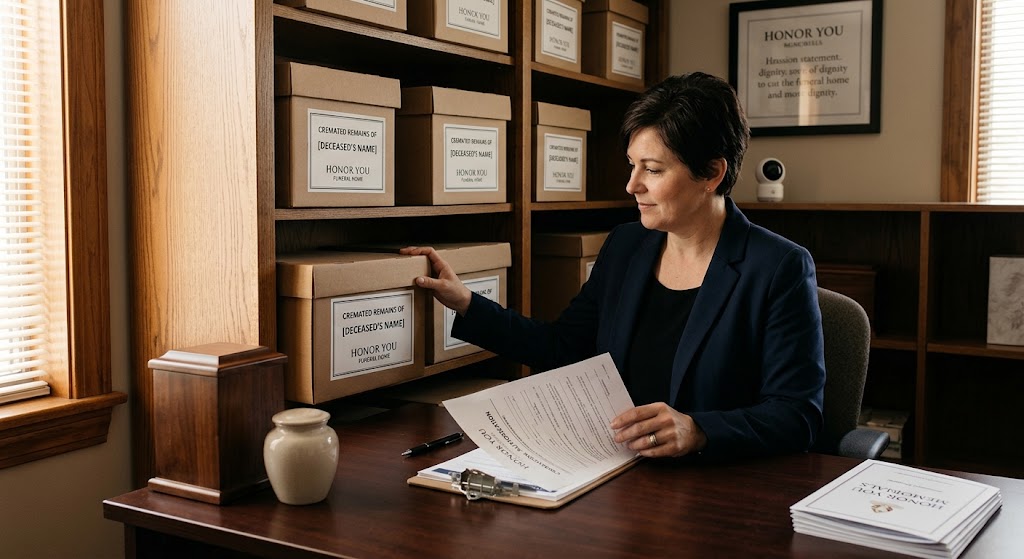
- The remains are placed in a labeled container and stored in a secure area.
- The funeral home reviews the cremation authorization and service agreement.
- Staff call, email, or write to the authorized person using the contact information on file.
- Any required written notice and waiting period are completed.
- The provider checks for special requirements, including an available pathway for eligible unclaimed Veterans when applicable.
- If the remains are still unclaimed, the provider arranges a permitted final disposition.
- The provider keeps a record of what occurred.
The exact legal requirements differ by state.
A provider may voluntarily keep remains longer than the minimum period.
Its willingness to do so does not create a nationwide rule, and families should not rely on indefinite storage without written confirmation.
How May Unclaimed Cremated Remains Be Handled?
Permitted methods vary.
Depending on applicable law, funeral homes and crematories may use:
- Cemetery burial
- Placement in a niche or crypt
- A memorial garden
- Lawful scattering
- Transfer to an appropriate public authority
- A dignified group burial when permitted
A provider may also choose to retain remains longer than the minimum period.
Location Rules Still Apply
Even when a provider has authority to arrange disposition, the final location must still comply with applicable rules.
For example, EPA rules for burial at sea generally require cremated remains to be placed at least three nautical miles from land and the placement to be reported within 30 days.
Public lands, state waters, private property, and cemeteries may have their own:
- Permission requirements
- Permit requirements
- Scattering restrictions
Unclaimed Veteran Remains
For unclaimed remains that may belong to a Veteran, the National Cemetery Administration provides a process for funeral homes and others to request eligibility determinations.
Eligible unclaimed Veterans may qualify for burial in a national cemetery once eligibility and required arrangements are confirmed.
What to Do If the Funeral Home Still Has the Ashes
Act promptly, but do not panic.
Use this checklist to establish what is true and preserve your options.
1. Confirm the Current Status
Call the funeral home and ask whether the cremated remains are physically in its care.
Record:
- The date
- The name of the person who confirmed the status
- Their job title
2. Request the Rules in Writing
Ask for:
- The signed cremation authorization
- The service agreement
- The retention policy
- The collection deadline
- Any fees
- The state rule the provider believes applies
3. Verify Who May Receive the Remains
Ask which person is named in the authorization and what identification or written permission is required.
A family relationship alone may not settle the question.
4. Arrange a Practical Handoff
Possible options may include:
- Personal pickup
- Pickup by an approved representative
- Transfer to another funeral home
- Transfer to a cemetery
- Compliant shipment if the provider offers it
5. Keep Records
Save:
- Emails
- Letters
- Receipts
- Authorizations
- Tracking information
- The final release record
A missed pickup date does not necessarily mean the cremated remains have already been disposed of. Confirm their status before assuming the family has lost its options.
Can Cremated Remains Be Mailed?
Some providers offer mailing.
If mailing is available, use the carrier method the provider confirms is permitted.
USPS updated its rule in March 2025 to require the Priority Mail Express Cremated Remains Box for shipments of cremated remains.
Before arranging shipment, ask about:
- Required packaging
- Identification
- Tracking
- Signature requirements
- Cost
- International restrictions
International requirements can be more restrictive.
What If the Funeral Home Says the Ashes Were Already Disposed Of?
Ask for a written account rather than relying on a brief phone explanation.
Request:
- The date of disposition
- The method used
- The location
- The notices sent
- The contact attempts documented
- The record showing who authorized or carried out the action
If the explanation conflicts with your documents, the provider refuses to produce records it is required to maintain, or you suspect misconduct, contact the state agency that licenses funeral homes and crematories.
Depending on the dispute, a:
- Consumer-protection office
- Qualified attorney
may also be able to help.
What If the Funeral Home Closed?
If the funeral home:
- Closed
- Merged
- Changed ownership
the state licensing agency may be able to identify the successor custodian of its records and unclaimed remains.
How to Keep Cremated Remains From Becoming Unclaimed
Clear communication can prevent many problems.
- Keep your phone number, email address, and mailing address current with the provider.
- Confirm the authorized recipient.
- Give that person copies of the relevant documents.
- Tell the funeral home in writing if travel, health, cost, or family circumstances will delay collection.
- Ask for a written extension.
- Confirm whether storage fees apply.
- Choose a pickup, transfer, shipping, burial, niche, or scattering plan before the deadline.
- Keep the cremation certificate, authorization, service agreement, and release receipt together.
People delay collection for many understandable reasons, including:
- Grief
- Distance
- Family disagreement
- Uncertainty about a final resting place
Clear communication can protect the remains while the family makes a thoughtful decision.
After Collection: Choosing a Memorial That Fits
You do not need to make every memorial decision on pickup day.
Cremated remains may stay in the temporary container while the authorized person considers:
- An urn
- A cemetery niche
- Burial
- Lawful scattering
- Another meaningful plan
Families who are still considering a permanent plan can explore meaningful things to do with cremation ashes after the remains are safely in their care.
Honor You also offers:
- Memorial keepsakes
- Personalized urn plates
- A digital Memorial Garden for families who want to preserve and share a loved one’s story
These choices can be made after the immediate collection and legal questions are resolved.
The Most Important Next Step
A funeral home may sometimes arrange lawful final disposition of unclaimed cremated remains, but the authority and process are not the same everywhere.
If you believe a funeral home still has someone’s remains:
- Contact the provider.
- Ask for the current status in writing.
- Ask for the exact deadline.
- Confirm who is authorized to receive the remains.
- Arrange pickup or another approved plan before the family loses options.
Frequently Asked Questions
Can a Funeral Home Throw Ashes Away?
The word “dispose” does not mean a funeral home may handle cremated remains like ordinary trash.
It may be permitted to arrange a lawful final disposition only under the authorization, agreement, policy, and state rules that apply.
Permitted methods may include:
- Burial
- Inurnment
- Lawful scattering
- Transfer to an authorized entity
How Long Can a Funeral Home Keep Unclaimed Ashes?
There is no single U.S. deadline.
Some states specify a period and notice process, while others use different rules for funeral homes and crematories or rely more heavily on the agreement and reasonable conduct.
Ask the provider for its written policy and the governing state rule.
Must the Funeral Home Contact the Family First?
Many laws and agreements require notice or reasonable contact efforts, but the method and timing vary.
Ask for copies of written notices and a log of contact attempts if a deadline or disposition is in question.
Can a Funeral Home Scatter Ashes Without Permission?
It may have authority to arrange lawful scattering after the remains become legally unclaimed and all required steps are complete, or when the authorized person requested that service.
The location must also comply with applicable:
- Land rules
- Water rules
- Cemetery rules
- Permit requirements
Can Someone Else Collect the Ashes?
Possibly.
The person named in the authorization may be able to designate another person, but the funeral home will usually require written permission and identification.
Confirm the provider’s requirements before sending someone to pick up the remains.
Can a Funeral Home Charge Storage or Disposition Fees?
Fees depend on the signed agreement, provider policy, and applicable law.
Ask:
- When a fee begins
- How it is calculated
- Whether an extension changes the cost
- Whether transfer or shipment changes the cost
Request the answer in writing.
What Happens If a Funeral Home Closes?
Contact the state funeral-service licensing agency.
It may know which business or public authority took custody of the records and unclaimed remains.
Gather:
- The deceased person’s name
- Date of death
- Cremation documents
- Receipts
- Relevant correspondence
before contacting the agency.
What If the Unclaimed Remains Belong to a Veteran?
Ask the provider to request an eligibility determination from the National Cemetery Administration.
Eligible unclaimed Veterans may qualify for burial in a national cemetery, but eligibility must be confirmed and the required arrangements completed.
Can a Funeral Home Mail Cremated Remains?
Some providers offer mailing.
The shipment must follow current carrier and destination rules.
For domestic USPS shipments, confirm the required Priority Mail Express Cremated Remains Box and ask about:
- Identification
- Tracking
- Signatures
- Cost
- International restrictions
What Should I Do If I Missed the Pickup Deadline?
Contact the funeral home immediately.
Ask whether the remains are still in its care, what deadline currently applies, whether an extension is available, and what steps are required for release.
Do not assume the remains have already been disposed of until the provider confirms their status.
Can a Funeral Home Keep Ashes Forever?
A funeral home may choose to retain remains longer than the minimum period required by law or contract, but families should not assume indefinite storage is available.
Ask for the provider’s retention policy and any fees in writing.