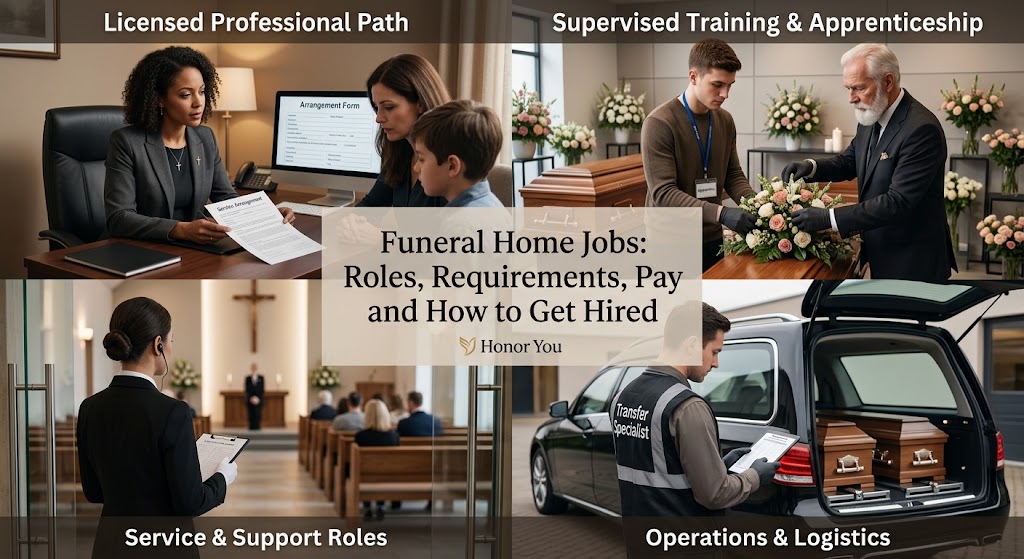
Funeral homes employ licensed professionals, skilled technicians, sales and administrative staff, drivers, attendants, and other support workers.
Some careers require mortuary science education, supervised training, examinations, and a state license. Others may be open to applicants with a high school diploma, transferable experience, and employer training.
Because titles and legal duties vary by state, the best path starts with choosing a role and checking the rules where you plan to work.
This guide explains common funeral home jobs, typical entry requirements, current national pay benchmarks, day-to-day work conditions, and practical ways to find and apply for openings in the United States.
“There is no single path into funeral service. Some positions require formal education and a license, while others offer an entry point through administration, transportation, customer service, facilities, or support work.”
Quick answer: Funeral home careers include licensed roles such as funeral director and embalmer, as well as attendants, receptionists, transfer technicians, crematory operators, managers, preneed counselors, and facilities staff. Requirements depend on the duties and state law, so applicants should verify the exact education, training, licensing, and experience requirements for the role they want.
What Jobs Are Available at a Funeral Home?
A funeral home depends on more than one profession.
Teams may arrange services with families, prepare a person for burial or cremation, complete legal records, coordinate transportation, run ceremonies, maintain facilities, manage finances, and create printed or digital tributes.
Honor You’s overview of what funeral homes do provides more context on how these responsibilities fit together.
The table below is a starting point, not a licensing guide. Employers may combine duties, and state law can limit who may perform specific tasks.
| Role | Typical Duties | Common Entry Path | License Commonly Required? | Job Titles to Search |
|---|---|---|---|---|
| Funeral director or mortician | Meets with families, arranges services and disposition, manages records, coordinates staff and vendors | Mortuary or funeral service degree, supervised experience, exams | Usually, but title and scope vary by state | Funeral director, mortician, apprentice funeral director |
| Embalmer | Preserves and prepares remains, maintains records, follows health and safety procedures | Funeral service education, supervised training, exams | Commonly required; rules vary | Embalmer, apprentice embalmer, funeral director and embalmer |
| Funeral arranger | Discusses service options, schedules details, prepares documents and coordinates providers | Varies from employer training to a licensed pathway | Depends on state and duties | Funeral arranger, arrangement counselor |
| Funeral home manager | Oversees staff, schedules, compliance, operations, finances and family service | Funeral service experience plus management skills | May be required when licensed duties are included | Funeral home manager, location manager, managing funeral director |
| Funeral attendant or service assistant | Greets guests, sets up rooms, moves flowers, assists ceremonies and processions | High school diploma and short-term training are common | Often not, but duties are limited by state law | Funeral attendant, funeral service assistant, funeral home assistant |
| Removal or transfer technician | Transfers a deceased person from the place of death, documents custody and prepares vehicles or equipment | Employer training, valid driver’s license, safe lifting skills | Requirements vary by state and employer | Removal technician, transfer specialist, transport technician |
| Crematory operator | Verifies identity and authorization, operates equipment, processes remains, cleans and maintains the facility | High school diploma and employer training are common; certification may apply | State and local requirements vary | Crematory operator, cremation technician |
| Administrative or reception staff | Answers calls, schedules appointments, manages records, processes payments and supports families | Office, hospitality or customer service experience | Usually not for administrative-only duties | Funeral home receptionist, administrative assistant, office coordinator |
| Preneed or family service counselor | Explains advance-planning options, follows up with families and may sell funded plans | Sales and service experience; employer and product training | Insurance, preneed or other licensing may apply | Preneed counselor, family service counselor, advance planning advisor |
| Facilities, grounds or delivery staff | Maintains buildings and grounds, prepares spaces, drives vehicles or delivers memorial items | Role-specific experience and employer training | Usually not, unless duties cross into regulated work | Groundskeeper, maintenance associate, funeral vehicle driver |
Licensed and Education-Dependent Roles
Funeral directors, morticians, embalmers, and some arrangers perform regulated work.
The words “funeral director,” “mortician,” and “embalmer” are not interchangeable everywhere. A professional may hold more than one license, while another workplace may separate arranging, directing, embalming, and management among different employees.
See Honor You’s closer look at what a mortician does and the embalmer’s role for more detail.
According to the Bureau of Labor Statistics, the common route into funeral directing includes an associate degree in funeral service or mortuary science, one to three years of supervised training, and state or national examinations.
Most states and the District of Columbia require funeral service workers in these occupations to be licensed.
Entry-Level and Nonlicensed Funeral Home Jobs
Many applicants enter funeral service through support work.
Funeral attendants, receptionists, administrative assistants, service assistants, drivers, grounds staff, and some transfer roles may offer employer training.
These positions can build experience in:
- Customer care
- Ceremony setup
- Scheduling
- Paperwork
- Transportation
- Standards of conduct around grieving families
“Nonlicensed” does not mean unrestricted.
An attendant may set up a visitation room but may not be allowed to make arrangements or perform preparation work. A transfer technician may need specific documentation, training, permits, or availability. A preneed counselor may face insurance or sales licensing rules.
Read the job description carefully and verify state requirements before accepting regulated duties.
Part-Time and Remote Funeral Service Roles
Part-time work is most common in funeral attendance, visitation support, transportation, reception, facilities, and on-call service assistance.
Hours can be unpredictable because services, transfers, and family needs do not always fit a standard weekday schedule.
Most hands-on funeral home jobs must be performed on site.
Legitimate remote opportunities are more likely to appear in:
- Customer support
- Scheduling
- Bookkeeping
- Marketing
- Preneed support
- Insurance
- Obituary writing
- Technology companies that serve funeral homes
Remote-job caution: A legitimate listing should name a real employer, explain the duties, and use a normal application process. Be cautious of vague offers, upfront fees, or requests for sensitive financial information early in the hiring process.
Licensed vs. Nonlicensed Funeral Home Jobs
The fastest way to narrow your options is to decide how much formal training you are ready to pursue.
Choose a licensed path if you want to arrange and direct funerals, embalm, or take responsibility for regulated establishment operations.
Start by reviewing your state board’s education, supervised-experience, examination, and continuing-education rules. The National Funeral Directors Association’s licensing directory can help you locate the right authority.
Choose a support path if you want to test your fit, enter sooner, or use skills from another field.
Customer service, hospitality, healthcare support, caregiving, logistics, office administration, maintenance, and professional driving can translate well.
Support experience can strengthen a future application to mortuary school or an apprenticeship, but it does not replace a required credential.
For students comparing programs, the American Board of Funeral Service Education listed 58 accredited programs in 2026.
Check the live directory and your target state’s rules before enrolling, especially if you may move after graduation.
Graduating from an accredited program can establish eligibility for the National Board Examination, but passing the exam does not by itself grant a state license.
The International Conference of Funeral Service Examining Boards explains current exam and candidate requirements.
What Is Working in a Funeral Home Really Like?
Funeral service combines careful operations with personal service during emotionally intense circumstances.
It can be meaningful work, but the conditions deserve an honest look.
- Schedules may include evenings, weekends, holidays, on-call periods, and work beyond 40 hours. The BLS notes that irregular hours are common.
- Families may need clear answers while grieving, stressed, or divided about decisions. Active listening and calm explanations matter.
- Details are time-sensitive. Permits, authorizations, identity checks, service schedules, obituaries, transportation, and merchandise orders must be accurate.
- Some roles involve standing, lifting, driving, moving equipment, and working around remains. Preparation and crematory work also require strict safety procedures.
- Discretion is part of the job. Employees handle private family information and may see difficult circumstances.
- Teamwork is constant. One service can involve directors, attendants, drivers, clergy, cemetery or crematory staff, florists, printers, and other providers.
Public-facing roles require warmth without overstepping. Preparation and operations roles require the same respect, plus precision and comfort with technical procedures.
Reading about how funeral homes work can help you picture the pace and handoffs before you apply.
Funeral Home Job Requirements
Education, Apprenticeships and State Licensing
For a licensed funeral director or embalmer path, expect some combination of an accredited education, supervised practical experience, examinations, an application, and a background or character review.
A typical path may take several years, but there is no single national timeline.
Before paying for a program or accepting an apprenticeship:
- Find the licensing board for the state where you expect to work.
- Confirm the exact license associated with your intended duties.
- Check approved education, minimum age, supervised-experience, and examination rules.
- Ask how out-of-state education or experience is evaluated.
- Confirm continuing-education and renewal obligations.
Job titles can be misleading.
If a listing includes embalming, arranging, signing documents, or managing a licensed establishment, verify that the listed credential matches those duties.
Skills Funeral Homes Look For
Employers need more than an interest in the profession.
Strong candidates can show:
- Active listening and clear, respectful communication
- Reliability during time-sensitive or on-call work
- Accuracy with names, dates, authorizations, payments, and schedules
- Confidentiality and mature judgment
- Organization across several cases or services
- Emotional steadiness without becoming detached
- Teamwork with families, coworkers, clergy, cemeteries, crematories, and vendors
- Safe driving and physical readiness when the role requires them
- Comfort learning regulated procedures and following them consistently
Use examples from prior work.
A hotel front-desk employee may have managed sensitive complaints and changing schedules. A healthcare aide may understand calm communication and confidentiality. A dispatcher or delivery driver may bring route planning, documentation, and reliability.
Can You Work at a Funeral Home Without a Degree?
Yes.
Many funeral homes hire attendants, receptionists, administrative assistants, drivers, maintenance staff, and some transfer or service assistants without a mortuary science degree.
A high school diploma, a suitable driving record, schedule flexibility, customer service skills, or role-specific experience may be enough for some openings.
The employer and state still determine what you may do.
Ask which duties are included, what training is provided, and which tasks are reserved for licensed staff.
If you are considering volunteering or shadowing, review Honor You’s guide to volunteering at a funeral home, including the distinction between observation, structured internships, volunteer service, and paid work.
How Much Do Funeral Home Jobs Pay?
National medians give you a comparison point, not a promised offer.
The following figures come from BLS 2025 occupational data.
| Occupation | May 2025 Median Annual Wage |
|---|---|
| Funeral home managers | $78,790 |
| Embalmers | $58,780 |
| Morticians, undertakers and funeral arrangers | $55,010 |
| Crematory operators | $43,650 |
| Funeral attendants | $35,680 |
Pay varies by location, employer, experience, license, schedule, commissions, and the mix of duties.
These figures are occupation medians, so they should not be presented as starting salaries.
Manager data also require care because the BLS wage estimates exclude self-employed workers, while many funeral home managers are self-employed.
The BLS projects overall employment for the funeral service workers covered in its Occupational Outlook Handbook profile to grow 4 percent from 2025 to 2035.
It projects 4 percent growth for funeral home managers and 3 percent for morticians, undertakers, and funeral arrangers, with about 5,600 openings annually across the two groups.
Most openings are expected to come from replacing workers who leave the occupations or labor force.
Pay benchmark note: National wage medians are useful for comparison, but they are not guaranteed starting salaries and do not reflect every local market, commission plan, ownership structure, schedule, or self-employed funeral professional.
How to Get a Job at a Funeral Home
1. Check the Requirements in Your State
Start with the license, not the school brochure.
If your goal is funeral directing, embalming, arranging, crematory work, or preneed sales, confirm the legal requirements for that role in your state.
Save the relevant board page and use it to evaluate programs and job descriptions.
2. Search the Job Titles Employers Actually Use
Searching only “funeral home jobs near me” can bury useful openings under broad job-board results.
Combine your city or state with several titles:
- Funeral attendant
- Funeral service assistant
- Funeral home receptionist
- Removal technician or transfer specialist
- Funeral arranger or arrangement counselor
- Apprentice funeral director
- Apprentice embalmer
- Crematory operator or cremation technician
- Family service counselor
- Preneed counselor
- Funeral home administrator
Look at individual funeral home career pages, established job boards, the NFDA Funeral Career Center, state funeral director associations, and mortuary school job boards.
Smaller funeral homes may recruit through professional relationships, so a concise, respectful inquiry can be useful even when no opening is posted.
3. Build Relevant Experience Without Overstating It
For entry-level work, emphasize service and operational experience that matches the job.
Good examples include:
- Handling confidential records
- Assisting upset customers
- Coordinating events
- Answering phones
- Maintaining vehicles
- Lifting safely
- Working nights or weekends
- Following regulated procedures
Do not imply that observing a funeral or attending a short course qualifies you for licensed duties.
Describe exactly what you did, what you learned, and who supervised you.
If you lack direct experience, a job shadow, informational interview, accredited program visit, or structured internship can help you make a better decision.
4. Tailor Your Resume and Prepare for the Interview
Mirror the employer’s language when it is accurate.
If the posting emphasizes family care, scheduling, documentation, and availability, provide one specific example for each relevant skill.
Keep the tone professional and avoid framing your interest around curiosity about death.
Prepare to answer questions such as:
- Why do you want to work in funeral service?
- How have you supported someone who was upset without taking over the conversation?
- Can you work the stated on-call, evening, weekend, or holiday schedule?
- How do you prevent errors in sensitive records?
- Are you comfortable with the physical and emotional duties listed?
- How would you protect a family’s privacy?
Ask your own questions about training, supervision, schedule rotation, lifting expectations, dress standards, licensing support, and how performance is evaluated.
5. Evaluate the Employer and Offer
A credible employer should explain the role, pay structure, schedule, training, reporting line, and any license or driving requirements.
Confirm whether a sales role is salary, hourly, commission, or a combination.
Ask how on-call time is scheduled and compensated.
For an apprenticeship, verify that the experience will meet your state board’s rules and how it will be documented.
Is a Funeral Home Career Right for You?
Funeral service may be a strong fit if you can stay calm, notice small details, respect private information, communicate with grieving people, and accept that the schedule may change quickly.
It also helps to be comfortable working within rules and receiving feedback, especially while training.
Reconsider a role, or choose a different part of the industry, if:
- You cannot meet its schedule or physical requirements.
- Repeated exposure to grief is affecting your health.
- The education and licensing commitment does not match your goals.
Administrative, technology, memorial design, cemetery, insurance, and vendor roles can still support funeral service without placing you in every aspect of funeral home operations.
A practical next step: Choose two job titles from this guide. Check your state’s rules for both, then search those exact titles with your city or state. Compare several descriptions before changing your resume or enrolling in a program.
Honor You works with families and funeral homes to create personalized funeral programs and memorial products.
These materials are one part of the broader service coordinated by funeral home teams.
You can also explore more funeral home resources as you learn about the profession.
Frequently Asked Questions About Funeral Home Jobs
Can You Work at a Funeral Home With No Experience?
Yes.
Some funeral homes hire attendants, receptionists, administrative assistants, drivers, and service or transfer assistants with no direct funeral industry experience.
Customer service, hospitality, healthcare support, logistics, and office experience can help.
The employer should explain training and limits on your duties.
Licensed positions still require the education, supervised experience, exams, and credentials set by the state.
What Funeral Home Jobs Do Not Require a Degree?
Funeral attendant, receptionist, administrative assistant, facilities worker, driver, and some service assistant or transfer technician positions may not require a college degree.
Requirements depend on the employer, state, and actual tasks.
Crematory, preneed, arranging, transportation, or preparation duties may require certification, permits, insurance licensing, or supervision even when a degree is not required.
Do You Need a License to Work at a Funeral Home?
Not for every job.
Funeral directors and embalmers are generally licensed, while many administrative, facilities, reception, and attendance roles are not.
State law controls which duties require a credential.
Check the state licensing board and the job description instead of relying only on the title.
What Is the Highest-Paying Job in a Funeral Home?
Among the roles in the BLS comparison used in this guide, funeral home managers had the highest May 2025 national median wage at $78,790.
That does not mean every manager earns more than every licensed director or embalmer.
Location, ownership, commission, experience, schedule, and duties all affect pay, and BLS employee wage data exclude self-employed workers.
Are There Part-Time Funeral Home Jobs?
Yes.
Funeral homes may use part-time or on-call attendants, drivers, reception staff, service assistants, and transfer personnel.
The schedule may be tied to visitations, services, removals, evenings, or weekends rather than fixed daily hours.
Ask how far in advance shifts are posted and how on-call time is handled.
Can Funeral Home Jobs Be Remote?
Most funeral care and operations jobs are on site.
Remote roles are more likely in bookkeeping, scheduling, customer support, marketing, obituary writing, preneed support, insurance, or software and service companies that work with funeral homes.
Verify the employer and avoid listings that request fees or financial information before a legitimate interview and offer process.
What Should I Wear to a Funeral Home Job Interview?
Choose conservative business attire in a neutral color, with clean shoes and limited fragrance or accessories.
The goal is to show that you understand the formal, family-facing setting.
If the job includes driving, transfers, preparation, or facilities work, you can ask whether a second practical interview or physical demonstration requires different clothing.
To understand the impact of quality memorial services on the families you may serve, you can read our reviews.
Is Working at a Funeral Home Emotionally Difficult?
It can be.
Employees regularly serve people who are grieving and may encounter traumatic deaths, family conflict, urgent decisions, and unpredictable hours.
Good supervision, clear boundaries, peer support, time away from work, and access to mental health care can help.
Applicants should consider their own response to grief and ask employers how staff are supported.