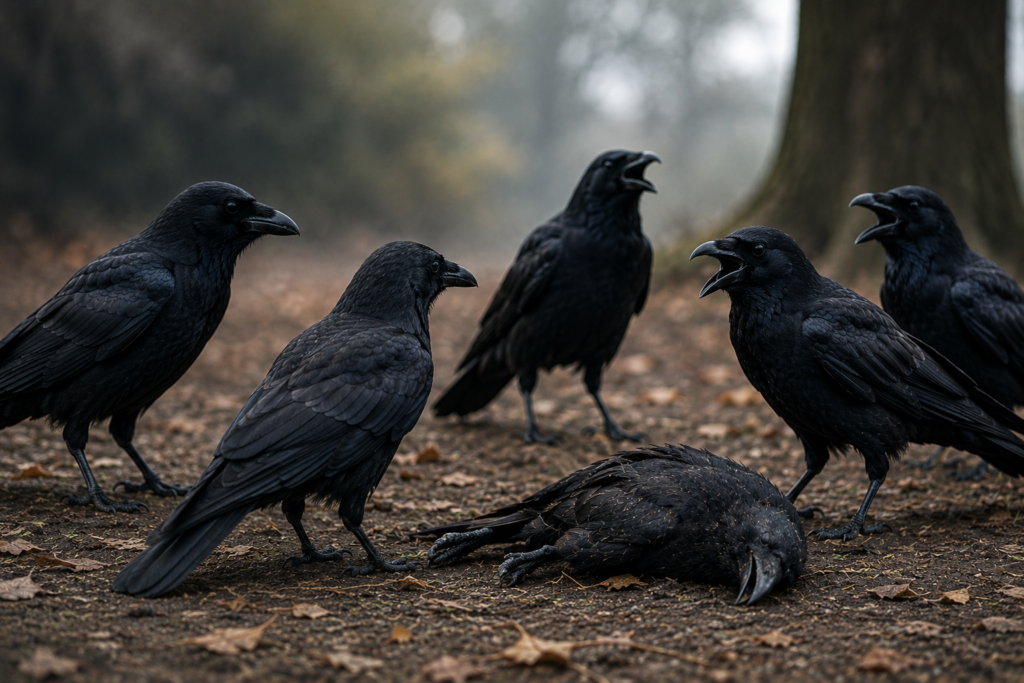
A crow funeral is the name people give to a gathering of crows around a dead member of their species. The birds may call loudly, recruit other crows, watch the body, and remain cautious around the location afterward.
The word “funeral” makes the scene sound like a human memorial service. Research points more strongly to another purpose: crows use the presence of a dead crow to learn about danger. That does not prove that they feel no grief. It means that threat assessment and social learning are the functions scientists can currently support with experimental evidence.
“A crow funeral is not necessarily a memorial ritual in the human sense. Research shows that these gatherings help crows identify threats, alert other birds, and remember potentially dangerous places and individuals.”
Quick answer: A crow funeral occurs when crows gather around a dead crow, often calling loudly and recruiting other birds. Scientific research suggests these gatherings primarily help crows assess danger and learn about potential threats. Whether crows also experience grief or mourning remains an open scientific question.
What Happens at a Crow Funeral?
A crow funeral often begins when one crow notices a dead crow and gives harsh alarm or scolding calls. Other crows may approach and join the calling. The growing group can gather in nearby trees, on wires, or on the ground while watching the body and scanning the surrounding area.
A typical sequence may include:
- Discovery: One or more crows notice the body.
- Alarm: The birds call loudly and interrupt their normal feeding or travel.
- Recruitment: Nearby crows respond and gather.
- Assessment: The group watches the body, the location, nearby animals, and people.
- Mobbing or avoidance: Crows may scold a perceived threat or keep their distance.
- Departure: The birds disperse, sometimes remaining wary of the area afterward.
Not every encounter follows every step. Group size, noise, distance from the body, and the length of the gathering can all vary. Some crows approach closely, while others observe from a safer position.
The event may last minutes, but there is no scientifically established duration that applies to every gathering.
The American crow is a highly social bird that lives in family groups and shares information through calls and group behavior. A noisy gathering can therefore serve as both an alarm and a lesson for birds that did not witness the original danger.
Why Do Crows Gather Around a Dead Crow?
The strongest explanation is that a dead crow provides information about a potentially dangerous place, predator, or person.
In a 2015 study published in Animal Behaviour, University of Washington researchers Kaeli Swift and John Marzluff presented wild American crows with different combinations of a dead crow, a red-tailed hawk, and unfamiliar masked people.
The crows scolded and recruited other crows after seeing a dead member of their own species. They also became slower to approach food in areas associated with the event, with caution continuing for as long as 72 hours in the experiment.
A dead pigeon did not produce the same robust response. That control matters because it suggests the crows were not simply reacting to any dead animal. A dead crow carried particular information about a threat that could also affect them.
A dead crow can function as a warning signal, giving other crows information about a place, predator, or person that may be dangerous.
Crows Can Learn Who Appears Connected to the Danger
The crows did more than notice the body. They learned to associate an unfamiliar human face with the dangerous scene.
After a single event in which a masked person appeared near a dead crow or predator, the birds later scolded that person when the individual returned without the original stimulus. The learned association remained detectable six weeks later.
This does not mean a crow understands guilt in the human sense. It shows that crows can connect a recognizable person with a dangerous event and use that memory later.
Separate University of Washington experiments showed that knowledge of a threatening human face can spread socially after trapping events. Recruitment at a dead-crow gathering may likewise expose nearby birds to alarm responses, but that specific transmission pathway was not directly tested in the 2015 dead-crow experiment.
A Dead Crow Engages Decision-Making Systems
A 2020 PET brain-imaging study added another layer to the evidence.
In this small study of seven captive crows, viewing an unfamiliar dead crow increased activity in the nidopallium caudolaterale, or NCL, relative to control conditions.
Predicted hippocampal and amygdala responses were not detected, although the authors found some support for activity in the striatum and septum. The pattern is consistent with context-dependent decision-making, not proof of a particular subjective experience.
What the research suggests: Taken together, behavioral and neurological evidence makes a crow funeral look less like a burial service and more like a public safety alert in which birds gather information and adjust their future behavior.
Are Crows Mourning or Learning About Danger?
Danger learning is supported by controlled experiments. Mourning remains an open question.
Scientists can measure calls, recruitment, feeding delays, learned avoidance, physical contact, and brain activity. They cannot directly ask a crow what it feels when a mate, offspring, parent, or unrelated crow dies.
That limitation is important because much of the research has used taxidermy specimens unfamiliar to the participating birds.
A crow’s response to a long-term mate or family member could differ from its response to an unknown bird. American crows can form lasting social bonds, so the possibility of an emotional response should not be dismissed simply because danger learning has been demonstrated.
At the same time, calling the gathering proof of grief goes beyond the available evidence. Loud calls and group attendance may look like human mourning, but the same behaviors can recruit help, identify a threat, and teach others to avoid danger.
The most accurate conclusion is not that crows either mourn or learn. They clearly learn. What they may feel alongside that learning is unresolved.
Common Myths About Crow Funerals
Myth: Crows Bury Their Dead
There is no good scientific evidence that American crows routinely dig graves, cover dead crows, or perform burial rites.
Stories about crows placing grass, sticks, or objects near a body are sometimes interpreted as ceremonial offerings, but an object near a carcass is not proof of intentional burial or tribute.
No routine burial behavior has been established scientifically. Controlled field studies describe alarm calling, recruitment, caution, and occasional contact, not a crow burial rite.
Myth: Every Gathering Is a Memorial Service
The word “funeral” describes how the event looks to people.
Unlike human memorial services—which vary deeply across cultures, such as Zoroastrian funeral traditions, Buddhist funeral traditions, or traditional African funeral customs—crow gatherings do not establish the birds’ motivation as grief.
Experimental findings show that crows use these encounters to assess risk and learn about dangerous places, predators, and people.
Myth: Crows Always Touch or Eat the Body
Most crows keep their distance.
In a 2018 study of physical interactions with dead crows, Swift and Marzluff found that contact was atypical. When it occurred, it could include touching, pecking, dragging, aggression, or rare sexual behavior.
The researchers concluded that these uncommon contacts did not support a simple explanation based on food, territorial defense, or information gathering.
A crow funeral should not be pictured as a group routinely handling or consuming the dead bird.
Myth: A Crow Funeral Predicts Another Death
Crows have carried associations with death, change, intelligence, and mystery in many stories and traditions.
Science does not support the claim that a gathering of crows predicts a human death or other future event.
The immediate explanation is usually close at hand: the birds have found a dead crow and are responding to a possible threat.
Myth: Crow Funerals Always Last a Certain Amount of Time
There is no fixed schedule.
Some observed gatherings disperse within minutes, while activity can recur if new birds arrive or the perceived danger remains. Research trials often use set observation periods, but those experimental windows should not be presented as a universal natural duration.
What Should You Do If You Find a Dead Crow?
A dead crow may be the result of a collision, predation, disease, or another cause that cannot be determined by sight.
The CDC notes that infected crows and jays are among the birds known to become sick and die from West Nile virus. Give the bird space and keep children and pets away from it.
For U.S. readers, the safest steps are:
- Do not touch the bird with bare hands.
- Check local instructions. Contact your state wildlife agency, state health department, animal control office, or local public works department. Reporting practices differ by location.
- Report unusual die-offs. Several dead birds in one place or birds showing unusual illness may warrant investigation. Dead-bird reports can assist monitoring for West Nile virus and avian influenza.
- Follow disposal directions. If local authorities tell you to dispose of the bird, use disposable gloves or an inverted plastic bag to pick it up. Place it in a bag and put it in the trash if that is permitted locally.
- Wash thoroughly. Wash your hands with soap and water after removing gloves.
The CDC’s dead-bird guidance advises avoiding bare-handed contact and checking with state or local agencies. USGS guidance says a cluster of sick or dead animals may warrant reporting to state or federal wildlife agencies or a local health department.
Current advice can change during animal-disease outbreaks, so local officials should remain the final authority.
Important: Do not handle a dead crow with bare hands. Keep pets and children away and check current state or local wildlife and public-health guidance before moving or disposing of the bird.
What Can a Crow Funeral Symbolize?
Science can explain much of the crow’s behavior without deciding what the experience means to a human observer.
Someone who encounters a crow funeral during a period of grief may see vigilance, community, remembrance, or the way one life can command the attention of many others.
Those reflections can be personally meaningful. They should simply be kept separate from claims about what the crows themselves believe.
A symbol does not need to be a prediction. It can be an invitation to pause.
Human memorial traditions also gather people around a loss, reflecting the evolution of funeral ceremonies throughout the years, but their purpose is expressed through stories, photographs, prayer, music, and shared memories.
For those navigating a death, Honor You offers grief and loss resources and additional articles on the Honor You blog.
What Crow Funerals Can Teach Us About Attention and Memory
A crow funeral reveals something remarkable even when we resist turning it into a human ceremony.
Crows notice death. They interrupt ordinary activity, alert others, examine the context, and remember what may have placed another crow at risk.
That response is practical, social, and cognitively demanding. It shows how information about danger can move through a community and remain useful after the immediate event has passed.
For people, remembrance serves a different purpose. We gather to preserve identity, tell stories, and make a life visible in the details that matter.
Families preparing a service can explore Honor You’s personalized memorial products, including funeral programs, prayer cards, keepsakes, photo displays, and digital tributes.
Key takeaway: The science of crow funerals does not give us a simple answer about animal grief. It gives us a more careful one: crows pay attention to the dead, learn from what happened, and carry that knowledge forward.
Frequently Asked Questions
Do Crows Really Have Funerals?
Crows hold gatherings that people commonly call funerals. The birds may alarm-call, recruit others, observe the body, and avoid the area afterward.
Research supports danger assessment and social learning as central functions, but does not prove that the gathering is a memorial ritual like a human funeral.
How Long Does a Crow Funeral Last?
There is no fixed duration. A gathering may last several minutes or continue longer depending on the number of birds, the setting, and whether a possible threat remains nearby.
Claims that every crow funeral lasts a specific amount of time are not supported.
Do Crows Bury Dead Crows?
No routine burial behavior has been established scientifically. Controlled field studies describe alarm calling, recruitment, caution, and occasional contact, not a crow burial rite.
Do Crows Remember Who Killed Another Crow?
Crows can remember a person associated with a dead crow, but the research does not show that they understand who “killed” it.
In experiments, crows learned to scold a masked person seen near a dead crow or predator and retained that association for at least six weeks.
Should I Remove a Dead Crow From My Yard?
Check with your state wildlife agency, health department, or local animal-control authority first.
Do not handle the bird with bare hands. If officials direct you to dispose of it, follow their protective and bagging instructions.