Walking into a new church for the very first time can be an incredibly inspiring yet socially intimidating experience. As a visitor navigates unfamiliar hallways, attempts to grasp local worship customs, and searches for a place to sit, they are quietly determining whether this community is a place they can eventually call home. Ministry research consistently shows that a guest decides within the first few minutes of arriving whether they feel truly welcomed, valued, and noticed. Because of this brief window of opportunity, pastoral teams and outreach coordinators must establish clean, hospitable, and intuitive pathways for connection.
One of the most dependable, time-tested tools for bridging the gap between a brief initial visit and long-term membership is the humble connect card. Implementing strategically designed church visitor cards provides your welcoming team with a seamless, respectful method to learn who attended your weekend services, collect vital contact details, and execute structured outreach without making newcomers feel overwhelmed or cornered by aggressive sales tactics. Instead of acting as a sterile administrative form, a well-executed card functions as an extended hand of fellowship—a quiet, dignified message signaling that your church is genuinely invested in their spiritual journey.
This comprehensive guide dives deep into the strategic art of designing, distributing, and executing follow-up strategies for church welcome cards. Whether your goal is to refresh old physical templates, build a high-converting digital connection portal, or train your hospitality volunteers to navigate visitor interactions naturally, this article provides the foundational toolkits, copy-and-paste wording examples, and mistake-avoidance frameworks your ministry needs to turn an initial attendance milestone into a lifelong relational connection.
What Are Church Visitor Cards?
At their functional core, church visitor cards are simple, beautifully structured physical or digital documents deployed during weekly services to capture basic contact details and spiritual milestones from first-time guests. Known across various denominations as connection cards, welcome slips, or church guest cards, these pieces of stationery serve as the primary entry point for a church’s administrative database or guest follow-up system. They transform an anonymous face in the congregation into a known individual with unique prayers, needs, and communication preferences.
To maximize their operational effectiveness, a versatile church visitor information card must be easily accessible at multiple focal points throughout your campus. In a physical environment, they are traditionally distributed across the following locations:
- The Welcome Table or Connection Desk: Centrally located hubs in the main lobby or foyer where dedicated hospitality volunteers greet newcomers face-to-face.
- Church Pews or Seatback Pockets: Placed directly within arm’s reach of attendees, allowing guests to fill them out privately during reflective moments of the service.
- VIP Guest Bags or Welcome Kits: Gift packages handed out by greeters that contain helpful introductory information booklets, ministry overviews, and a dedicated new visitor cards for church registration form.
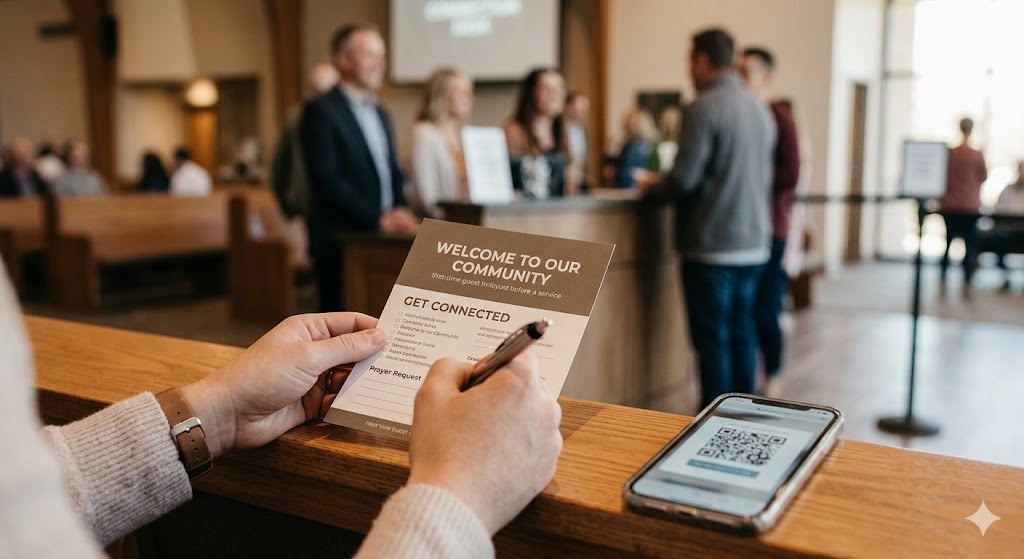
In the modern ministry space, physical materials are frequently paired with digital infrastructure. Incorporating a dynamic online form or a prominent QR code on your auditorium screens enables mobile-savvy guests to complete a digital visitor card straight from their smartphones without needing to search for a pen.

Why Church Visitor Cards Are Important
Failing to collect contact information from a first-time guest means missing a critical opportunity to build a relationship. Once a visitor drives away from your parking lot, your hospitality team loses its ability to proactively foster connection. This reality highlights why implementing structured visitor cards for church operations is a fundamental baseline for long-term growth and outreach success.
When properly integrated into your weekend liturgy, these cards offer several primary organizational benefits:
- Accurately Identifies Newcomers: It gives pastors clear, real-time insight into the growth patterns of their congregation, helping leadership move away from guesswork and lean on concrete data.
- Streamlines Church Visitor Follow-Up: Providing a structured collection system ensures that your administrative staff can immediately copy accurate contact information into your church management software, triggering automated or personal outreach sequences within 24 to 48 hours.
- Empowers Practical Pastoral Care: Newcomers often use these cards to request immediate support, register for upcoming small groups, or submit confidential prayer requests that go directly to the pastoral prayer team.
- Provides Critical Outreach Insights: Tracking answers to the standard question, “How did you hear about us?” helps stewardship teams evaluate the real-world impact of their digital marketing, community mailers, or personal invitation campaigns.
This commitment to building well-organized, highly functional resources closely aligns with HonorYou’s broader foundational strategy of refining user experiences, improving site structures, and empowering communities with the essential tools they need to navigate meaningful milestones. Just as a well-ordered church infrastructure uses connection cards to welcome people into a spiritual family, prioritizing clean navigation templates and rich, intentional site organization ensures that searching families can seamlessly access life-giving community support portals during moments of celebration, transition, or remembrance.
What to Include on a Church Visitor Card
One of the most frequent administrative blunders a church can make is treating a connection card like a comprehensive credit application or tax document. Forcing a first-time visitor church attendee to fill out rows of fine print creates immediate psychological friction, which dramatically lowers submission rates. The rule of thumb for effective database design is simple: collect only the essential details required to launch an authentic, meaningful conversation.
When engineering your next batch of physical or digital templates, prioritize these highly recommended high-converting information fields:
- Full Name: Clean spacing for both first and last names.
- Primary Phone Number & Email Address: The core operational lifelines for executing your digital outreach strategy.
- Mailing Address (Optional): Useful if your ministry plans to send a physical postcard or a gift box, but explicitly mark it as optional to protect personal privacy boundaries.
- Status Checkboxes: Clear options such as “First-Time Guest,” “Regular Attendee,” or “Looking for a Spiritual Home.”
- How Did You Hear About Us?: Simple multiple-choice checkboxes listing Social Media, Google Search, Friend Invitation, or Community Signage.
- Preferred Contact Method: Let them choose whether they prefer a text message, phone call, or email.
- Prayer Requests & Ministry Interests: A dedicated blank space where they can quickly write personal needs or check off interests like Children’s Ministry, Small Groups, or Volunteer Teams.
“A shorter card with clear whitespace and fewer requirements will consistently outperform a congested, overly detailed questionnaire by reducing a guest’s cognitive friction during a service.”
Church Visitor Card Wording Examples
The copy and phrasing you place at the top of your physical stationery establishes the tone for your church’s entire hospitality culture. If your wording feels overly corporate or legalistic, guests will hesitate to fill it out. However, utilizing warm, intentional, and reassuring language immediately frames the process as a relationship-building tool rather than a cold data-collection effort. Choose a style below that mirrors your church’s unique cultural personality:
Simple & Direct Wording
Perfect for traditional, multi-generational, or high-attendance liturgical environments where clarity and respect are paramount:
“Thank you for visiting us today! We are so incredibly glad you chose to join our community for worship. Please take a quick moment to fill out this card so we can officially welcome you, answer any questions you may have, and help you find your next steps.”
Modern & Friendly Wording
An ideal option for contemporary church plants, community fellowships, and ministries that want to cultivate a casual vibe:
“Welcome to the family! We are deeply honored to share this space with you today. Tell us a little bit about yourself below so we can stay in touch, answer your questions, and help you feel completely at home here. No pressure—just connection.”
Care & Prayer-Focused Wording
A beautiful approach that emphasizes pastoral care, community support, intercessory prayer, and unconditional love over cold data entry:
“We would love to pray for you. More than anything else, our church is here to support you through life’s joys and burdens. Please use this space to share any prayer requests, questions, or ways our pastoral care teams can stand beside you this week.”
Design Tips for Church Visitor Cards
The visual look and layout of your custom visitor stationery impacts its fill-out rate just as much as the text itself. A cluttered card with tiny fonts and microscopic fill-in lines looks unprofessional and deters older attendees or busy parents. Your goal should be a clean layout that prioritized readability above all else.
When partnering with a professional layout artist or designing a custom template from scratch, implement these essential print guidelines:
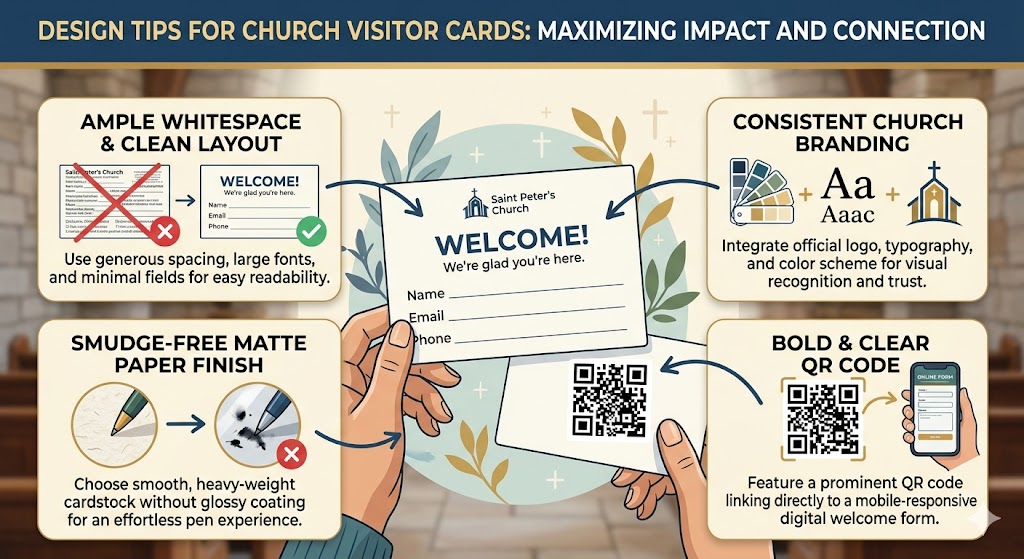
- Keep the Layout Clean and Spacious: Ruthlessly cut unnecessary text or fields to ensure there is plenty of whitespace. If lines are crammed too closely together, people with larger handwriting will skip the card entirely.
- Incorporate Consistent Church Branding: Use your ministry’s official typography, color palette, and high-resolution logo to build brand trust and visual recognition.
- Select a Matte Paper Finish: Never print physical connection cards on ultra-glossy paper stocks. Glossy surfaces smudge easily when written on with standard ballpoint or gel pens, frustrating your guests. A smooth, heavy-weight matte cardstock provides a premium feel and an effortless writing experience.
- Include a Bold, Clear QR Code: For those who prefer digital interactions, feature a prominent, high-contrast QR code on the back of the physical card that links directly to a mobile-responsive church visitor form.
If your team is currently deciding on physical dimensions for your guest engagement stationery, reviewing established, professional print guidelines can save your team considerable time and money. For example, exploring industry-standard formatting dimensions—like those highlighted in our resource on choosing the right prayer card dimensions—provides a helpful baseline for selecting clean, pocket-friendly layouts that fit perfectly into seatbacks without bending. Similarly, pulling design inspiration from modern typography trends found in premium celebration of life invitations can help you strike a beautiful balance between reverence, warmth, and contemporary style.
Printed vs. Digital Church Visitor Cards
A frequent debate among creative pastors is whether to completely abandon physical cards for digital alternatives like text-to-join keywords or QR links. While digital platforms are cost-effective, completely eliminating physical touchpoints often alienates less tech-savvy generations, new families with small children, or individuals who want a break from screens during worship. The most effective approach for a growing church is a hybrid model that utilizes both mediums.
| Medium | Core Advantages | Best Use-Case Scenarios |
|---|---|---|
| Printed Cards | Offers a tangible, analog touchpoint; perfect for note-takers and multi-generational crowds; doesn’t require cell service or tech experience. | Traditional sanctuaries, morning worship services, physical pew pockets, and welcome gift bags. |
| Digital Cards | Zero print overhead costs; eliminates data entry errors; integrates immediately with automated email and SMS workflows. | Livestream church broadcasts, youth ministries, young adult gatherings, and large-screen announcement slides. |
How to Encourage Guests to Fill Out Your Cards
Simply printing a beautiful connect card and hiding it in a pew pocket will rarely yield a high volume of guest registrations. If your community leadership fails to talk about the card openly, your visitors will assume the document is intended strictly for internal membership business. To get more cards turned in, your hospitality teams must build an intentional, low-pressure strategy that highlights the card during every weekend service.
Try implementing these practical, real-world steps to encourage guest participation:
- Dedicate a Specific Announcement Window: Have a warm, welcoming pastor physically hold up the card during the mid-service greeting time, clearly explaining exactly where to find it and why it matters.
- Offer a Small, Thoughtful Welcome Gift: Incentivize submissions by letting guests know they can trade their completed card at the welcome desk for a free premium gift, such as a custom church coffee mug, a local bakery treat, or an inspirational book.
- Clearly Explain the ‘Why’: Reassure your audience by stating explicitly that you protect their privacy: “We promise we won’t show up unannounced at your house or spam your inbox; we just want to send a brief thank-you note and pray over your week.”
Follow-Up Ideas After Someone Fills Out a Visitor Card
Gathering contact information is only half the battle. The real breakthrough in guest retention happens during the 48 hours following a service, when your team follows up on the information collected. A guest who receives a prompt, sincere, and personalized message is far more likely to return for a second consecutive weekend.
An effective, multi-layered church visitor follow-up system should feature these key touchpoints:
- The Monday Morning Email: Send a clean, visually appealing, and concise message from the lead pastor thanking them for spending their Sunday morning with your community. Keep it focused on gratitude and avoid a heavy sales pitch.
- The Mid-Week Personal Text: Have a hospitality coordinator send a direct, personalized text message on Tuesday afternoon: “Hi Sarah, it was great meeting you at the Welcome Desk this weekend! Hope your week is off to an amazing start.”
- The Pastoral Prayer Confirmation: If the visitor wrote a specific prayer request on their card, ensure a team member follows up explicitly on that item by Friday: “We wanted to let you know our pastoral team prayed for your upcoming medical procedure this morning. We are standing with you.”
- The Newcomer Event Invitation: Automatically add them to a gentle monthly invitation loop for a casual “Pizza with the Pastors” lunch or an introductory meet-and-greet gathering designed for new families.
Church Visitor Card Template
To reduce your administrative planning workload, you can copy, paste, and customize this clean, standard church visitor card template text directly into your local word processor, design software, or digital form builder:
Welcome to [Church Name]!
We are absolutely thrilled that you chose to worship with us today. Whether you are looking for a new spiritual home or just passing through town, you are welcome here. Please take a moment to share your journey with us.
Name: ____________________________________________________
Email Address: _____________________________________________
Phone Number: ___________________________________________
Preferred Contact Method: [ ] Text Message [ ] Email [ ] Phone CallIs this your very first visit? [ ] Yes [ ] No
How did you hear about our church?
[ ] Social Media [ ] Website Search [ ] Friend/Neighbor [ ] Community EventI would love more information on:
[ ] Children’s Ministry [ ] Small Groups / Bible Studies [ ] Volunteering [ ] How to Follow ChristYour Prayer Requests or Comments:
_________________________________________________________________________________
_________________________________________________________________________________*Privacy Note: Your personal information is sacred to us. We will use it exclusively to connect with you and will never sell or share it with third parties.
Common Mistakes to Avoid
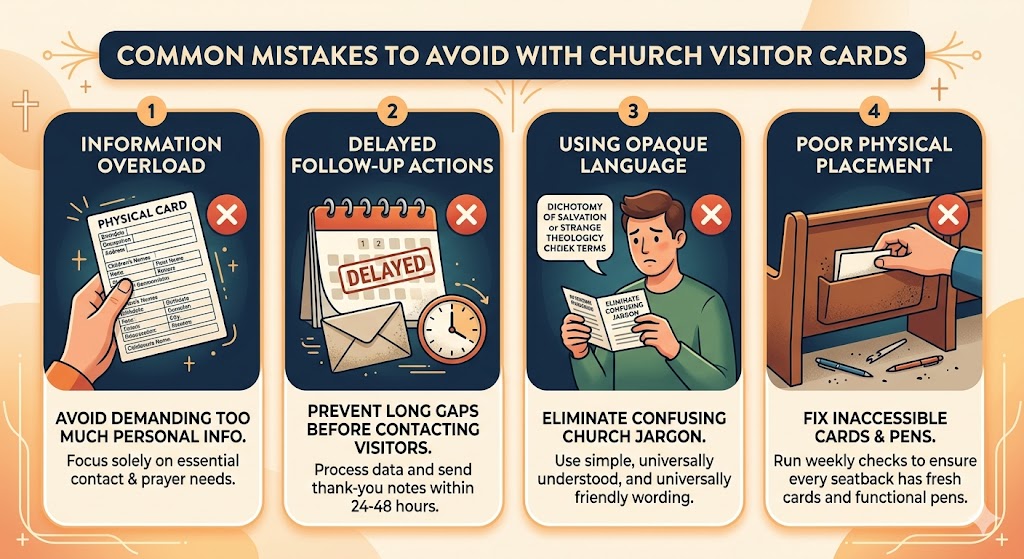
Even with excellent intentions, simple missteps in card implementation can accidentally create long-term barriers for visitors. Reviewing this quick operational checklist will keep your engagement strategy polished, safe, and relationally effective.
| Common Mistake | Why to Avoid It | What to Do Instead |
|---|---|---|
| Information Overload | Demanding birthdates, occupation details, and complete family descriptions right away feels intrusive and lowers response rates. | Focus solely on their name, primary contact channel, and immediate prayer needs. |
| Delayed Follow-Up Actions | Waiting until the following Friday or two weeks later to reach out makes your church look disorganized or indifferent. | Process all incoming data by Monday evening and send out your first thank-you notes within 24-48 hours. |
| Using Opaque Language | Using internal church lingo or complex theological jargon can confuse and distance non-churchgoers. | Keep your wording simple, accessible, clear, and universally friendly. |
| Poor Physical Placement | Forgetting to place pens nearby or leaving cards hidden at the bottom of shelves makes it physically difficult for guests to participate. | Run weekly checks to ensure every seatback pocket has functional pens and a fresh, clean card. |
Final Thoughts
When you boil church growth strategies down to their core, a visitor card is much more than a simple slip of cardstock or a digital entry field in a database. It serves as a vital hospitality tool that bridges the gap between an anonymous first-time visit and a meaningful, long-term relationship within a thriving spiritual community. It tells your guests that you see them, value them, and are ready to support them on their spiritual path.
By keeping your layout clean and easy to scan, choosing clear and welcoming wording, removing pressure from the response process, and building a fast, intentional follow-up workflow, your ministry team can confidently welcome newcomers with open arms. If your team is also looking to expand its community support materials or needs layout ideas for print assets, feel free to check out our comprehensive guide on high-quality printed obituary programs and custom layouts to learn more about setting high standards for all your community communications.
Frequently Asked Questions
What are church visitor cards used for?
Church visitor cards are specifically designed to gather basic contact information from first-time guests. This allows pastoral and hospitality teams to follow up promptly, answer questions, provide ministry details, and offer personalized spiritual care.
What essential information should a church visitor card include?
An effective card should always include the visitor’s full name, phone number, email address, an option to share prayer requests, a question about how they discovered the church, and clear check-boxes indicating their specific ministry interests.
Should our church use physical printed cards or digital QR codes?
For the best results, implement a hybrid model that uses both strategies. Physical printed cards work wonderfully for traditional settings, older generations, and seatback pockets, while digital forms paired with QR codes appeal to mobile-first visitors and streaming audiences.
How can we encourage more guests to actually complete our connect cards?
Make a clear, friendly announcement during the service that explains the card’s purpose. Ensure pens are readily available in all seating areas, keep the requested information brief, and consider offering a small, welcoming appreciation gift at the lobby desk in exchange for the completed card.
What should a church say when following up with a first-time visitor?
Keep your initial follow-up message brief, warm, and focused on gratitude rather than high-pressure commitments. Thank them sincerely for attending your worship service, ask if they have any questions about your programs, and invite them to join you for an upcoming weekend or an informal newcomer event.