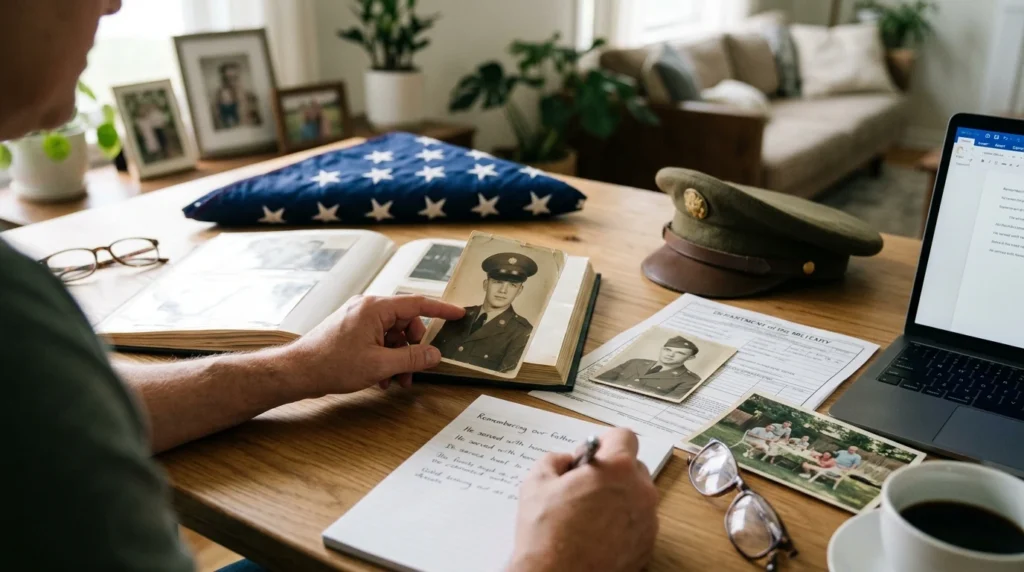
The most useful military obituary examples start with what a family knows. A sentence such as “Grace served in the U.S. Navy and later taught bookkeeping at the community college” tells readers something true about two parts of a life. You can add a rank, assignment, or award when you can verify it, but a branch and a memory are enough to begin.
As you write, think about who will recognize the person on the page. A Navy friend may remember Grace as the one who could make sense of any ledger. A former student may remember how she stayed after class until the numbers finally clicked. Together, those memories tell readers more about Grace than a list of dates ever could.
You do not need complete military records to honor a veteran’s life. Start with the branch they served in and one concrete, everyday memory that the people who loved them will instantly recognize.
Which Service Details Belong in a Veteran Obituary?
Write the person’s name the way the family wants it to appear. Then make two short lists: on one, put service facts you can confirm, such as branch, years served, occupation, or final rank. On the other, put personal details that someone who loved them would recognize—look for an ordinary habit, a cause they supported, or something they made time to teach.
Pick the facts that help readers understand this particular person. If your father talked often about the friendships he made as an Army cook, that job may belong in the first paragraph. If your aunt rarely talked about her service and wanted to be remembered for the children’s choir she directed, begin with the choir and give her military service its own sentence later. For help organizing the rest of the notice, see Honor You’s guidelines for writing an obituary.
When a Detail Is Uncertain
The National Archives guide to separation documents describes information a DD Form 214 typically contains, including a last duty assignment, rank, military specialty, and awards. If the family already has the record, use it to check a spelling or title, copying only the details you intend to publish (as family copies contain sensitive personal information).
If relatives remember details differently, narrow the sentence to what they can confirm. “He served in the U.S. Army” is a complete sentence that you can print while a question about his final rank remains open. Likewise, dates establish when someone served—use words such as “deployed” or “in combat” only when you have specific confirmation.
Three Military Obituary Examples
These fictional examples use varying amounts of information. You can borrow their structure and replace every name, memory, and service detail with your own.
1. A Short Newspaper Notice
“Eleanor ‘Nell’ Porter, 82, of Maplewood, died on October 8. A U.S. Navy veteran and retired school secretary, Nell knew the name of every child who stopped at her desk. She is survived by her wife, Frances, and her nephews, Martin and Luis. Friends are invited to remember Nell at a gathering on October 18 at 2 p.m. at the community hall.”
Nell’s notice has room for one precise image: a child at her desk. If you need an even shorter version for print, combine the first two sentences while keeping the service information intact—for example, “Eleanor ‘Nell’ Porter, 82, of Maplewood, a Navy veteran and longtime school secretary, died on October 8.” The family can include the fuller memory in the printed program.
2. A Life Remembered Beyond the Uniform
“Thomas Bell could tell who was coming up the porch steps by the sound of their shoes. His nieces and nephews spent half their summers there, helping him shell peas, listening to baseball and trying to catch him looking at the crossword answers. Tom, 78, died on May 14 with his family beside him.
“Tom served as a mechanic in the U.S. Air Force. He remained close to two friends from those years, making the same Sunday evening phone call even as the three men moved across the country. Back home, he kept cars running for neighbors who could pay him and neighbors who could only offer a good story.
“He is survived by his sister, June, and three generations of nieces and nephews. His family will gather privately. Anyone who remembers Tom is welcome to take a long lunch with an old friend in his honor.”
A longer veteran obituary gives you room to explain what a military friendship became after service. If you are sharing a remembered conversation, ask someone who was there to verify it; when exact words are uncertain, paraphrase the memory in your own voice.
3. When the Family Knows Only the Branch
“Marian Ellis, a retired bus driver and U.S. Army veteran, died on February 3 at age 86. On her early route, she waited until her youngest passengers found their seats before she pulled away. Years later, some of those children brought their own children to meet her.
“Marian is survived by her daughter, Naomi, and her grandson, Ellis. The family will hold a private gathering and welcomes written memories to share with Ellis as he grows up.”
There is no gap for readers to fill here. The family knows Marian served in the Army and knows exactly how she cared for children on her route, and both facts deserve their place. If service records arrive later, the family can decide whether to expand an online tribute or simply keep the new information for themselves.
A Military Obituary Template You Can Adapt
Read the result aloud and remove any unused brackets or prompts. If the notice starts to sound too much like a form, move the sentence about the person’s everyday life to the very beginning—you can introduce a teacher through the students who came to dinner every graduation weekend, then bring in their name, dates, and service.
Turn a Service Detail Into a Story
Imagine a first draft says, “Pat was a decorated hero who served overseas.” The family has confirmed that Pat repaired radios in the Navy and remembers a kitchen drawer full of spare parts, but is unsure about any official awards. Try revising it to: “Pat repaired radios in the Navy. At home, the kitchen drawer held the exact spare part somebody needed.” This revision keeps the military fact the family can stand behind while giving readers a genuine glimpse of Pat at home.
Prepare the Obituary for a Newspaper or Funeral Program
Ask the publication for its length limits, submission deadline, and proofing process before the family begins cutting a favorite passage. Honor You’s guide to obituary costs explains why publication choice and word count matter. If space is tight, remove repeated descriptions first while keeping the preferred name, essential family information, and any details guests will rely on to attend.
For printed funeral programs, the longer version can sit comfortably beside a photograph or the order of service. Read the draft at the actual size it will appear in print. Have a relative who served check the military wording, and ask another reader to verify names, dates, and relationships—giving both readers the exact same version so the printer receives one approved text.
Read the service announcement as if you were a guest. Is the stated time for the gathering or the burial? Is everyone invited? If military honors are being arranged, name them only after the organizer confirms them. “The family will gather privately” is sufficient when a public invitation is unnecessary. Finally, verify that the exact same information appears wherever the obituary will be shared.
Frequently Asked Questions
Does a veteran’s rank have to appear before their name?
No. You can use the name the person used in daily life and mention a verified rank in the service sentence. If the family prefers a formal title before their name, confirm the exact wording and the publication’s house style before sending the final proof.
How do we describe peacetime service?
Name the branch and, if known, the specific work or years served. “Luis served in the Coast Guard and particularly valued the people he trained with” is plenty when that is what the family remembers—honorable service does not require a combat reference.
Should we include an award we cannot verify?
It is best to leave unverified awards out of the version going to print. You can ask a trusted relative to check the official name on separation records if you want to add it later; a confirmed detail about the person’s everyday work stands strongly on its own.
Do we need to mention military funeral honors?
Include confirmed details when the family wants guests to know what to expect, though it is also completely fine to share just the gathering’s time and place.
Need Help Shaping Your Loved One’s Tribute?
Writing about a life of service while navigating grief is no small task. If your family has gathered the facts and memories but would like compassionate support weaving them together, Honor You’s professional obituary writing service can help you put all the pieces into a dignified, lasting tribute.