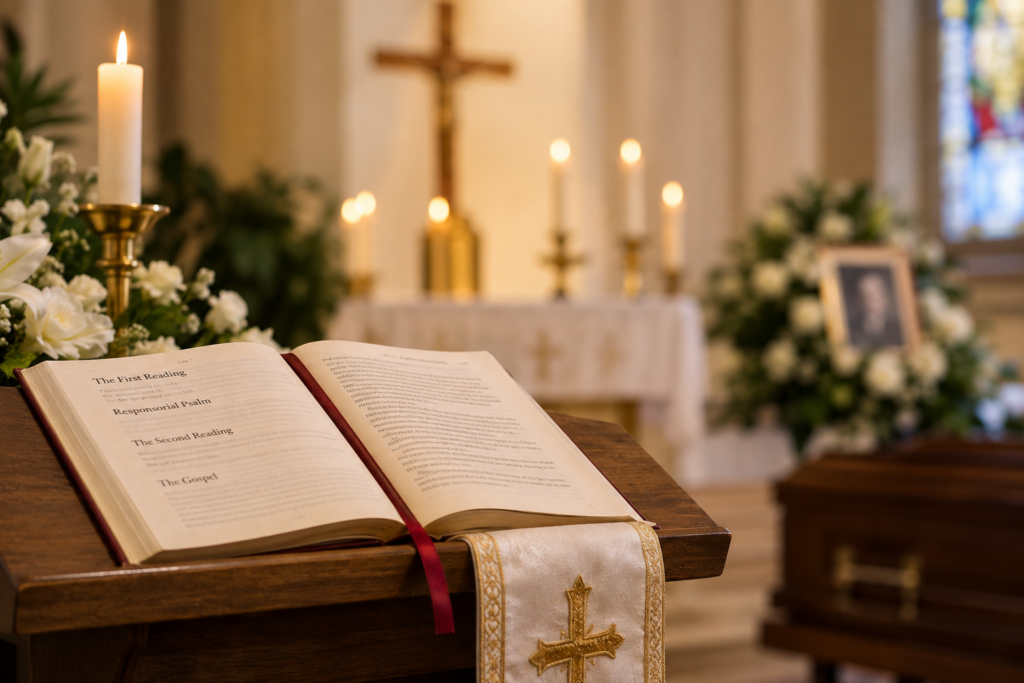
Planning a funeral for a loved one is a deeply emotional and challenging experience. If you are arranging a Catholic Requiem Mass, you will be asked to select the readings for funeral mass. For many grieving families, participating in this process offers a profound sense of comfort, but it can also feel overwhelming if you are unfamiliar with the Catholic lectionary.
The Catholic funeral liturgy is designed to express our hope in eternal life, the resurrection, and the paschal mystery of Christ. The words spoken at the altar are meant to bring solace to the sorrowful while celebrating the faith of the deceased. Whether you are looking for funeral Bible verses that reflect a long life of quiet faith, or scriptures that provide strength following a sudden loss, the Church offers a rich selection of approved texts.
In this comprehensive guide, we will walk you through the funeral mass order of service, explain the rules surrounding Catholic funeral readings, and provide a curated list of the most beautiful and comforting Old Testament, New Testament, Psalm, and Gospel selections.
Understanding the Liturgy of the Word at a Funeral Mass
When you sit down with your parish priest or bereavement coordinator to plan the mass, you will be looking at the Order of Christian Funerals. This official liturgical book outlines exactly how the mass must proceed. The portion of the mass where scriptures are proclaimed is called the Liturgy of the Word.
The Structure of Catholic Funeral Readings
A standard Catholic funeral mass follows a specific structural progression. To help families understand the flow of the readings, here is a quick overview:
| Reading Type | Source Material | Who Proclaims It |
|---|---|---|
| First Reading | The Old Testament (Except during Easter season) | A Lector (Family member or friend) |
| Responsorial Psalm | The Book of Psalms | A Cantor (Sung) or a Lector (Spoken) |
| Second Reading | The New Testament (Usually the Epistles) | A Lector (Family member or friend) |
| The Gospel | Matthew, Mark, Luke, or John | The Priest or Deacon |
Who Should Read?
The Catholic Church highly encourages the active participation of the grieving family and close friends. You will need to select one or two people to serve as Lectors for the First and Second readings. When choosing these individuals, select people who are comfortable speaking in public and who can maintain their composure during an emotional moment.
As per liturgical rules, the Gospel is always reserved for an ordained minister—either the presiding Priest or a Deacon.
Popular Old Testament Readings (First Reading)
The Old Testament readings for funeral masses set the foundational tone of hope, emphasizing God’s eternal promise to His people. Below are some of the most comforting and frequently chosen selections.
- Wisdom 3:1-9
Theme: Peace and eternal reward after suffering.This is arguably the most popular first reading for a Catholic funeral. It offers immense comfort, especially for families whose loved one endured a long illness, assuring them that the departed are finally at peace.
“The souls of the just are in the hand of God, and no torment shall touch them. They seemed, in the view of the foolish, to be dead; and their passing away was thought an affliction… but they are in peace.”
- Isaiah 25:6, 7-9
Theme: Hope and God’s victory over death.This powerful prophetic reading paints a picture of God destroying death forever and wiping away the tears from every face. It is an incredibly uplifting choice that focuses on the promise of salvation.
“He will destroy death forever. The Lord God will wipe away the tears from every face… Behold our God, to whom we looked to save us! Let us rejoice and be glad that he has saved us!”
- Ecclesiastes 3:1-11
Theme: The natural seasons of life.A deeply poetic and universally recognized passage, this reading helps families find meaning in the natural rhythm of life, death, joy, and sorrow.
“There is an appointed time for everything, and a time for every thing under the heavens. A time to be born, and a time to die; a time to plant, and a time to uproot the plant.”
- Lamentations 3:17-26
Theme: Trusting in God during deep sorrow.When the grief is heavy and the loss is particularly difficult, this reading validates that sorrow while pointing toward the enduring mercies of the Lord.
“My soul is deprived of peace, I have forgotten what happiness is… But this I will call to mind, and therefore I will hope: The favors of the Lord are not exhausted, his mercies are not spent.”
Comforting Responsorial Psalms
Following the First Reading, the congregation participates in the Responsorial Psalm. While these can be spoken by a Lector, responsorial psalms for funerals are most traditionally—and beautifully—sung by a parish cantor, accompanied by piano or organ. The congregation joins in by singing a repeated refrain.
- Psalm 23: “The Lord is my shepherd; there is nothing I shall want.” Easily the most recognizable psalm in the Bible, it offers profound comfort by visualizing God guiding us through the “valley of the shadow of death.”
- Psalm 27: “The Lord is my light and my salvation.” A psalm of fearlessness and faith, asking to dwell in the house of the Lord all the days of one’s life.
- Psalm 103: “The Lord is kind and merciful.” This psalm focuses on God’s immense forgiveness and compassion for our human frailties.
Uplifting New Testament Readings (Second Reading)
The new testament readings for catholic funeral masses are typically drawn from the Epistles (letters) of St. Paul and St. John. These texts directly address the resurrection of Jesus Christ and how His victory over death applies to all baptized Christians.
- Romans 6:3-9
Theme: Baptism and resurrection.This reading explicitly connects the deceased’s earthly baptism to their future resurrection. It is a cornerstone of Catholic theology regarding death.
“Are you unaware that we who were baptized into Christ Jesus were baptized into his death? … If, then, we have died with Christ, we believe that we shall also live with him.”
- Romans 8:31-35, 37-39
Theme: Unbreakable love.A triumphant and deeply reassuring passage, St. Paul reminds the grieving that absolutely nothing—not even death itself—can separate us from God’s love.
“What will separate us from the love of Christ? Will anguish, or distress, or persecution, or famine, or nakedness, or peril, or the sword? … No, in all these things we conquer overwhelmingly through him who loved us.”
- 1 Thessalonians 4:13-18
Theme: Comfort for the grieving.St. Paul wrote this letter specifically to a community that was mourning the loss of their loved ones, urging them not to grieve “like the rest, who have no hope.”
“We do not want you to be unaware, brothers, about those who have fallen asleep, so that you may not grieve like the rest, who have no hope. For if we believe that Jesus died and rose, so too will God, through Jesus, bring with him those who have fallen asleep.”
- Revelation 14:13
Theme: Rest from earthly labors.A short but incredibly poignant reading, perfect for someone who worked tirelessly in their life or suffered significantly before passing.
“Blessed are the dead who die in the Lord from now on. ‘Yes,’ said the Spirit, ‘let them find rest from their labors, for their works accompany them.'”
The Gospel Reading
The Gospel is the climax of the Liturgy of the Word. While the Priest or Deacon generally selects this reading based on their homily, many priests welcome family requests when choosing gospel readings for funeral masses.
- John 11:17-27 (Jesus and Martha)This is the story of Jesus raising Lazarus from the dead. Jesus speaks directly to Martha in her grief, providing one of the most famous promises in the Christian faith.
“Jesus told her, ‘I am the resurrection and the life; whoever believes in me, even if he dies, will live, and everyone who lives and believes in me will never die.'”
- Matthew 5:1-12 (The Beatitudes)Often chosen for individuals who lived exceptionally gentle, merciful, and charitable lives, the Beatitudes remind us that God blesses those who mourn.
“Blessed are the poor in spirit, for theirs is the Kingdom of heaven. Blessed are they who mourn, for they will be comforted. Blessed are the meek, for they will inherit the land.”
- John 14:1-6 (Many Dwelling Places)Jesus comforts His disciples before His own death, assuring them that He is going ahead to prepare a place for them in heaven.
“Do not let your hearts be troubled. You have faith in God; have faith also in me. In my Father’s house there are many dwelling places… I am going to prepare a place for you.”
How to Choose the Right Readings for Your Loved One
With so many beautiful options provided by the Lectionary, narrowing down your choices can feel daunting. The best approach is to let the life, faith, and circumstances of your loved one guide your selections.
Reflecting on Their Life and Faith
Think about the themes that best represent the person you are honoring. Did they endure a long, difficult illness? Wisdom 3 or Revelation 14 speak beautifully to finding peace and rest after suffering. Did they have a vibrant, fearless personality? The triumphant tones of Romans 8 might be the perfect fit. If they were the peacemaker of the family, the Beatitudes in Matthew 5 will honor their gentle spirit.
Your parish priest is also a wonderful resource. During your bereavement meeting, share stories about your loved one. A good priest can suggest readings that will perfectly align with the homily they plan to deliver.
Preparing the Lectors
If you have asked family members or friends to proclaim the readings for the funeral mass, be sure to give them a copy of the text a few days in advance. Standing at the pulpit (ambo) in front of a grieving congregation is highly emotional. Give them these practical tips:
- Take a breath: Before speaking the first word, look down, take a deep breath, and exhale slowly.
- Pace yourself: When people are nervous or crying, they tend to speed-read. Read much slower than you think is necessary.
- Embrace the silence: If you get choked up, simply stop. The congregation is fully supportive of you. Take a moment of silence, clear your throat, and continue when you are ready.