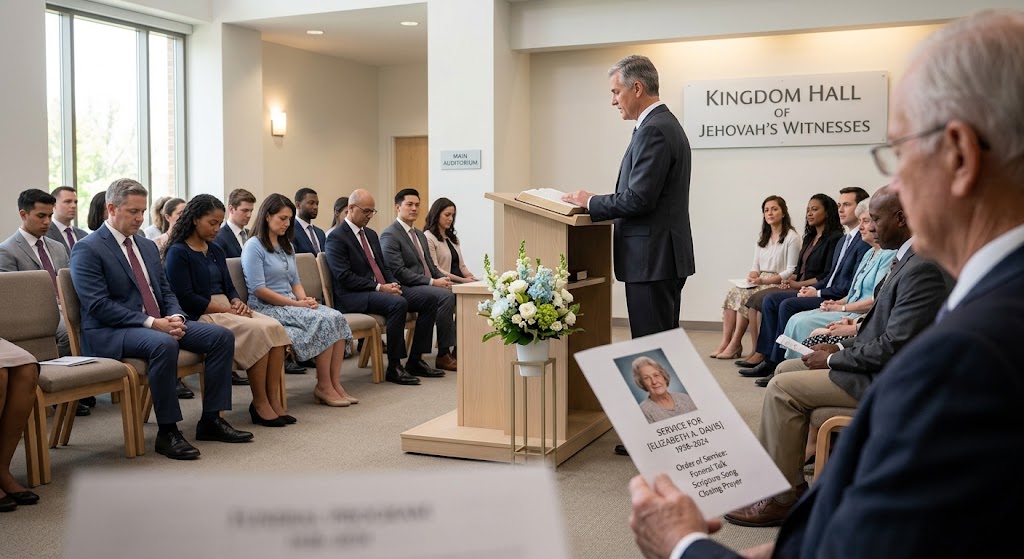
Jehovah’s Witness funerals are usually simple, dignified services centered on Bible-based comfort and the hope of resurrection.
The service may be held at a Kingdom Hall, funeral home, private home, crematory, or graveside. A funeral talk is the main element, and a Scripture-based song may be included before the service closes with prayer.
Non-Witnesses are welcome at Kingdom Hall funerals; attendance at other venues follows the family’s arrangements.
Some details vary by family, congregation, location, and funeral home. That matters when planning a service or deciding what is appropriate as a guest.
This guide explains the practices that are consistently supported by official Jehovah’s Witness guidance, then separates them from choices that families make for themselves.
“Jehovah’s Witness funeral customs are shaped by Bible-based beliefs about death, grief, resurrection, and modesty, but many practical details are left to the family.”
What Do Jehovah’s Witnesses Believe About Death and Funerals?
Jehovah’s Witness funeral customs grow from several beliefs about death, grief, and resurrection.
Understanding those beliefs makes the service easier to follow and helps guests avoid assumptions based on other Christian traditions.
Grief Is Natural
Jehovah’s Witnesses do not treat sadness as a lack of faith.
Their official guidance points to Biblical examples of people mourning and describes a funeral as a time for empathy.
Family members and friends may express grief openly, and each person’s experience of loss is personal.
The Dead Are Unconscious
Witnesses believe that the dead are not conscious and cannot influence the living.
For that reason, they avoid customs that depend on the idea that the deceased is watching, communicating, or receiving offerings.
They also generally avoid language that assumes the person immediately went to heaven or became an angel.
Resurrection Is the Central Hope
The funeral message focuses on the Biblical promise of a future resurrection and a time when death will be no more.
This hope shapes the service more strongly than ritual.
The purpose is to comfort people who are grieving and remind them of the beliefs the deceased valued.
Modesty Guides the Arrangements
Jehovah’s Witnesses generally favor simple, respectful arrangements rather than lavish ceremonies designed to display wealth or status.
Modesty does not mean the service must feel impersonal.
It means that design, flowers, clothing, and printed materials should support the occasion without becoming the focus of it.
What Happens at a Jehovah’s Witness Funeral?
A Jehovah’s Witness funeral is commonly organized around a Bible-based talk.
The speaker explains what the Bible says about death and resurrection, offers comfort to the bereaved, and may mention the deceased’s good qualities or faithful example.
The balance differs from a conventional eulogy, which often devotes most of the service to a detailed life story.
Location
The family may choose a Kingdom Hall, funeral home, private home, crematory, or graveside.
A Kingdom Hall service is open to the public, including relatives, friends, neighbors, and coworkers who are not Jehovah’s Witnesses.
The practical choice of venue may depend on availability, attendance, local congregation arrangements, and the family’s wishes.
The Funeral Talk, Song, and Prayer
The funeral talk is typically delivered by a qualified member of the congregation.
Scripture is central.
Official guidance says that a song based on the Scriptures may be sung, and the service concludes with a comforting prayer.
Because music and other details may vary, planners should confirm the order of service with the family and the congregation member conducting the funeral.
How Long Does the Service Last?
Services are often concise, but there is no universal duration in official faith guidance.
Confirm timing with the family, the person giving the funeral talk, and the venue.
Travel, venue requirements, family wishes, and any graveside arrangements can affect the total time.
How to Plan a Jehovah’s Witness Funeral
Begin by asking what the deceased wanted and what the family understands those wishes to be.
Contact the local congregation early, especially if the family hopes to use a Kingdom Hall or have a congregation elder deliver the funeral talk.
Interfaith families may find it helpful to name one family contact who can coordinate decisions among the funeral home, speaker, and relatives.
- Confirm the venue, date, expected attendance, and whether a graveside service or reception will follow.
- Ask the speaker which Scriptures, song, and biographical details are appropriate for the program.
- Clarify family preferences for flowers, photos, viewing, and printed or digital memorial materials.
- Review all wording for beliefs that may have been borrowed unintentionally from another tradition.
- Keep the design respectful and uncluttered, with accurate names, dates, service details, and contact information.
Burial or Cremation
Jehovah’s Witnesses do not have a Biblical command requiring burial or forbidding cremation.
The decision is left to the individual or family, with consideration for personal wishes and practical needs.
The official Bible guidance on cremation confirms that either choice may be made respectfully.
Viewing, Casket, Embalming, and Timing
There is no single required approach to an open or closed casket, embalming, or the number of days between death and the funeral.
These decisions can depend on the family’s wishes, applicable law, the funeral home, travel needs, and the condition of the body.
Ask rather than assuming a rule based on one funeral, one congregation, or an unsourced online guide.
Creating a Simple Funeral Program
A printed program can help guests follow the service and preserve accurate details for family members.
Before finalizing the layout, confirm the content with the family and the person conducting the funeral.
A simple program might include:
- The deceased’s full name, photograph, birth and death dates, and service details
- The order of service, including the funeral talk, any confirmed Scripture-based song, and closing prayer
- A concise obituary or biographical note that reflects the family’s preferences
- Selected Scriptures or a short message of comfort approved for the service
- Acknowledgments and information about burial, cremation, or a gathering after the service
Honor You offers customizable funeral programs and a professional obituary writing service.
Families can choose only the elements that fit their beliefs and service plans.
Etiquette for Attending a Jehovah’s Witness Funeral
Guests do not need to know every custom before attending.
A quiet, supportive presence is more important than perfect familiarity.
The following guide helps separate widely appropriate gestures from details that should be confirmed with the family.
| Usually Appropriate | Ask the Family First | Generally Avoid |
|---|---|---|
| Modest, respectful attire | Flowers or a memorial gift | Crosses or faith-specific symbols from another tradition |
| Arriving on time and silencing devices | Photos, keepsakes, or a detailed printed tribute | Debating beliefs or correcting the speaker during the service |
| A brief, sincere condolence | Participating in a song or prayer if you are unsure | Language that assumes the deceased is conscious in heaven |
| Practical help, such as meals or transportation | A viewing, reception, or public personal tribute | Lavish displays that conflict with the family’s preference for simplicity |
What to Wear
Choose clean, modest clothing suitable for a solemn gathering.
A suit, dress, skirt, trousers, or similarly respectful outfit can be appropriate.
Black is not a universal requirement, and guests should not feel pressure to follow a strict color rule that the family has not stated.
Flowers and Sympathy Gifts
Flowers may be acceptable, but preferences vary.
Official Watchtower guidance on flowers explains that a floral gesture can be acceptable when it is not tied to a belief the giver or recipient considers unscriptural.
A small, tasteful arrangement or a card is usually a safer choice than an elaborate display.
Avoid arrangements built around a cross or symbols the family may not use.
When in doubt, ask a close relative where flowers should be sent or whether the family would prefer practical help instead.
What to Say to the Family
Simple words are often best:
- “I’m sorry for your loss.”
- “I’m thinking of your family.”
- A brief memory about the person who died
Listen without trying to explain away grief.
Offers of specific help, such as bringing a meal, driving a relative, or handling an errand, can be more useful than broad promises.
For additional support after the service, Honor You’s grief and loss resources provide practical guidance for families and friends.
Practices That May Differ From Other Funerals
Jehovah’s Witness funerals generally avoid customs connected to the belief that the dead are conscious or can affect the living.
Official guidance specifically discusses wake keeping, lavish funeral celebrations, death anniversaries, sacrifices for the dead, and speaking to the dead.
That does not mean every family will make identical choices about viewing, flowers, receptions, photographs, or personal memories.
Religious services conducted by Jehovah’s Witnesses do not charge a fee or take a collection.
Funeral home, cemetery, cremation, printing, transportation, and other practical expenses are separate matters.
For interfaith families: Explain the service plan early and respectfully so guests understand which forms of participation are optional and which customs the family has chosen not to include.
Frequently Asked Questions
Can a Non-Jehovah’s Witness Attend the Funeral?
Yes.
Non-Witnesses are welcome at a funeral held at a Kingdom Hall, and the service is open to the public.
Guests can sit respectfully and follow the room without participating in anything that conflicts with their own conscience.
Do Jehovah’s Witnesses Have Eulogies?
The main feature is usually a Bible-based funeral talk rather than a long conventional eulogy.
The talk may recall the deceased’s good qualities and faithful example.
Any additional personal tributes should be coordinated with the family and the speaker instead of assumed.
Are Jehovah’s Witness Funerals Open Casket?
They may be open or closed casket.
Official funeral guidance does not require one approach.
The decision belongs to the family and may also depend on funeral home recommendations and practical circumstances.
Can Jehovah’s Witnesses Be Cremated?
Yes.
Jehovah’s Witnesses do not teach that burial is required or that cremation prevents resurrection.
Burial and cremation are personal or family decisions.
Do Jehovah’s Witnesses Accept Flowers?
Flowers can be appropriate, but there is no need to guess.
Ask about the family’s preferences, choose a modest arrangement, and avoid religious symbols they may not use.
A sympathy card or practical support may be equally welcome.
Do Jehovah’s Witnesses Attend Funerals of Other Religions?
Each Witness decides according to personal conscience.
Someone may attend to support a grieving family while choosing not to participate in religious actions that conflict with their beliefs.
Do Jehovah’s Witnesses Mourn?
Yes.
Their resurrection hope does not remove grief.
Official guidance recognizes mourning as a normal response to loss and emphasizes empathy for the bereaved.
Plan With Respect, Clarity, and Family Input
The most respectful Jehovah’s Witness funeral arrangements begin with listening.
Confirm the deceased’s wishes, involve the family and local congregation early, and separate faith-based practices from choices that vary by household.
A modest service can still be personal, warm, and carefully organized.
Honor You can help families prepare a clear, dignified program or organize an obituary for the service.
Use the family’s approved wording, images, Scriptures, and order of service, then review every detail with the person conducting the funeral before printing.
For help with a custom program, contact Honor You.