
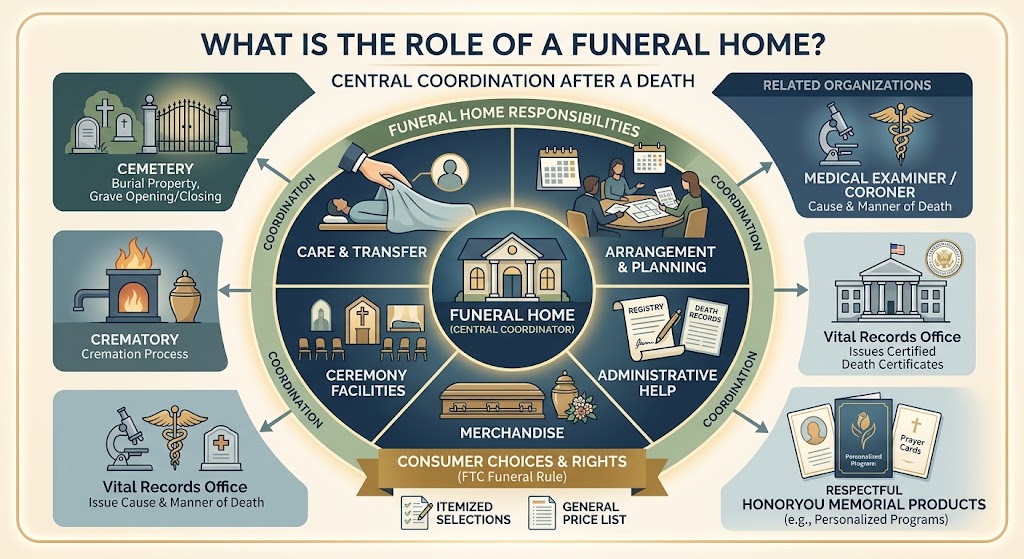
A funeral home is a funeral-service business that provides care, facilities, products, and coordination after a death. Funeral establishments and funeral-service professionals are regulated under state and, in some places, local law. Required licenses, professional titles, and permitted activities vary by jurisdiction.
A funeral director is usually the family’s main contact. The director explains options, records selections, obtains authorizations, coordinates providers, and helps keep arrangements on track. That broad coordinating role does not mean the funeral home performs every task itself.
Related organizations have different responsibilities:
- A cemetery provides burial property and services such as opening and closing a grave.
- A crematory performs cremation and may be owned by a funeral home or operate independently.
- A medical examiner or coroner investigates certain deaths and may determine cause and manner of death under local law.
- A government vital-records office issues certified death certificates after a death is registered.
This page maps services, responsibilities, and consumer choices. Readers who want the chronological sequence can see how funeral homes work step by step.
“A funeral home acts as a central coordinator after a death, but not every task—from medical certification to cemetery work—is performed by the funeral home itself.”
Quick answer: A funeral home provides care for the deceased, helps families make arrangements, coordinates paperwork and outside providers, offers facilities and merchandise, and organizes services such as viewings, funerals, memorials, burial, or cremation. Its exact services and legal responsibilities depend on the provider and local law.
What Services Do Funeral Homes Provide?
The service list varies by provider, facility, disposition, and family choice. A General Price List should identify the services available from a particular funeral home and their prices.
Transfer, Custody, and Care
A funeral home can arrange transfer from a home, hospital, care facility, or another location after any required release.
It provides secure shelter and tracks the identity of the deceased while the person is in its care.
Authorized care may include:
- Refrigeration
- Bathing
- Dressing
- Cosmetics
- Embalming
- Preparation for a viewing or identification
The Federal Trade Commission’s Funeral Rule says embalming is generally not required by law.
Covered providers must obtain permission before embalming except in limited circumstances and explain when a law or selected arrangement makes it necessary.
Refrigeration, prompt burial, or prompt cremation may be alternatives, subject to state and local rules and provider policies.
Arrangement and Decision Support
The funeral director helps the authorized decision-maker compare disposition, ceremony, merchandise, transportation, and timing options.
The director should distinguish a legal requirement from a provider policy or a choice created by a particular service plan.
Families can select a simple disposition, a ceremony with the deceased present, a later memorial, or another arrangement that fits their needs and lawful options.
Documents and Administrative Help
Funeral-home staff commonly collect biographical information, work with the person certifying the death, and submit registration information to the appropriate government office.
They may order certified death certificate copies for the family, but the government vital-records authority issues those copies.
Staff may also help with:
- Permits
- Obituary submission
- Social Security notification
- Documentation for veterans’ benefits
The exact assistance should be confirmed.
The National Institute on Aging guidance on what to do after someone dies covers agency notifications, property, financial documents, and other work outside the funeral home’s usual scope.
Ceremony Facilities and Coordination
A funeral home may provide rooms and staff for a viewing, visitation, funeral, memorial, or celebration of life.
It can coordinate:
- Schedules
- Flowers
- Audiovisual equipment
- Processions
- Clergy or celebrants
- Musicians
- Military honors
- Venue requirements
Families may instead use a place of worship, cemetery, community venue, private setting, or online format.
Burial and Cremation Coordination
For burial, the funeral home may coordinate transportation, permits, the committal, and scheduling with a cemetery.
Cemetery property, grave opening and closing, outer burial containers, and markers may appear on a separate bill or as third-party charges.
For cremation, the funeral home obtains authorizations and coordinates with a crematory.
Families can ask:
- Where the cremation occurs
- Whether the funeral home owns the crematory
- How identity is tracked
- Which charges belong to the crematory
Merchandise, Memorial Materials, and Outside Vendors
Funeral homes may offer caskets, urns, alternative containers, flowers, register books, tribute videos, monuments, and printed materials.
Some items are supplied by outside vendors. Ask who controls the price, production schedule, correction process, and delivery.
Families can also select an independent specialist.
HonorYou creates personalized funeral programs and memorial products, including programs, prayer cards, bookmarks, and keepsakes designed around a person’s photos and story.
Aftercare and Preplanning
Some providers offer grief-resource referrals, practical checklists, or help ordering additional documents.
They may also offer advance planning or funding arrangements.
Preplanning terms, cancellation rights, transferability, and handling of funds vary, so review the written agreement and applicable state protections.
Who Is Responsible for Each Task After a Death?
The funeral home may be the central coordinator without being the organization legally or practically responsible for every task.
| Task | Usually Responsible | What the Family Should Know |
|---|---|---|
| Authorize arrangements | Family or legally authorized decision-maker | Authority depends on state law and any valid advance documents. |
| Transfer, shelter, and authorized care | Funeral home | Transfer is a distinct service. Care choices depend on the plans and local rules. |
| Certify cause of death | Physician, medical examiner, or coroner | The funeral home does not determine cause of death. |
| Conduct an autopsy | Medical examiner, coroner, or qualified medical facility | Funeral homes generally do not perform autopsies. |
| Register the death and obtain certified copies | Funeral home often files or assists; government vital-records office issues copies | Ask about filing help, copy fees, and expected processing. |
| Choose disposition and ceremony details | Authorized decision-maker, with guidance as desired | Cultural, religious, personal, and financial priorities can shape the choices. |
| Perform cremation | Crematory | Confirm the facility, ownership, identification safeguards, and separate fees. |
| Provide burial property and cemetery work | Cemetery | Cemetery rules and charges are separate from funeral-home responsibilities. |
| Provide clergy, flowers, printing, catering, or other specialty services | Clergy, celebrant, or outside vendor, sometimes arranged by the funeral home | Ask who is responsible for payment, changes, and corrections. |
A funeral home may coordinate a task without being the party that legally performs or controls it.
What May Be Non-Declinable, Separately Selected, or a Third-Party Charge?
Under the FTC Funeral Rule, a covered funeral provider may charge a basic services fee that consumers cannot decline after selecting that provider.
It is the only fee a funeral home may designate as non-declinable.
Other funeral-home services, merchandise, and third-party charges must be described separately, although a law or a family’s selected arrangement may make a particular item necessary.
| Potentially Non-Declinable | Separately Selected Funeral-Home Services and Goods | Third-Party or Cash-Advance Items |
|---|---|---|
| Basic services fee for the funeral director and staff, as disclosed on the General Price List | Transfer from the place of death; additional transportation; refrigeration; embalming or other preparation; facilities and staff for a ceremony; hearse; casket, urn, or alternative container; direct cremation; immediate burial | Cemetery or crematory charges; certified death certificate copies; clergy or celebrant; newspaper notice; florist; musicians; monument; venue; catering |
Ask what the basic services fee covers.
The FTC permits it to include services common to arrangements, such as planning, permits, record preparation, coordination, and a proportionate share of overhead.
Transfer is not part of the non-declinable category merely because most families need it. It should appear as a separate selection and price.
Covered providers must give price information by telephone when asked.
They must provide a written General Price List when a consumer begins discussing funeral goods, services, or arrangements in person.
Required casket and outer burial container price disclosures also apply.
After selections are made, the family must receive an itemized written statement showing each selected item and its cost.
Consumer right: Families generally have the right to choose individual goods and services rather than accept a package, apart from the permitted basic services fee and items required by law or necessary for the selected arrangements.
A funeral home cannot refuse, or charge a handling fee for, a casket or urn bought elsewhere.
The FTC’s funeral costs and pricing checklist can help families compare providers and identify cash-advance items.
Ask whether the funeral home adds a service charge to amounts paid to third parties.
What Does the Family Need to Decide or Bring?
Early decisions usually concern the provider, the authorized decision-maker, the planned disposition, and any viewing or religious practice that affects care or timing.
A family can ask what truly requires an immediate answer and defer other selections while reviewing prices.
Useful information and documents may include:
- The deceased’s identification and biographical details requested for the death record
- Advance instructions, prepaid arrangements, cemetery documents, and military discharge records when applicable
- Clothing and a recent photograph if identification or viewing is planned
- Obituary facts, family names, a preferred photo, and any charitable designation
- Preferences for readings, music, speakers, flowers, photos, and memorial materials
- Insurance information or other funding documents the funeral home has agreed to review
Not every document must be ready before contacting a provider.
Ask what is needed now and what can be supplied later.
The National Institute on Aging’s guidance also recommends locating important legal and financial papers and contacting relevant agencies and organizations after a death.
Questions That Clarify Scope and Consumer Choice
These questions focus on what the provider is selling, coordinating, or requiring:
- What does your basic services fee include, and which services are priced separately?
- Is this item required by law, required by your policy, or necessary only for the arrangement we selected?
- Can we choose every item separately, and can unwanted package items be removed?
- Can we provide a casket or urn purchased elsewhere without a handling fee?
- Which charges are cash-advance items, and do you add a service charge or markup?
- Which services do your staff perform, and which providers remain responsible for outside work?
- How long are these quoted prices valid, and which third-party amounts may change?
- What are the terms for changing or canceling a selection?
- Will the written statement identify every selection, required disclosure, and third-party charge?
HonorYou’s broader guide to questions to ask a funeral home covers provider credentials, facilities, communication, and care.
Families still selecting a provider can also compare funeral homes in their area.
Frequently Asked Questions
What Is Included in a Funeral Home’s Basic Services Fee?
The fee may cover services common to arrangements, including planning, permit and record preparation, coordination with other parties, and a proportionate share of overhead.
The exact inclusions and price must appear on the provider’s General Price List. Ask whether a specific task is covered or separately priced.
Is Transfer Included in the Basic Services Fee?
Transfer from the place of death is a separately listed service under the FTC Funeral Rule, not part of the fee solely because it is commonly needed.
Review the General Price List for the transfer price, mileage limits, staff requirements, and any additional transportation charges.
Can a Funeral Home Require a Package?
Covered providers generally must let consumers select individual goods and services.
A family may choose a package for convenience or value, but it should not be forced to buy unwanted items.
Exceptions include the permitted basic services fee, legal requirements, and items necessary for selected arrangements.
Can a Family Provide Its Own Casket or Urn?
Yes.
Under the FTC Funeral Rule, a funeral home cannot refuse or charge a handling fee for a casket or urn purchased elsewhere.
Confirm delivery timing, dimensions, condition, and who will receive the item so it is suitable for the planned disposition.
What Are Cash-Advance Items?
Cash-advance items are goods or services purchased from third parties on the family’s behalf, such as cemetery work, obituary placement, flowers, or clergy honoraria.
The written statement should identify them.
Ask whether the funeral home charges the same amount it pays or adds a service charge.
Which Funeral Services May Be Purchased Separately?
Depending on availability and local requirements, families may select transfer, care, facilities, transportation, merchandise, direct cremation, immediate burial, and other services individually.
The General Price List is the starting point. Ask the provider to explain any claimed legal requirement or arrangement-specific necessity in writing.
Understanding the Funeral Home’s Role
A funeral home provides care, professional guidance, administrative help, facilities, products, and coordination, but it does not own every responsibility after a death.
Clear role boundaries and itemized prices help families choose only what fits their needs.
Once arrangements are set, HonorYou can create personalized funeral programs, prayer cards, and memorial keepsakes that reflect the person being remembered.
